RV batteries typically take 2 to 12+ hours to charge, depending on the battery type, capacity, depth of discharge, charger output, and power source. Lithium batteries generally charge the fastest, while AGM and flooded lead-acid batteries take longer because charging slows as they near full capacity.
For example, a 100Ah lithium battery with a 50A charger may recharge from 50% in about 2 to 3 hours, while a comparable flooded lead-acid battery may take 6 to 12+ hours.
This guide explains how to estimate RV battery charging time, compare battery types, and understand the factors that affect charging speed.
Key Takeaways
- Most RV batteries take 2 to 12+ hours to recharge.
- Lithium LiFePO₄ batteries charge faster than AGM and flooded lead-acid batteries.
- Charger amperage has the biggest impact on charging speed.
- Lead-acid batteries slow down during the final part of charging.
- Solar and alternator charging times vary more than shore power or generator charging.
- The basic formula is: Amp-hours needed ÷ charger amps = estimated charging hours.
- The real charging time is often longer than the formula because chargers reduce current near full charge.
- The safest charge rate is the one recommended by your battery manufacturer.
Disclaimer: This article is for general informational purposes only. RV battery systems and charging requirements vary by equipment and manufacturer. Always follow the instructions provided by your battery, charger, and RV manufacturers.
Quick Answer: How Long Does It Take to Charge RV Batteries?
Most RV batteries take anywhere from 2 to 12+ hours to recharge, depending on the battery type, charger output, battery capacity, and charging source. Lithium batteries are typically the fastest to charge, while flooded lead-acid and gel batteries usually take longer because of their multi-stage charging process.
| RV Battery Type | Estimated Time From 50% Discharge | Why It Takes This Long |
| Lithium LiFePO₄ | 2 to 5 hours | Accepts higher current and has a shorter final charging stage |
| AGM | 5 to 10 hours | Charges slower near full capacity |
| Flooded Lead-Acid | 6 to 12+ hours | Uses bulk, absorption, and float stages |
| Gel Battery | 8 to 12+ hours | Requires slower and more careful charging |
These are general estimates. Actual charging time depends on battery capacity, charger output, temperature, battery condition, and power use during charging. Larger discharges and lower-amperage chargers increase charging time, while lithium-compatible chargers typically charge lithium batteries faster than older lead-acid converters.
The Simple Formula to Estimate RV Battery Charging Time
The easiest way to estimate RV battery charging time is to divide the amp-hours you need to replace by the charger’s output amps.
Charging Time = Amp-Hours Needed ÷ Charger Output Amps
Amp-hours needed means the amount of energy you used from the battery. It does not always mean the full battery size.
For example, if you have a 100Ah battery and it is drained to 50%, you need to replace about 50Ah.
With a 20A charger:
50Ah ÷ 20A = 2.5 hours
However, this is only the math estimate. In real RV use, the charging time may be closer to 3 to 4 hours because charging is not perfectly efficient. The charger may reduce current near full charge. Your RV may also be using lights, fans, water pump power, refrigerator controls, or inverter loads while the battery is charging.
Why the Formula Is Only an Estimate
- Chargers reduce current as the battery gets closer to full.
- Lead-acid batteries need an absorption stage.
- Solar output changes throughout the day.
- Battery age affects charge acceptance.
- Cold temperatures can slow charging.
- RV appliances may use power while the battery is charging.
- Long or undersized cables can create voltage drop.
- Charger settings may not match the battery chemistry.
The formula gives you a useful starting point. Your battery monitor, charger display, or solar controller will give you a better real-world view.
RV Battery Charging Time by Battery Type
Charging time varies significantly by battery chemistry. Lithium batteries generally recharge the fastest, while lead-acid batteries require more time because of their multi-stage charging process. The sections below compare the most common RV battery types and their typical charging times.
How Long Does It Take to Charge a Lithium RV Battery?
A lithium RV battery usually takes 2 to 5 hours to charge from 50%, depending on battery size and charger output. Lithium LiFePO₄ batteries charge faster because they accept higher current and do not need a long absorption stage like lead-acid batteries.
| Lithium Battery Size | Charger Size | Approximate Charge Time From 50% |
| 100Ah | 20A | 3 to 4 hours |
| 100Ah | 50A | 2 to 3 hours |
| 200Ah | 40A | 3 to 5 hours |
| 200Ah | 60A | 2.5 to 4 hours |
| 400Ah | 60A | 4 to 7 hours |
| 400Ah | 100A | 3 to 5 hours |
Lithium batteries are popular with RV owners because they charge quickly, provide more usable capacity, and handle partial charging better than lead-acid batteries. This makes them especially useful for boondocking, solar charging, and generator charging.
However, lithium batteries need the right charging profile. Many LiFePO₄ batteries should not be charged below freezing unless they have internal heating or low-temperature charging protection. Charging a cold lithium battery incorrectly can damage the cells.
How Long Does It Take to Charge an AGM RV Battery?
An AGM RV battery usually takes 5 to 10 hours to charge from 50%. AGM stands for Absorbed Glass Mat. It is a sealed lead-acid battery, so it still follows a lead-acid style charging process.
AGM batteries may charge faster than flooded lead-acid batteries in some cases, but they still slow down near full capacity. The charger has to reduce current during the absorption stage to finish charging safely.
AGM batteries are sensitive to overcharging. A smart charger with the correct AGM profile is important because too much voltage can shorten battery life. If your RV converter is old, it may not charge AGM batteries as accurately as a modern multi-stage charger.
How Long Does It Take to Charge a Flooded Lead-Acid RV Battery?
A flooded lead-acid RV battery usually takes 6 to 12+ hours to charge from 50%. Flooded batteries are common in older RVs and entry-level battery setups, but they charge more slowly than lithium batteries.
Flooded lead-acid charging happens in three main stages:
- Bulk stage: The charger sends higher current into the battery. This is the fastest stage and usually brings the battery to around 70% to 80%.
- Absorption stage: The charger holds voltage steady while current slowly tapers down. This stage can take several hours.
- Float stage: The charger lowers voltage to maintain the battery once it is full.
The absorption stage is the main reason flooded lead-acid batteries take so long to reach 100%. The battery may look almost charged, but the final part still needs time.
Flooded lead-acid batteries also need more maintenance. They may require distilled water, clean terminals, and proper ventilation during charging.
How Long Does It Take to Charge a Gel RV Battery?
A gel RV battery usually takes 8 to 12+ hours to charge, depending on battery size, charger amperage, and battery condition. Gel batteries are another type of sealed lead-acid battery, but they are more sensitive to incorrect charging voltage.
Gel batteries usually need slower and more controlled charging. A charger with the correct gel profile is important. Too much charging voltage can create internal damage and reduce battery life.
If your RV uses gel batteries, avoid guessing the charger settings. Check the battery label or manufacturer manual before charging.
RV Battery Charging Time by Power Source
Different power sources charge RV batteries at different speeds. The actual charging time depends on the battery type, charger output, and how much power is available from the source. The sections below explain what to expect from shore power, generators, solar panels, driving, and portable chargers.
Charging RV Batteries With Shore Power
Shore power charges RV batteries through the RV converter or inverter/charger. When you plug into a campground pedestal or household outlet, your RV receives AC power. The converter changes that AC power into DC power to charge the RV battery bank.
Typical charge times from 50% discharge are:
- Lithium battery: 2 to 6 hours
- AGM battery: 5 to 10 hours
- Flooded lead-acid battery: 6 to 12+ hours
The actual time depends on the converter’s amp rating. A 55A converter can charge much faster than a 10A charger, but only if the battery can safely accept that current.
Some older RV converters charge slowly or use outdated charging profiles. They may also fail to fully charge lithium batteries because lithium batteries need different voltage settings than lead-acid batteries.
If you upgraded to lithium, check whether your converter is lithium-compatible. If it is not, your lithium batteries may charge slowly, stop short of full, or require a converter upgrade.
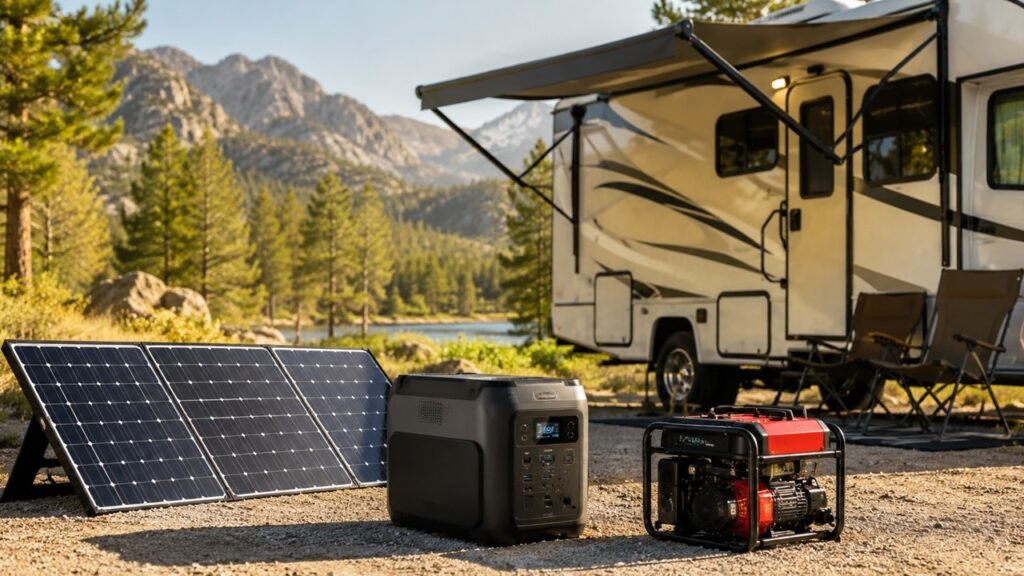
Charging RV Batteries With a Generator
A generator usually charges RV batteries the same way shore power does. The generator provides AC power. The RV converter or inverter/charger then converts that AC power into DC charging power for the batteries.
Generator charging time depends on the charger, not just the generator. A large generator will not charge the battery quickly if the RV converter only sends 10A or 20A to the battery.
Lithium batteries are often better for generator charging because they can accept higher current and do not need a long absorption stage. This means you can often run the generator for less time compared with lead-acid batteries.
Lead-acid batteries are less generator-friendly because the absorption stage is slow. You may run a generator for hours just to finish the final part of the charge.
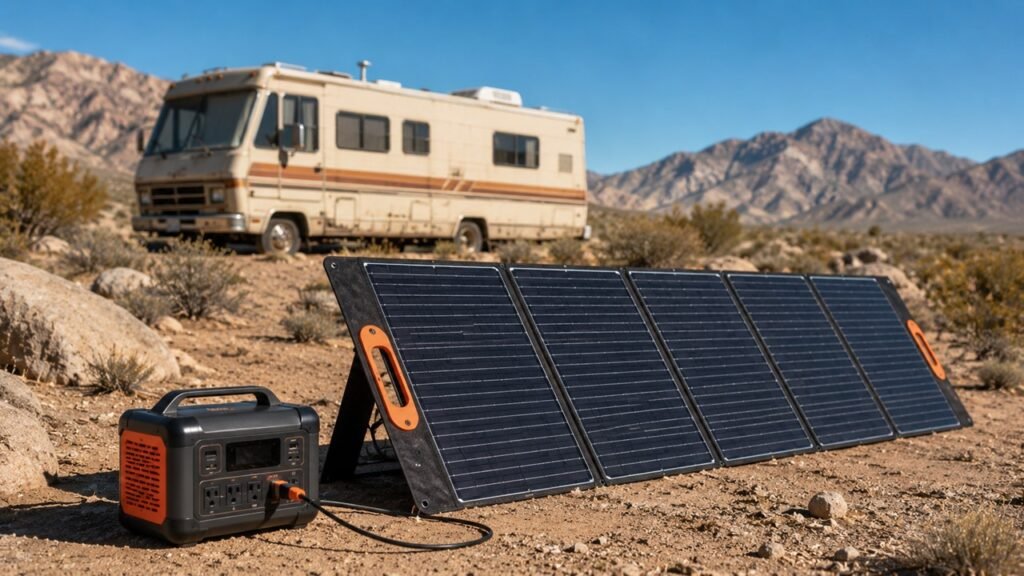
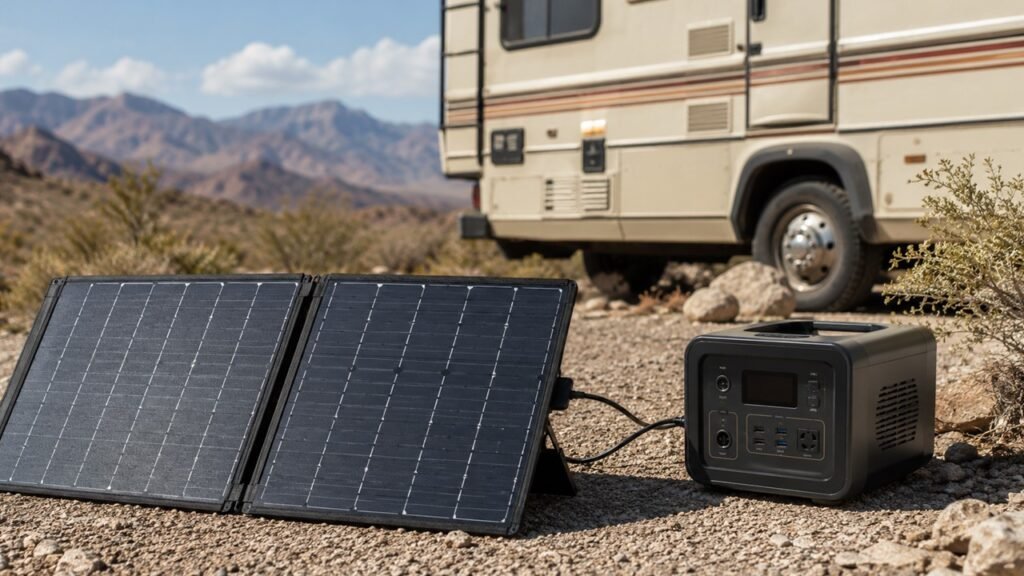
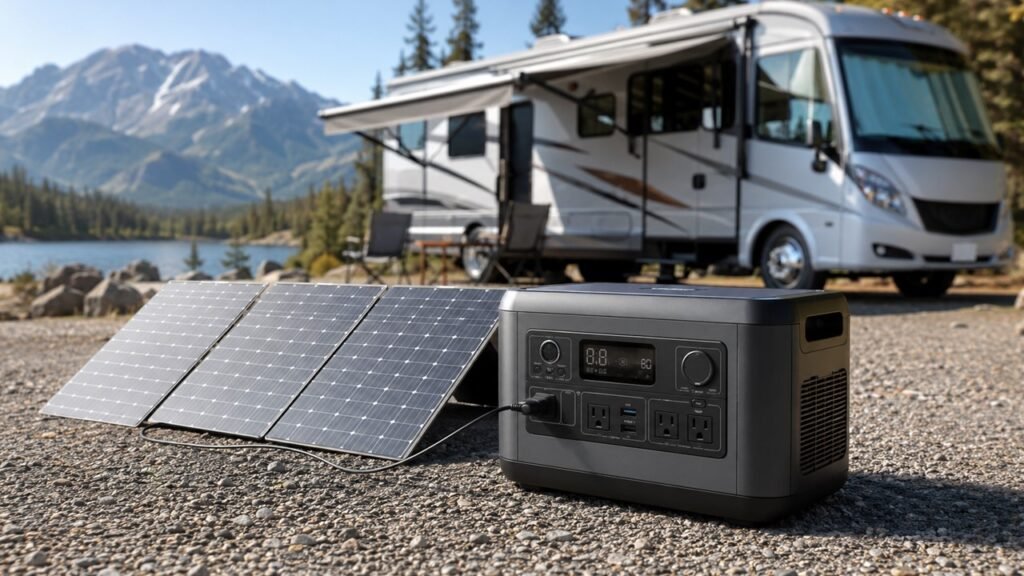
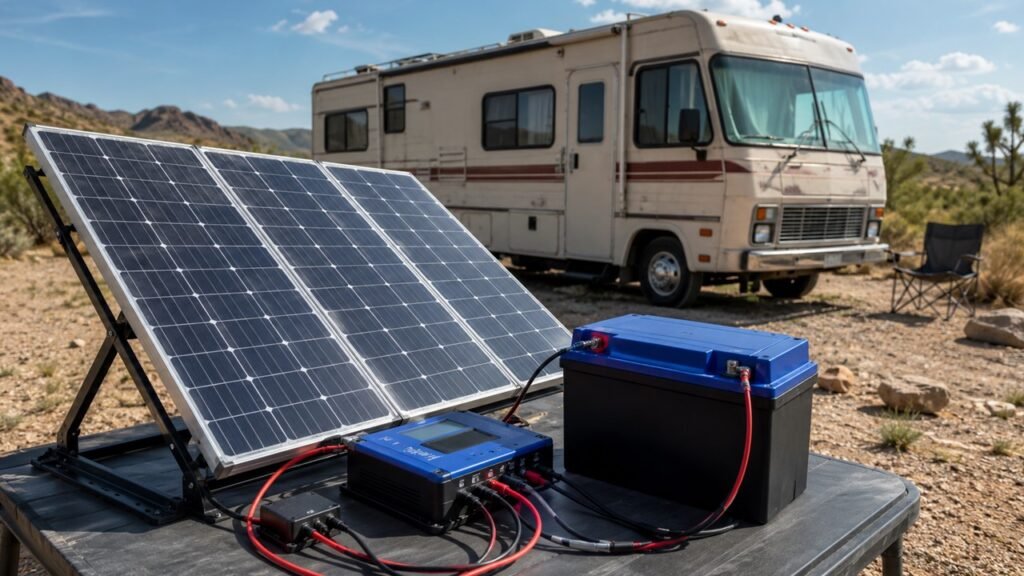
Charging RV Batteries With Solar Panels
Solar charging is the hardest to estimate because sunlight changes throughout the day. A solar panel’s real output depends on sun angle, shade, clouds, panel temperature, wiring losses, charge controller efficiency, and the season.
| Solar Setup | Best-Case Daily Output | Practical Use |
| 100W solar panel | 25 to 35Ah/day | Small battery maintenance |
| 200W solar panels | 50 to 70Ah/day | Light RV use |
| 400W solar panels | 100 to 140Ah/day | Better for boondocking |
| 600W+ solar panels | 150Ah+/day | Larger battery banks |
A 200W solar setup may replace about 50Ah in one sunny day. That could recharge a 100Ah battery from 50% if your RV is not using much power during the day.
However, solar charging can take much longer in shade, cloudy weather, winter, or forested campsites. Flat-mounted roof panels also produce less than perfectly angled panels in many conditions.
Solar works best when it is sized for your daily power use, not just your battery size. If you use 80Ah per day, your solar setup should replace about 80Ah per day in normal camping conditions.
Charging RV Batteries While Driving
RV batteries can charge while driving, but the speed depends on your setup. Some systems only provide a small charging current. Others use a DC-to-DC charger for safer and faster charging.
Common driving charge setups include:
- A 7-pin trailer connector, which usually provides limited charging current.
- A motorhome alternator, which may charge faster.
- A battery isolator, which connects the starting battery and house battery under certain conditions.
- A DC-to-DC charger, which regulates voltage and current between the alternator and house battery.
- A dual-input DC-to-DC charger, which may combine alternator charging and solar input.
A 7-pin trailer connector is usually best for maintaining or lightly topping up a battery, not quickly recharging a deeply discharged battery. A DC-to-DC charger is a better option for lithium batteries because it protects the alternator and provides a controlled charging profile.
Charging while driving can take several hours or all day, depending on current output and battery size.
Charging RV Batteries With a Portable Battery Charger
A portable smart charger is useful for storage, maintenance, or charging a removed battery. It connects directly to the battery and charges according to the selected battery profile.
The charger must match the battery type. Lithium, AGM, flooded lead-acid, and gel batteries have different charging needs.
A small 5A maintainer may be fine for keeping a lead-acid battery topped off during storage, but it will be slow for recharging a large RV battery bank. A 20A to 50A smart charger is more practical for regular charging, depending on your battery size and safe charge rate.
Charging Time Examples for Common RV Battery Setups
The examples below show typical charging times for common RV battery banks. Actual results vary based on battery type, charger output, temperature, and battery condition.
| Battery Bank | Battery Type | Charger Size | Approximate Time From 50% |
| 100Ah | Lithium | 20A | 3 to 4 hours |
| 100Ah | Lithium | 50A | 2 to 3 hours |
| 100Ah | AGM | 20A | 5 to 7 hours |
| 100Ah | Flooded Lead-Acid | 20A | 6 to 8+ hours |
| 200Ah | Lithium | 40A | 3 to 5 hours |
| 200Ah | AGM | 40A | 5 to 8 hours |
| 200Ah | Flooded Lead-Acid | 40A | 7 to 12+ hours |
| 400Ah | Lithium | 60A | 4 to 7 hours |
| 400Ah | Lead-Acid | 60A | 10 to 14+ hours |
These examples assume the battery starts around 50% state of charge. They also assume the charger is working properly and the battery can safely accept the charger’s output.
Real charging times may be longer if your RV is using power at the same time. For example, lights, fans, furnace blowers, refrigerator controls, water pumps, and inverter loads can reduce the net charging current going into the battery.
If your charger sends 40A but your RV is using 10A, only about 30A may be going into the battery.
What Affects RV Battery Charging Time?
- Battery capacity: Larger Ah batteries take longer to recharge because they store more energy.
- Depth of discharge: A battery drained to 20% takes much longer to charge than one drained to 70%.
- Charger amperage: A 50A charger charges much faster than a 10A charger when the battery can safely accept the current.
- Battery chemistry: Lithium batteries usually charge faster than AGM and flooded lead-acid batteries.
- Charging stage: Lead-acid batteries slow down during the absorption stage.
- Battery age: Older batteries may accept charge more slowly and hold less capacity.
- Temperature: Cold batteries often charge slower. Lithium batteries may stop charging below freezing.
- Cable size: Thin or long cables can create voltage drop and reduce charging speed.
- Active RV loads: Appliances using power during charging extend total charging time.
- Solar conditions: Shade, clouds, dirty panels, and low sun reduce solar charging output.
- Charger settings: The wrong charging profile can undercharge or overcharge the battery.
- Battery health: A weak battery may charge strangely, drop voltage quickly, or never reach full capacity.
How Many Amps Should You Use to Charge an RV Battery?
The right charging amperage depends on your battery size, chemistry, and manufacturer’s recommendation. Do not choose charger size by guessing. Always check the battery manual or label.
A common conservative guideline is to charge many lead-acid batteries at about 10% to 20% of their amp-hour capacity. Many lithium batteries can accept higher current, but the safe limit still depends on the battery’s design and BMS.
| Battery Bank Size | Conservative Charger Size | Faster Charger Size |
| 100Ah | 10 to 20A | 30 to 50A for lithium |
| 200Ah | 20 to 40A | 50 to 100A for lithium |
| 300Ah | 30 to 60A | 75 to 150A for lithium |
| 400Ah | 40 to 80A | 100 to 200A for lithium |
Lead-acid batteries usually benefit from slower and more controlled charging. Lithium batteries often handle higher current better, but they still have maximum charge limits.
A charger that is too small will work slowly. A charger that is too large can damage the battery, overheat wiring, or exceed the battery’s safe charge rate.
Why the Last 20% Takes the Longest
The last part of charging often takes the longest because the charger reduces current as the battery nears full capacity.
During the bulk stage, the charger sends higher current into the battery. This stage is fast. Once the battery reaches the target voltage, the charger moves into absorption mode. In absorption mode, voltage stays steady while current slowly drops.
Lead-acid batteries spend a long time in this absorption stage. This is why they may reach 80% quickly but need several more hours to reach 100%.
Lithium batteries usually have a shorter final charging stage. In many RV setups, lithium batteries can charge to a high state of charge during the bulk stage, then finish faster than lead-acid batteries.
This matters for generator use. If you use lead-acid batteries, you may need to run a generator for a long time to complete the final charge. If you use lithium batteries, you can often replace more energy in less generator runtime.
Is It Okay to Stop Charging Before 100%?
Yes, but the answer depends on battery type.
- Lithium: It is usually fine to stop charging before 100%. Partial charging does not harm lithium batteries in normal RV use.
- Flooded lead-acid: It should be fully charged regularly to reduce sulfation and capacity loss.
- AGM: It should also be fully charged often for best lifespan.
- Gel: It needs correct voltage settings and should not be overcharged.
- Solar setups: Lithium batteries work better with partial daily charging than lead-acid batteries.
This is one reason boondockers often prefer lithium. Solar may not fully recharge the battery every day, especially in cloudy weather. Lithium batteries handle that pattern better than lead-acid batteries.
With lead-acid batteries, repeated partial charging can shorten lifespan. If you use lead-acid batteries off-grid, try to bring them to a full charge regularly.
How to Know When Your RV Battery Is Fully Charged
- Check a shunt-based battery monitor for state of charge.
- Check your charger indicator light or charger app.
- Check your solar charge controller display.
- Use a multimeter after the battery has rested.
- Use the lithium battery app if your battery has Bluetooth.
- Watch whether charging current has tapered down near full.
- For flooded lead-acid batteries, use a hydrometer if you know how to use it safely.
A basic RV battery light panel is not very accurate. It often estimates charge based on voltage, which can be misleading while the battery is charging or under load.
A shunt-based battery monitor is more accurate because it measures power going in and out of the battery. It works more like a fuel gauge for your battery bank.
Can You Leave RV Batteries Charging Overnight?
Yes, you can usually leave RV batteries charging overnight if you use a smart charger or a properly working RV converter with the correct battery profile.
A smart charger reduces current when the battery gets close to full. For lead-acid batteries, it may switch to float mode. For lithium batteries, it should use lithium-safe voltage settings and avoid unnecessary trickle charging.
Be more careful with older RV converters. Some old single-stage converters may overcharge batteries if left plugged in for long periods. This is more of a concern during storage than during a normal overnight charge.
Do not leave a battery charging if it is hot, leaking, cracked, swollen, smoking, or giving off an unusual smell. Stop charging and inspect the system safely.
How to Charge RV Batteries Faster Without Damaging Them
- Use a higher-amp charger that matches your battery’s safe charge rate.
- Upgrade an old converter if it does not support your battery type.
- Use a lithium-compatible charger for LiFePO₄ batteries.
- Use a DC-to-DC charger for alternator charging.
- Add more solar panels if you rely on solar.
- Use an MPPT solar charge controller for better solar efficiency.
- Use properly sized cables to reduce voltage drop.
- Keep battery terminals clean and tight.
- Avoid running high-draw appliances while charging.
- Keep batteries within their safe temperature range.
- Charge lead-acid batteries fully when possible.
- Follow the battery manufacturer’s voltage and current limits.
The goal is not just fast charging. The goal is safe charging. Charging too fast with the wrong settings can shorten battery life or damage equipment.
Common RV Battery Charging Mistakes
- Using a lead-acid charger on lithium batteries without checking compatibility.
- Using a lithium charging profile on lead-acid batteries.
- Draining lead-acid batteries too deeply.
- Assuming a 7-pin trailer connector will quickly recharge a trailer battery.
- Leaving an old converter plugged in for months without checking battery voltage.
- Charging lithium batteries below freezing without protection.
- Using undersized wires for high-current charging.
- Relying only on the RV’s basic battery indicator lights.
- Mixing lithium and lead-acid batteries on the same charging circuit without proper isolation.
- Ignoring battery manufacturer charging limits.
- Forgetting that RV loads reduce the net charging current.
- Expecting solar panels to produce full rated power all day.
RV Battery Charging Safety Tips
- Match the charger to the battery chemistry.
- Use properly sized fuses and cables.
- Keep flooded lead-acid batteries in a ventilated space.
- Wear eye protection when working around flooded batteries.
- Do not charge a battery that is hot, leaking, cracked, swollen, or damaged.
- Keep battery terminals clean and secure.
- Do not bypass the battery management system on lithium batteries.
- Avoid sparks near flooded lead-acid batteries.
- Do not charge frozen lithium batteries unless the battery is designed for safe cold-weather charging.
- Follow the battery manufacturer’s charging voltage and current limits.
- Turn off power before working on battery wiring.
- Ask a qualified RV technician if you are unsure about wiring, fuses, or charger settings.
When Slow Charging Means Something Is Wrong
A phone that charges slowly isn’t always experiencing normal wear and tear. In some cases, reduced charging speed can point to underlying hardware, software, or accessory issues that need attention.
The Charger Is Too Small
A 5A or 10A charger may take a long time to recharge a large RV battery bank. For example, replacing 100Ah with a 10A charger could take 10+ hours before efficiency losses and absorption time.
Small chargers are useful for maintenance, but they are not ideal for frequent deep recharging.
The Battery Is Old or Sulfated
Lead-acid batteries lose capacity over time. A sulfated battery may charge slowly, show strange voltage readings, or drop voltage quickly after charging.
If a lead-acid battery reaches full voltage quickly but cannot power loads for long, it may have lost real capacity.
The Converter Is Not Working Properly
If your RV is plugged into shore power but the battery voltage does not rise, the converter may not be charging. The problem could also be a blown fuse, tripped breaker, loose connection, or damaged wire.
A healthy charging system should usually raise battery voltage above resting voltage while charging.
Solar Panels Are Not Producing Enough Power
Solar charging may be slow because of:
- Shade
- Dirty panels
- Cloudy weather
- Low winter sun
- Loose wiring
- Wrong charge controller settings
- A blown fuse or breaker
- A weak or undersized solar array
- A charge controller that is not matched to the battery type
Solar output is rarely perfect in real camping conditions. Even a good solar setup may charge slowly under trees or during bad weather.
The Battery Monitor Is Inaccurate
Some battery monitors need proper setup and calibration. If the battery capacity, full-charge point, or charge efficiency is set incorrectly, the monitor may show the wrong state of charge.
Basic voltage meters can also mislead users because voltage changes while charging, resting, or powering loads.
Should You Upgrade to Lithium for Faster Charging?
Lithium is worth considering if you boondock often, rely on solar, run an inverter, use a generator, or want faster charging with less maintenance.
Lithium batteries offer several advantages:
- Faster charging
- More usable capacity
- Lighter weight
- Longer cycle life
- Better partial-charge performance
- Less maintenance
- Better efficiency for solar and generator charging
However, lithium is not always a simple drop-in upgrade. You may need extra equipment.
Possible downsides include:
- Higher upfront cost
- Need for a lithium-compatible converter
- Need for a DC-to-DC charger
- Cold-weather charging limits
- Possible wiring or fuse upgrades
- Need to check inverter/charger settings
If fast charging matters to your camping style, lithium can be a strong upgrade. If you mostly camp with shore power and rarely drain your batteries, AGM or flooded lead-acid may still be enough.
Final Verdict
For most RV owners, charging takes 2 to 5 hours for lithium, 5 to 10 hours for AGM, and 6 to 12+ hours for flooded lead-acid batteries from around 50% discharge.
The fastest way to estimate your own charging time is to calculate how many amp-hours you need to replace, then divide that number by your charger’s output amps.
For example, if your battery needs 80Ah replaced and your charger provides 40A, the math estimate is about 2 hours. In real use, it may take 3 hours or more because charging slows near full and your RV may be using power at the same time.
Use the correct charger, avoid draining lead-acid batteries too deeply, keep wiring in good condition, and follow the battery manufacturer’s safe charge limits. If fast charging is important for boondocking, solar, or generator use, lithium batteries are usually the better choice.
Related FAQs
How long does it take to charge a 100Ah RV battery?
A 100Ah RV battery usually takes 2 to 8+ hours to charge from 50%, depending on battery type and charger size. Lithium may take 2 to 4 hours, while lead-acid can take 6 to 8+ hours.
How long does it take to charge a 200Ah RV battery?
A 200Ah RV battery may take 3 to 12+ hours from 50% discharge. A 40A lithium charger may finish in around 3 to 5 hours, while a lead-acid battery can take much longer.
Do RV batteries charge when plugged into shore power?
Yes, most RV batteries charge when plugged into shore power if the converter or inverter/charger is working properly. If the battery voltage does not rise, check the converter, fuse, breaker, and wiring.
Do RV batteries charge while driving?
Yes, RV batteries can charge while driving, but charging speed varies. A 7-pin trailer plug is usually slow, while a DC-to-DC charger can provide faster and safer charging.
How long does it take to charge RV batteries with solar?
Solar charging can take one sunny day or several days depending on panel wattage, battery size, sunlight, shade, season, and power use inside the RV.
Can I charge an RV battery overnight?
Yes, you can charge an RV battery overnight if you use a smart charger or working RV converter with the correct battery profile. Avoid charging damaged batteries or using the wrong charger type.
Why does my RV battery charge slowly?
Slow charging can happen because of a small charger, old battery, absorption-stage slowdown, poor wiring, active RV loads, cold weather, weak solar input, or wrong charger settings.
Is lithium faster to charge than AGM?
Yes. Lithium batteries usually charge faster because they accept higher current and do not need a long absorption stage like AGM or flooded lead-acid batteries.
Can I leave my RV plugged in all the time?
You can leave an RV plugged in if the converter or charger has a proper smart charging profile. Older single-stage converters may overcharge batteries during long-term storage, so it is best to check voltage and manufacturer guidance.
How many amps do I need to charge an RV battery?
A common conservative range is 10A to 20A for a 100Ah lead-acid battery. Lithium batteries may accept 30A to 50A or more per 100Ah, but you should always follow the battery manufacturer’s maximum charge rate.
Why does my RV battery reach 80% quickly but take hours to finish?
The charger reduces current near full charge. Lead-acid batteries spend a long time in the absorption stage, which makes the final part of charging much slower.
Can solar fully charge RV batteries?
Yes, solar can fully charge RV batteries if the solar array is large enough, the charge controller is set correctly, and there is enough sunlight. Shade, clouds, and high daily power use can prevent a full charge.

Daniel Brooks writes about RV living, gear, and travel planning with a focus on everyday usability. His guides break down complex topics into simple advice for real RV owners. He reviews products with long-term use in mind, not marketing hype.