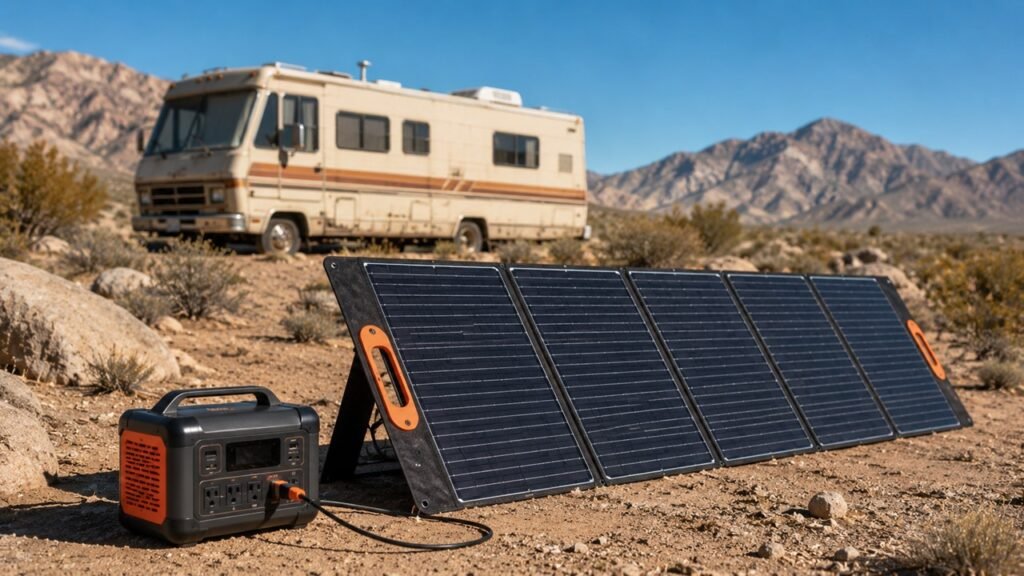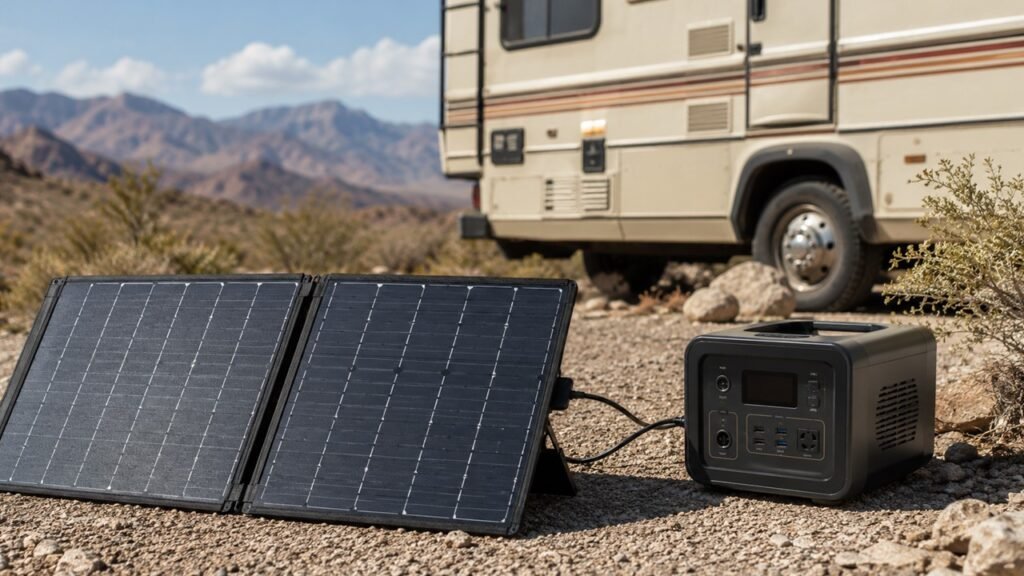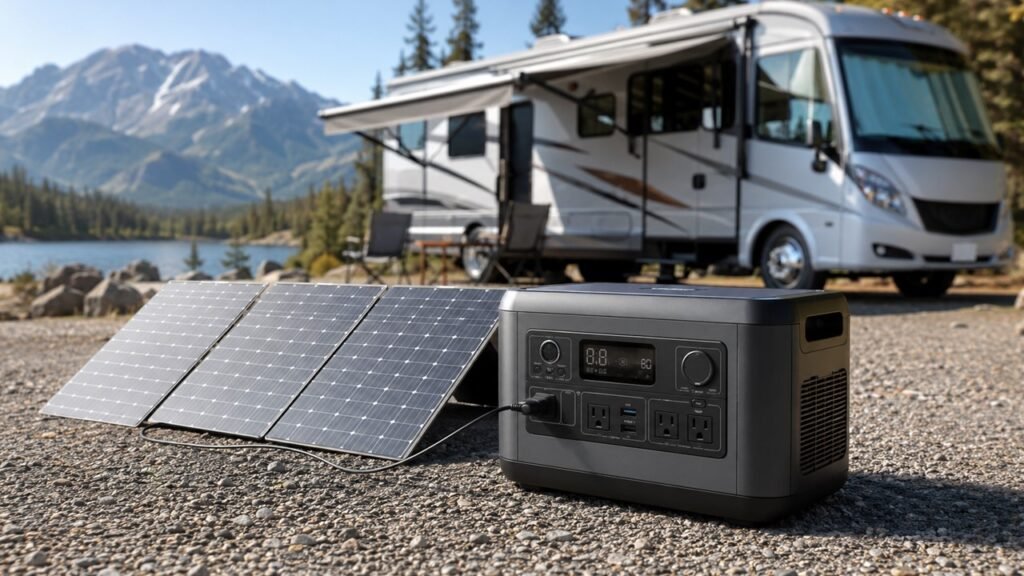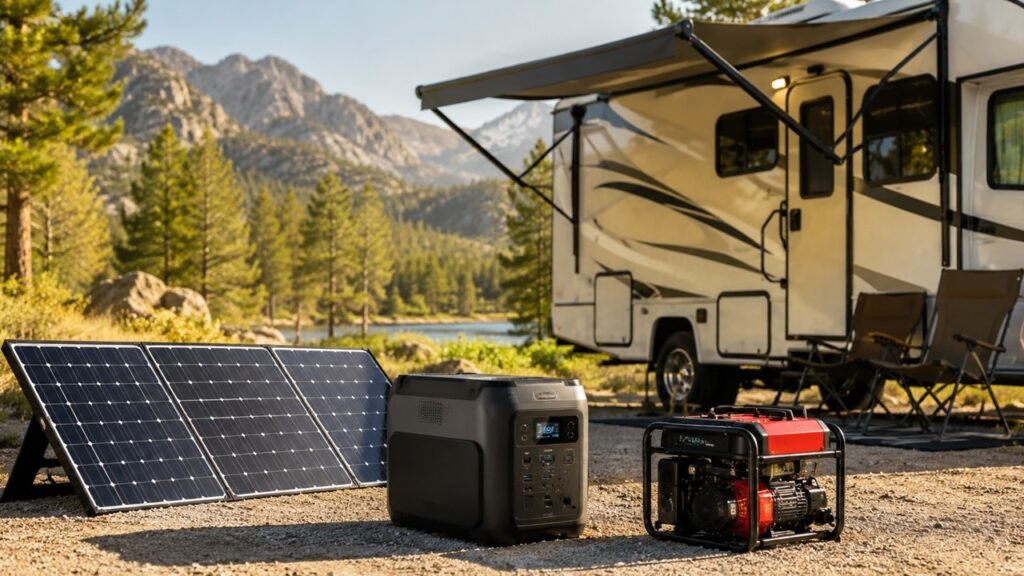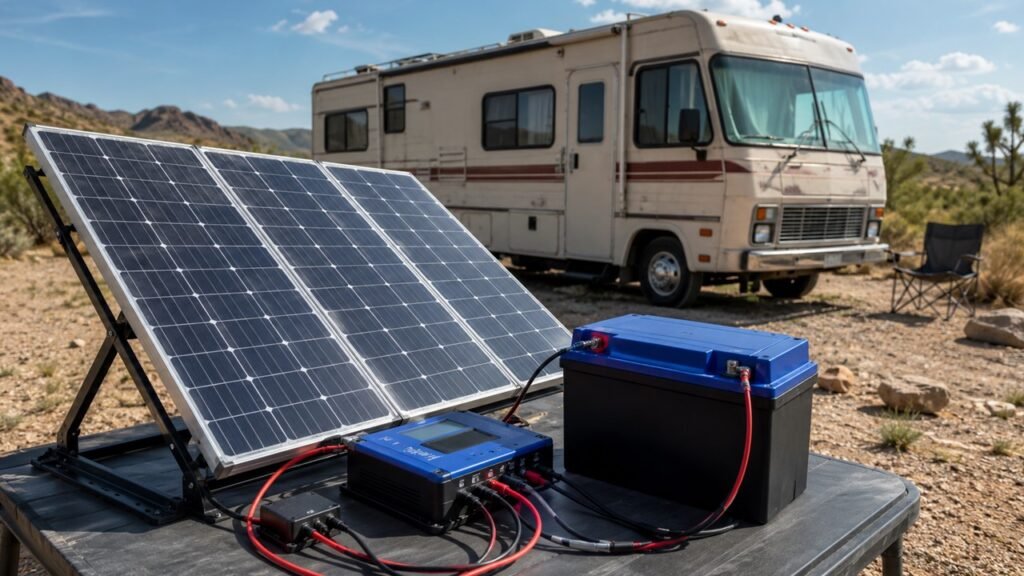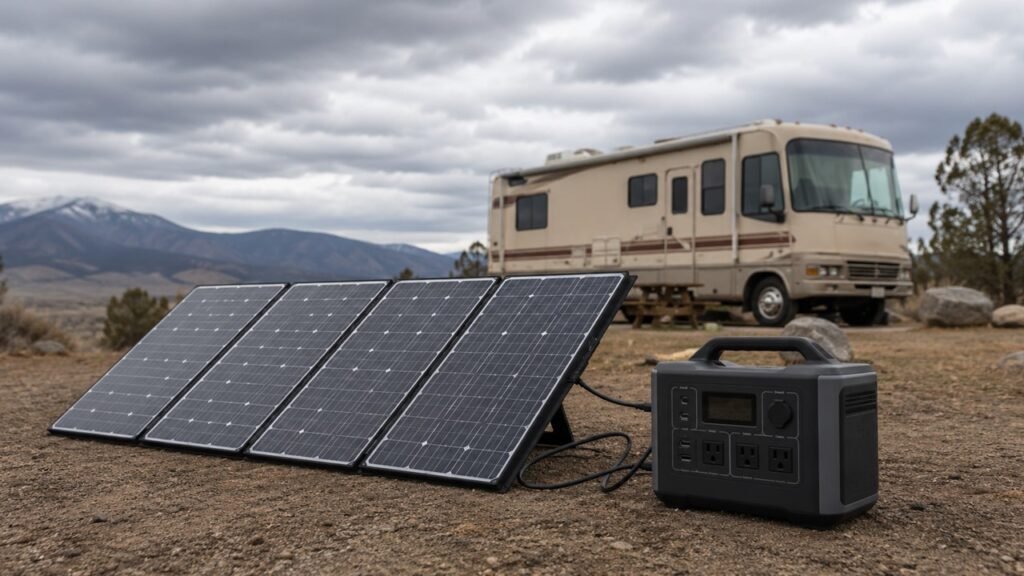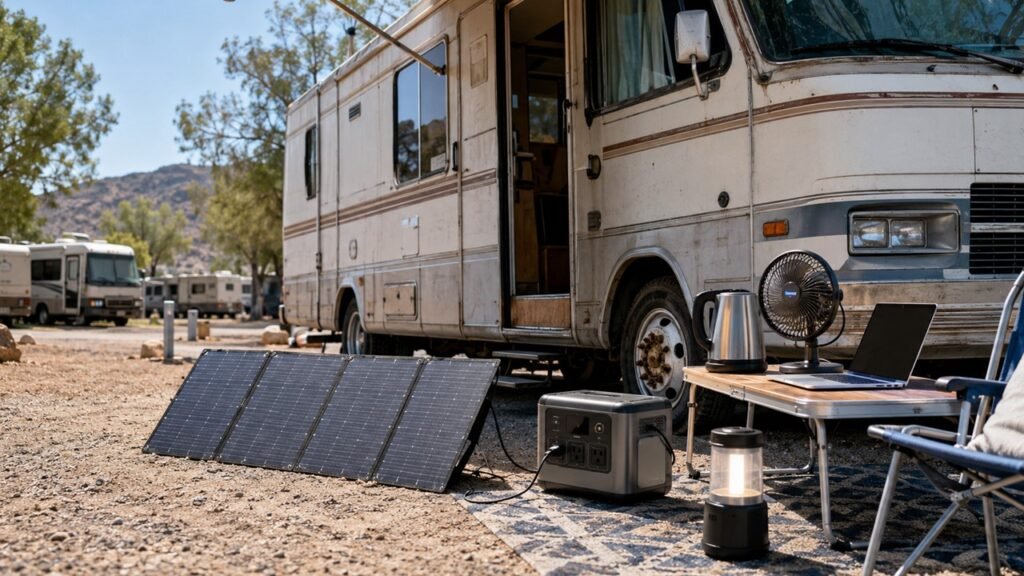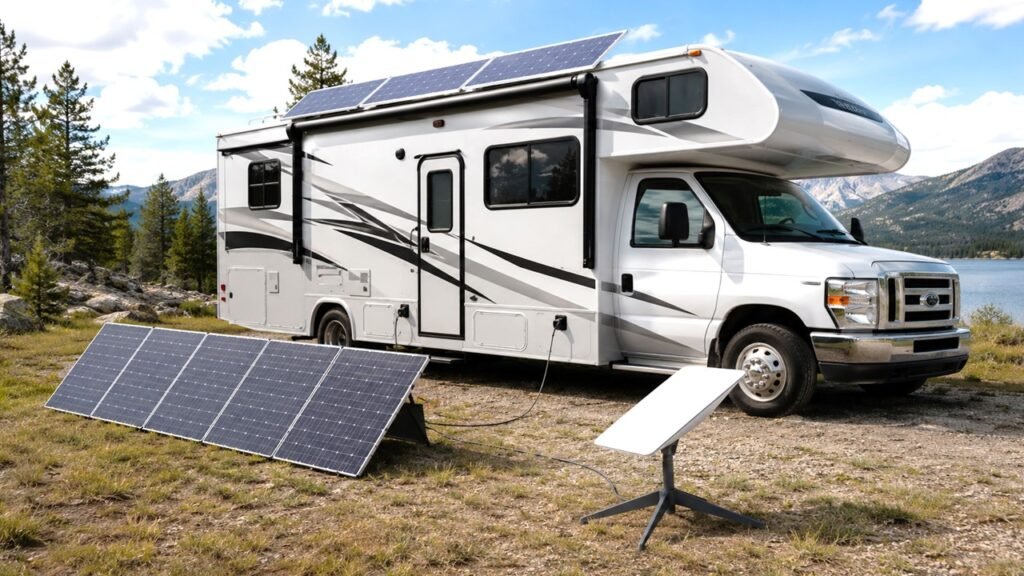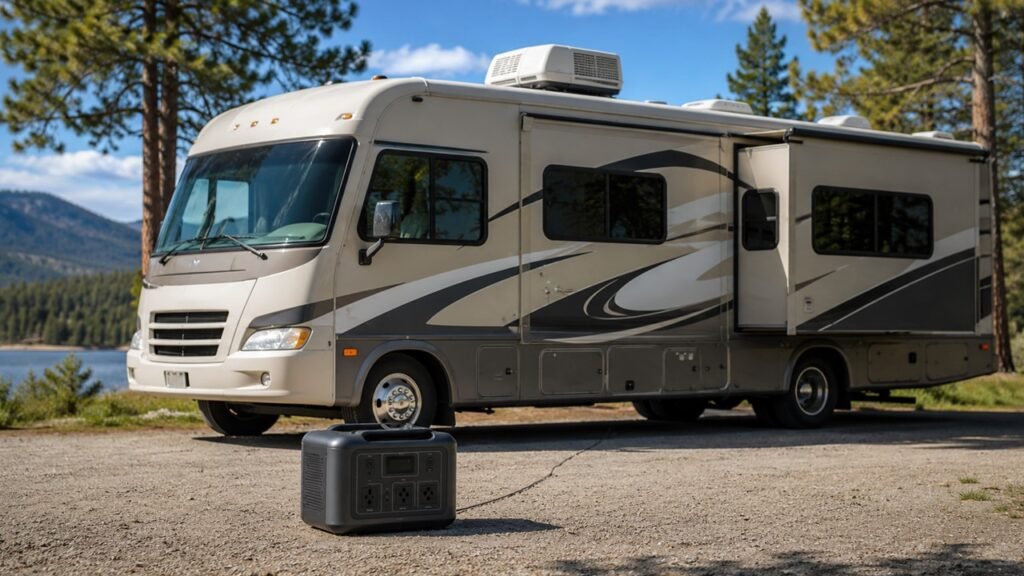
Yes, a solar generator can run an RV air conditioner, but only if the system is powerful enough. RV AC units pull a lot of power, especially when the compressor starts, so a small portable power station usually will not be enough.
If you’re looking to cool your RV off-grid, you’ll need the right mix of battery capacity, inverter output, solar input, and surge protection to make it work safely and realistically.
Key Summary
- A solar generator can run an RV air conditioner if its inverter can handle the AC startup surge and running wattage.
- Most RV air conditioners need about 1,000W to 1,800W while running and much higher power for startup.
- A 3,000Wh solar generator may run an RV AC for about 1 to 3 hours, depending on AC size, heat, cycling, and battery losses.
- A soft start device reduces compressor startup surge and makes solar generator use more realistic.
- Running RV AC all day usually requires a large battery bank, a 3,000W+ inverter, and 1,000W+ of solar input.
Can a Solar Generator Run an RV Air Conditioner?
If you’re wondering whether a solar generator can keep your RV cool on hot days, the short answer is yes. However, it only works well if the system is properly sized for your air conditioner.
Yes, a solar generator can run an RV air conditioner, but only if it has enough power capacity for the job.
The main thing to understand is that an RV air conditioner is not like a phone charger, fan, or small fridge. It needs strong continuous watts to keep running, high surge watts to start the compressor, and enough watt-hour capacity to avoid draining the battery too quickly.
A small portable power station usually cannot run an RV air conditioner well. It may start a very small AC for a short time, but most rooftop RV AC units need a larger solar generator with a powerful inverter and a bigger battery.
A solar generator also does not instantly create all the power your RV AC needs from the sun. Your air conditioner mainly runs from energy already stored in the battery. The solar panels help recharge that battery during the day, but their output changes based on sun angle, shade, clouds, and temperature.
So, the real answer is simple. Your solar generator powers the RV air conditioner using stored battery energy, the inverter converts that battery power into usable AC power, and the air conditioner needs a strong burst of power to start before it can run normally.
Why RV Air Conditioners Are Hard to Run on Solar
Before you invest in a solar setup, it’s important to understand why RV air conditioners are one of the most demanding appliances you can power.
RV air conditioners are hard to run on solar because they use a compressor, fan motor, and control board. The fan and electronics use steady power, but the compressor creates the biggest load.
When the compressor first turns on, it pulls a short but heavy burst of power. This startup surge can overload a weak inverter, even if the solar generator has enough power to run the AC after startup.
That is why running an RV AC on solar is more about proper system sizing than simply buying any portable power station. You need enough inverter output, battery storage, and solar input to handle real-world cooling demands.
The main challenges are:
- High startup surge
- High continuous running watts
- Fast battery drain
- Reduced solar output in clouds, shade, and extreme heat
- Limited RV roof space for large solar arrays
- Extra power loss through inverter conversion
How Many Watts Does an RV Air Conditioner Use?
Let’s look at the numbers so you can get a better idea of what kind of solar generator you’ll actually need.
Most RV air conditioners use much more power than smaller camping appliances. A compact AC may run on under 1,000 watts, but a common rooftop RV air conditioner often needs 1,200W to 1,800W while running and much more during startup.
| RV AC Size | Typical Running Watts | Typical Startup Watts | Solar Generator Difficulty |
| 5,000 BTU small AC | 400W to 700W | 1,000W to 2,000W | Easier |
| 8,000 BTU compact AC | 700W to 1,000W | 1,800W to 2,800W | Moderate |
| 13,500 BTU RV rooftop AC | 1,200W to 1,600W | 3,000W to 5,000W | Hard |
| 15,000 BTU RV rooftop AC | 1,500W to 1,800W | 3,500W to 6,000W | Very hard |
These numbers are estimates, not fixed rules. The actual wattage depends on the AC model, thermostat setting, outside temperature, RV insulation, and how often the compressor cycles on and off.
In mild weather, the AC may cycle and use less total energy. In extreme heat, the compressor may run longer, which drains the solar generator battery much faster.
Running Watts vs Starting Watts: The Key Difference
This is one of the most important concepts to understand because many people focus only on running watts and forget about startup power requirements.
Running Watts
Running watts are the amount of power your RV air conditioner uses after it has already started. This number tells you how much energy the AC will pull from the battery while cooling your RV.
For example, if your RV AC runs at 1,500 watts, it can drain a 3,000Wh solar generator quickly. After inverter losses, that setup may only provide a short cooling window.
Running watts decide runtime. The higher the running watts, the faster the solar generator battery drains.
Starting Watts
Starting watts are the short power spike your RV air conditioner needs when the compressor turns on. This spike usually lasts only a moment, but it can be much higher than the normal running load.
This is where many solar generators struggle. A unit may have enough power to run the AC, but not enough surge capacity to start it.
Starting watts decide whether the solar generator can start the RV air conditioner without shutting down, tripping, or showing an overload warning.
Why Surge Rating Matters
Before you buy a solar generator, make sure you check the surge rating as carefully as the battery size.
Surge rating matters because the RV AC compressor needs extra power at startup. Without enough surge capacity, the solar generator may fail before the AC even starts cooling.
- A 2,000W solar generator may run a small AC but fail to start a rooftop AC.
- A 3,000W inverter is usually a safer starting point for many RV rooftop air conditioners.
- A soft start can reduce surge demand and improve compatibility.
- Always check both continuous output and surge output before buying.
What Size Solar Generator Do You Need for an RV Air Conditioner?
The size of solar generator you need depends on how long you want to run your RV air conditioner and how large your AC unit is.
If you only want short cooling sessions during the afternoon, you can get by with a smaller setup. But if you want to cool your RV for several hours, especially in hot weather, you will need more battery capacity, more inverter power, and more solar input.
The key is not just watt output. You need to look at three things together: battery capacity, inverter output, and solar charging input.
Minimum Size for Short AC Runtime
If you just want to run your RV air conditioner for a short time, a smaller solar generator may work.
This kind of setup is better for quick cooling, small RV air conditioners, or mild weather. It is not the best choice for running a rooftop AC for hours in extreme heat.
For short AC runtime, look for:
- Battery capacity: 2,000Wh to 3,000Wh
- Inverter output: 2,000W to 3,000W
- Solar input: 400W to 800W
- Best for: small AC units or short afternoon cooling
This setup can help cool the RV for a little while, but the battery will drain quickly if the AC runs continuously.
Better Size for Practical RV Cooling
If you want more usable cooling time, a mid-size solar generator setup makes more sense.
This is where RV AC use becomes more realistic. You get enough battery capacity for a few hours of cooling, and the inverter is usually strong enough to handle many rooftop AC units, especially with a soft start.
For practical RV cooling, look for:
- Battery capacity: 4,000Wh to 6,000Wh
- Inverter output: 3,000W+
- Solar input: 800W to 1,200W
- Best for: several hours of daytime AC use
This type of setup is a good middle ground for campers who want quiet off-grid cooling without building a massive electrical system.
Ideal Size for Heavy Off-Grid Cooling
If you camp in hot climates or want longer AC runtime, you will need a much larger solar generator or full RV solar system.
This is the type of setup that makes sense for boondocking, desert camping, or long summer trips where the air conditioner needs to work hard.
For heavy off-grid cooling, look for:
- Battery capacity: 8,000Wh to 10,000Wh+
- Inverter output: 3,000W to 5,000W
- Solar input: 1,200W to 2,000W+
- Best for: boondocking, hot climates, and longer AC runtime
Even with this setup, you still need realistic expectations. Running RV AC all day and all night on solar alone can still be difficult without excellent sun, strong batteries, and smart energy use.
Quick Solar Generator Sizing Table for RV AC
Here is a simple sizing table to help you match your RV AC use with the right solar generator setup.
| Use Case | Recommended Battery Capacity | Recommended Inverter | Recommended Solar Input | Expected Result |
| Small AC for short use | 2,000Wh to 3,000Wh | 2,000W+ | 400W to 800W | 1 to 3 hours |
| Rooftop AC for afternoon cooling | 4,000Wh to 6,000Wh | 3,000W+ | 800W to 1,200W | 3 to 5 hours |
| Rooftop AC with stronger backup | 6,000Wh to 8,000Wh | 3,000W+ | 1,000W to 1,600W | 4 to 7 hours |
| Extended off-grid cooling | 8,000Wh to 10,000Wh+ | 3,000W to 5,000W | 1,200W to 2,000W+ | Longer daytime use |
These are estimates, not guarantees. Heat, shade, battery efficiency, inverter loss, and AC cycling can all change your real-world runtime.
How Long Can a Solar Generator Run an RV Air Conditioner?
A solar generator can run an RV air conditioner for anywhere from about one hour to several hours, depending on battery size and AC wattage.
The easiest way to estimate runtime is to divide usable battery capacity by the running watts of your RV air conditioner.
Runtime = Usable Battery Capacity ÷ AC Running Watts
Usable battery capacity is usually lower than the full rated capacity. That is because the inverter loses some energy while converting DC battery power into AC power, and you may not want to drain the battery completely.
| Solar Generator Capacity | AC Running at 1,200W | AC Running at 1,500W | Realistic Runtime |
| 2,000Wh | About 1.4 to 1.6 hours | About 1.1 to 1.3 hours | Short use only |
| 3,000Wh | About 2 to 2.4 hours | About 1.6 to 2 hours | Short afternoon cooling |
| 5,000Wh | About 3.3 to 4 hours | About 2.6 to 3.3 hours | Practical use |
| 8,000Wh | About 5.3 to 6.4 hours | About 4.2 to 5.3 hours | Strong off-grid setup |
| 10,000Wh | About 6.6 to 8 hours | About 5.3 to 6.6 hours | Extended cooling |
In real life, your runtime may be longer if the AC cycles on and off. It may be shorter if the weather is extremely hot and the compressor keeps running almost nonstop.
How Many Solar Panels Do You Need to Run RV AC?
You need a lot of solar panel power to support an RV air conditioner, especially if you want to recharge the battery while the AC is running.
Solar panels can help extend runtime, but they do not remove the need for a large battery. Your RV AC still pulls heavy power from the solar generator battery, while the panels refill that battery during daylight.
Solar Panels Do Not Replace Battery Capacity Instantly
A common mistake is thinking solar panels directly run the RV air conditioner all day.
In reality, solar output changes throughout the day. A 1,000W solar array will not usually produce 1,000W every hour. Shade, clouds, panel angle, heat, and wiring losses all reduce real-world output.
That is why battery capacity matters so much. The battery acts like your power reserve, while the solar panels work as the recharge source.
Basic Solar Panel Estimate
You can estimate daily solar production with a simple formula:
Daily Solar Production = Solar Panel Watts × Peak Sun Hours × Efficiency Factor
For example, a 1,000W solar array with 5 peak sun hours and 75% real-world efficiency may produce about 3,750Wh per day.
That sounds like a lot, but a rooftop RV air conditioner can use that much energy in only a few hours. This is why running AC on solar needs careful sizing.
Practical Solar Panel Recommendations
For RV AC use, more solar input gives you better recovery during the day.
- 400W to 600W solar input helps recharge small systems but will not support long AC runtime.
- 800W to 1,200W solar input is more practical for daytime RV AC support.
- 1,500W to 2,000W solar input is better for serious off-grid cooling.
- Rooftop space, panel angle, shade, and weather limit real-world output.
If your RV roof cannot fit enough panels, portable panels can help. Just remember that portable panels need setup space, sun exposure, and safe cable management.
Why a Soft Start Device Matters for RV AC
A soft start device matters because it helps reduce the heavy startup surge from your RV air conditioner.
When the compressor turns on, it needs a short burst of power. That burst can overload a solar generator, even if the same generator could run the AC after it starts.
A soft start smooths out that startup demand. This makes it easier for the inverter to handle the compressor without shutting down or tripping an overload warning.
A soft start can help because:
- A soft start lowers the initial power spike.
- A soft start reduces inverter overload risk.
- A soft start helps smaller generators start larger AC units.
- A soft start may reduce strain on the compressor.
- A soft start does not reduce total cooling demand dramatically.
That last point is important. A soft start helps with startup power, but it does not magically make your air conditioner use very little energy while running.
Can a 2000W Solar Generator Run an RV Air Conditioner?
A 2,000W solar generator may run a small RV air conditioner or an efficient window-style AC, but it is not ideal for most rooftop RV AC units.
The biggest issue is startup surge. A 13,500 BTU rooftop air conditioner may need far more than 2,000 watts to start, especially without a soft start device.
Battery capacity also matters. A 2,000W output rating only tells you how much power the unit can deliver at one time. It does not tell you how long it can keep the AC running.
So, if the solar generator has only 1,500Wh to 2,000Wh of battery capacity, the runtime may be very short even if it starts the AC.
Can a 3000W Solar Generator Run an RV Air Conditioner?
A 3,000W solar generator is a more realistic starting point for many RV rooftop air conditioners.
With a strong inverter and a soft start device, a 3,000W solar generator may be able to start and run a 13,500 BTU RV AC. Still, you need to check the exact AC wattage and the generator’s surge rating before connecting anything.
Runtime is the other part of the equation. A 3,000W inverter may start the AC, but a small battery will not run it for long.
For better results, pair a 3,000W inverter with a larger battery, ideally 4,000Wh or more if you want useful cooling time.
Can a 5000Wh Solar Generator Run RV AC Overnight?
A 5,000Wh solar generator may run an RV air conditioner for part of the night, but it may not provide true overnight cooling in hot weather.
If your AC pulls 1,200W to 1,500W while running, 5,000Wh can drain faster than many people expect. In mild weather, the AC may cycle on and off, which helps extend runtime. In hot and humid weather, the compressor may run much longer.
A 5,000Wh solar generator may struggle overnight because:
- AC wattage may stay high during hot nights.
- The compressor may cycle less often in humid weather.
- Battery reserve reduces usable capacity.
- Other RV loads also use power.
- Better insulation and fans can extend runtime.
So, yes, a 5,000Wh solar generator can help with nighttime cooling, but you should not expect guaranteed all-night AC in extreme heat.
Portable Solar Generator vs Full RV Solar System for AC
A portable solar generator is easier to use, but a full RV solar system is usually better for serious air conditioner runtime.
| Feature | Portable Solar Generator | Full RV Solar System |
| Installation | Easier | More complex |
| Portability | High | Low |
| AC runtime | Limited to moderate | Moderate to strong |
| Solar input | Often limited | Usually expandable |
| Cost | Lower to high | Higher upfront |
| Best for | Weekend trips and backup cooling | Serious boondocking and long stays |
Portable solar generators are great for beginners because they are simple, movable, and do not always require permanent wiring.
A full RV solar system makes more sense if you want to run an air conditioner regularly, add more solar panels, expand your battery bank, and manage larger daily loads.
Solar Generator Features for Running RV AC
If you are buying a solar generator for RV AC, do not shop by battery size alone. You need a system that can start the air conditioner, run it safely, and recharge fast enough to be useful.
Look for these features:
- High continuous AC output, preferably 3,000W or more
- Strong surge rating for compressor startup
- Large battery capacity, preferably 4,000Wh or more
- Expandable battery option for longer runtime
- High solar input, preferably 800W or more
- 30A RV outlet if you want easier RV connection
- LiFePO4 battery chemistry for longer cycle life
- Fast wall charging for campground or home recharge
- App monitoring for battery, load, and solar input tracking
The right solar generator for an RV air conditioner is not just powerful. It should also be expandable, efficient, and easy to monitor.
Solar Generator Setup Example for RV Air Conditioner
A good RV AC solar setup depends on how you camp. A weekend camper does not need the same system as a full-time boondocker in hot weather.
Basic Weekend Setup
This setup is better for short trips and limited AC use.
- Solar generator: 3,000Wh
- Inverter: 3,000W
- Solar panels: 600W
- AC type: small AC or rooftop AC with soft start
- Best use: short cooling sessions
This is a reasonable entry point if you only need to cool the RV for a short time during the hottest part of the day.
Practical Boondocking Setup
This setup makes more sense if you want several hours of real cooling.
- Solar generator: 5,000Wh to 6,000Wh
- Inverter: 3,000W+
- Solar panels: 1,000W to 1,200W
- AC type: 13,500 BTU rooftop AC with soft start
- Best use: afternoon cooling and partial evening use
For many RV owners, this is the more realistic setup. It gives you enough power to use the AC without draining the battery immediately.
Heavy-Duty Off-Grid Setup
This setup is for serious off-grid cooling in hot climates.
- Battery capacity: 8,000Wh to 10,000Wh+
- Inverter: 3,000W to 5,000W
- Solar panels: 1,500W to 2,000W+
- AC type: efficient rooftop AC or mini split
- Best use: hot climates and longer off-grid stays
This kind of system is expensive and takes planning, but it gives you a much better chance of running RV AC for longer periods.
Factors That Affect RV AC Runtime on Solar
Your solar generator runtime depends on more than the number printed on the battery.
Two people can use the same solar generator and get different results because their RVs, weather, insulation, and AC units are different.
The biggest runtime factors include:
- AC BTU rating
- Outside temperature
- RV insulation quality
- Direct sun exposure
- Thermostat setting
- Battery capacity
- Inverter efficiency
- Solar panel wattage
- Shade and cloud cover
- Other appliances running at the same time
- Whether the AC has a soft start
- Whether the compressor cycles often or runs continuously
If you reduce heat inside the RV, your solar generator will last longer. Window covers, fans, shade, and better insulation can make a noticeable difference.
When a Solar Generator Makes Sense for RV AC
A solar generator makes sense for RV AC when your cooling needs are realistic.
It works best when you want quiet power, short cooling sessions, and less dependence on fuel. It is also helpful in places where gas generators are restricted or too noisy.
A solar generator makes sense if:
- You camp in sunny areas.
- You need quiet power at night or in generator-restricted areas.
- You only need AC for a few hours.
- You use a soft start device.
- You have enough battery and solar input.
- You want less fuel use and less generator noise.
If you use solar wisely, it can make RV camping much more comfortable without the constant sound and smell of a gas generator.
When a Solar Generator Is Not Enough for RV AC
A solar generator is not always enough, especially if you expect the same cooling experience you get from shore power.
If the weather is extremely hot, the AC may run almost nonstop. In that case, even a large battery can drain quickly.
A solar generator may not be enough if:
- You want to run AC all day and all night.
- You camp in very hot or humid weather.
- You have limited solar panel space.
- You park mostly in shade.
- You use a large 15,000 BTU rooftop AC.
- You also run microwaves, heaters, coffee makers, or induction cooktops.
- You do not have enough battery capacity.
This does not mean solar is useless. It just means solar works best when you size the system properly and keep a backup option for demanding conditions.
Solar Generator vs Gas Generator for RV Air Conditioner
Solar generators and gas generators can both run RV air conditioners, but they solve the problem in different ways.
| Category | Solar Generator | Gas Generator |
| Noise | Very quiet | Noisy |
| Fuel | Sunlight and stored battery power | Gasoline, propane, or diesel |
| Runtime | Limited by battery and solar input | Limited by fuel supply |
| Maintenance | Low | Higher |
| Startup power | Depends on inverter and soft start | Usually strong |
| Weather dependence | High | Low |
| Best use | Quiet off-grid cooling for limited hours | Long AC runtime in extreme heat |
A solar generator is better when you want quiet, clean, low-maintenance power. A gas generator is better when you need longer AC runtime in extreme heat.
Many RV owners get the best result by using solar first and keeping a gas generator as backup.
Safety Tips Before Running RV AC on a Solar Generator
Before you connect your RV air conditioner to a solar generator, make sure the system is properly rated.
An RV AC is a heavy load, so you do not want to guess. Check the numbers, use the right cables, and avoid overloading the generator.
Follow these safety tips:
- Check the RV AC running watts and startup watts before connecting.
- Confirm the solar generator’s continuous output and surge output.
- Use a soft start if your AC has high compressor surge.
- Avoid overloading the generator with other appliances.
- Use the correct RV adapter and cable rating.
- Keep the solar generator in a dry, ventilated location.
- Do not modify RV wiring unless you are qualified.
- Ask a licensed RV electrician for permanent installations.
If you are unsure about your RV wiring, get professional help. It is better to size the system safely than risk damaging the AC, inverter, or RV electrical system.
Common Mistakes to Avoid
A lot of RV owners buy a solar generator based on one big number, then get disappointed when it cannot run the AC properly.
To avoid that, look at the whole system. Your battery, inverter, surge rating, solar input, and AC load all need to work together.
Avoid these mistakes:
- Buying based only on watt output and ignoring battery capacity
- Ignoring AC startup surge
- Assuming solar panels produce full rated power all day
- Expecting a small 1,000Wh power station to run rooftop AC
- Forgetting inverter losses
- Running too many appliances with the AC
- Parking in shade while depending on solar recharge
- Skipping the soft start device
- Undersizing solar panels for daily recharge
The biggest mistake is expecting a small portable power station to behave like shore power. RV air conditioning needs serious energy.
Is It Worth Running an RV Air Conditioner on a Solar Generator?
Running an RV air conditioner on a solar generator is worth it if you want quiet cooling, short off-grid AC runtime, and less reliance on fuel.
It is not always worth it if you expect full-day AC in extreme heat without a very large system. In that case, you may still need shore power, a gas generator, or a much bigger solar setup.
Solar works best when it is part of a realistic RV energy plan. Fans, insulation, shade, reflective window covers, and smart thermostat settings can reduce AC runtime and make your solar generator much more effective.
So, if you size the system properly and use it wisely, a solar generator can absolutely make RV camping cooler, quieter, and more comfortable.
Final Verdict
Yes, a solar generator can run an RV air conditioner, but the setup has to be sized correctly. Most rooftop RV AC units need more than a basic portable power station because they pull high running watts and a strong startup surge.
For most RV rooftop air conditioners, look for a solar generator with a 3,000W+ inverter, at least 4,000Wh to 6,000Wh of battery capacity, strong solar input, and a soft start device. This gives the system a much better chance of starting the AC, running it safely, and recharging during the day.
If you only need AC for a few hours, a high-capacity solar generator can work well. If you need all-day cooling in extreme heat, a larger RV solar system or a gas generator backup is still the safer choice.
Related FAQs
Can a solar generator run a 13,500 BTU RV air conditioner?
Yes, a solar generator can run a 13,500 BTU RV air conditioner if it has enough inverter output, battery capacity, and surge handling. A soft start device usually makes this much easier.
How big of a solar generator do I need to run RV AC?
Most RV AC setups need at least a 3,000W inverter and 3,000Wh to 6,000Wh of battery capacity for practical short-term cooling.
How long will a 3000Wh solar generator run an RV air conditioner?
A 3,000Wh solar generator may run an RV air conditioner for about 1 to 3 hours, depending on the AC wattage, inverter loss, outside heat, and compressor cycling.
Do I need a soft start for RV AC on solar?
A soft start is strongly recommended because it reduces compressor startup surge and helps the solar generator start the air conditioner without overloading.
Can solar panels alone run an RV air conditioner?
Solar panels alone usually cannot run an RV air conditioner reliably. You need a battery bank or solar generator to store power and handle changing solar output.
Can a 2000W solar generator run RV AC?
A 2,000W solar generator may run a small RV AC, but it often struggles with larger rooftop air conditioners unless the AC is efficient and has a soft start.
Is a solar generator better than a gas generator for RV AC?
A solar generator is quieter and cleaner, but a gas generator usually provides longer runtime in extreme heat. Many RV owners use solar first and keep gas backup for heavy AC use.

Daniel Brooks writes about RV living, gear, and travel planning with a focus on everyday usability. His guides break down complex topics into simple advice for real RV owners. He reviews products with long-term use in mind, not marketing hype.