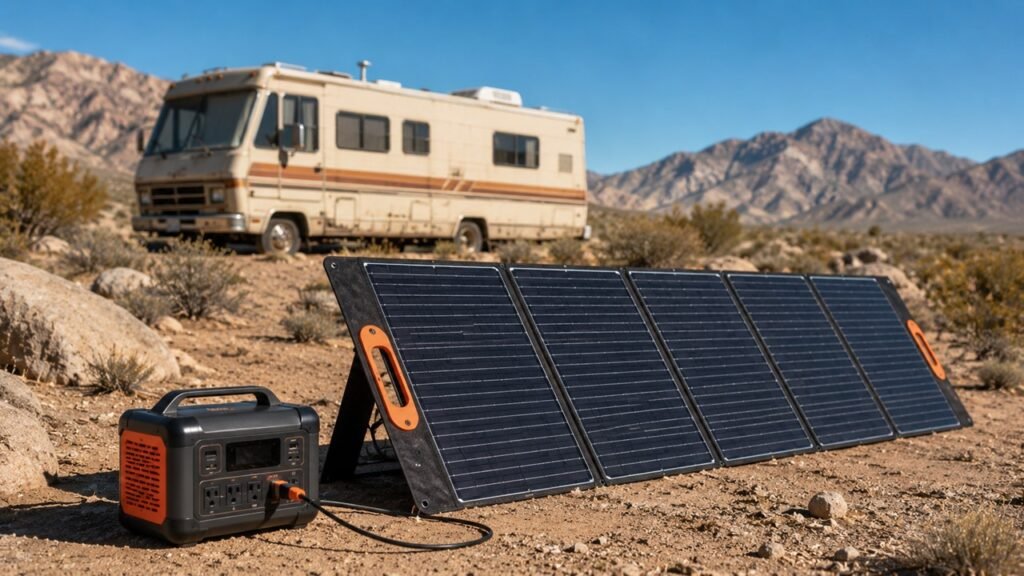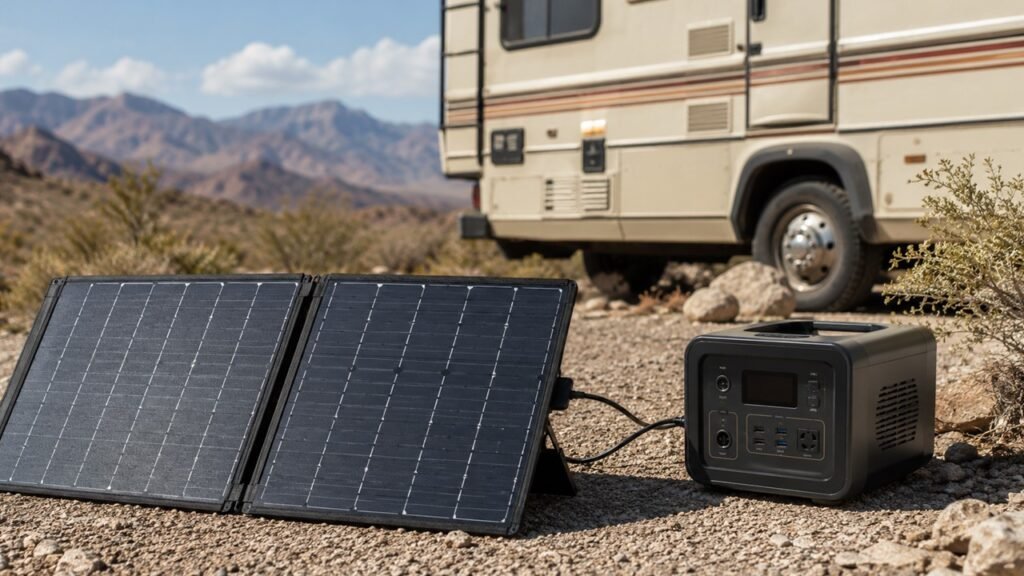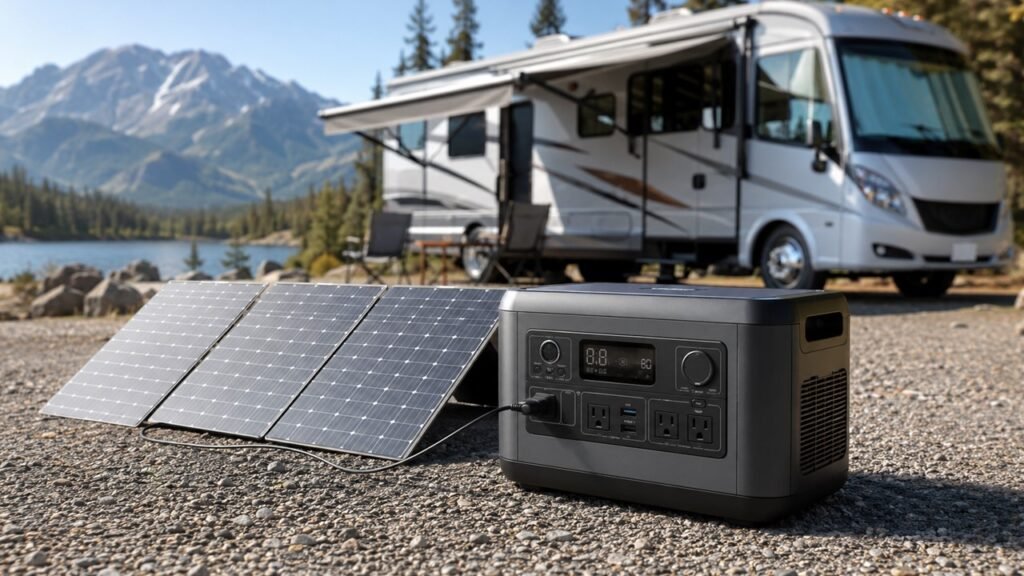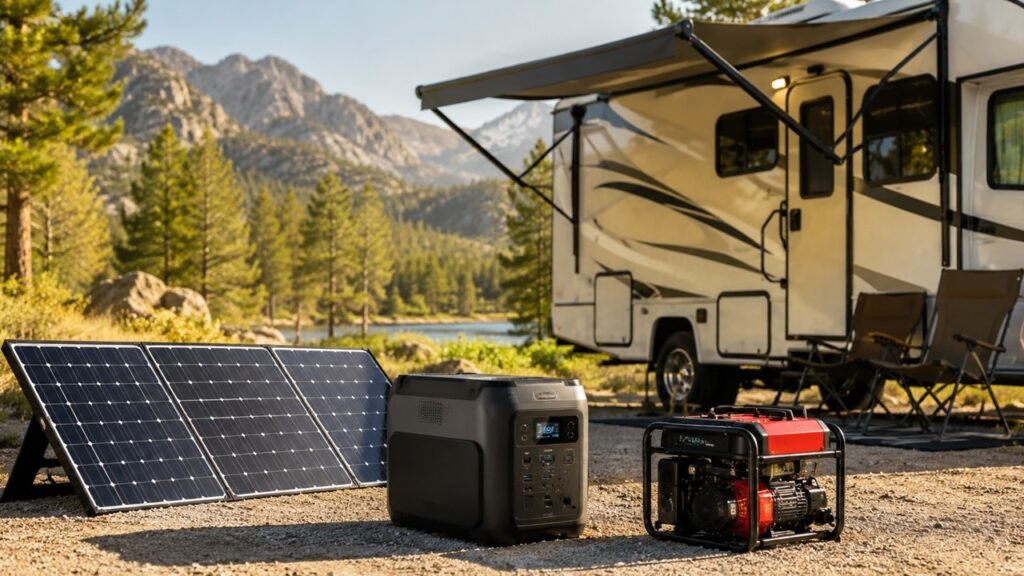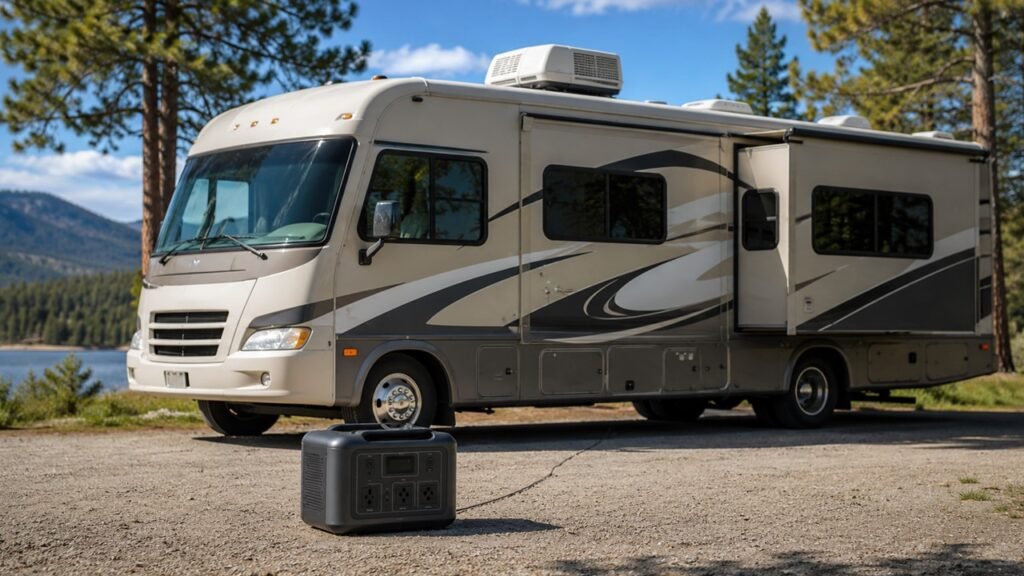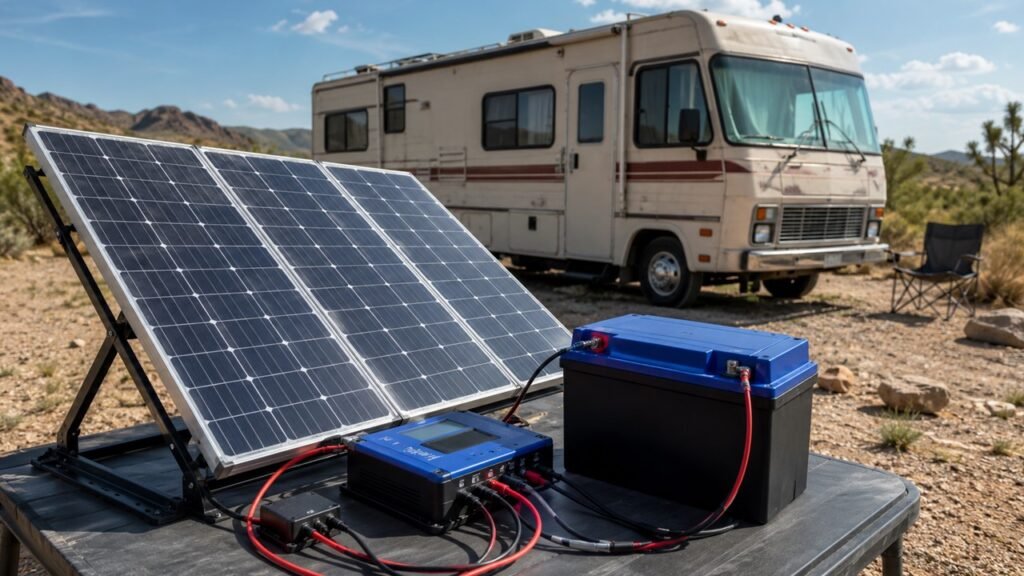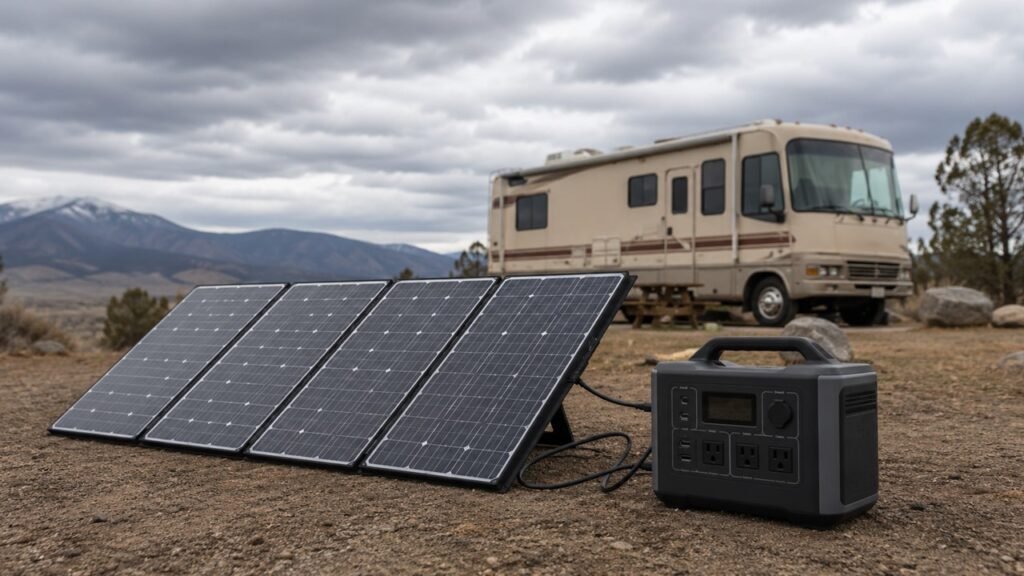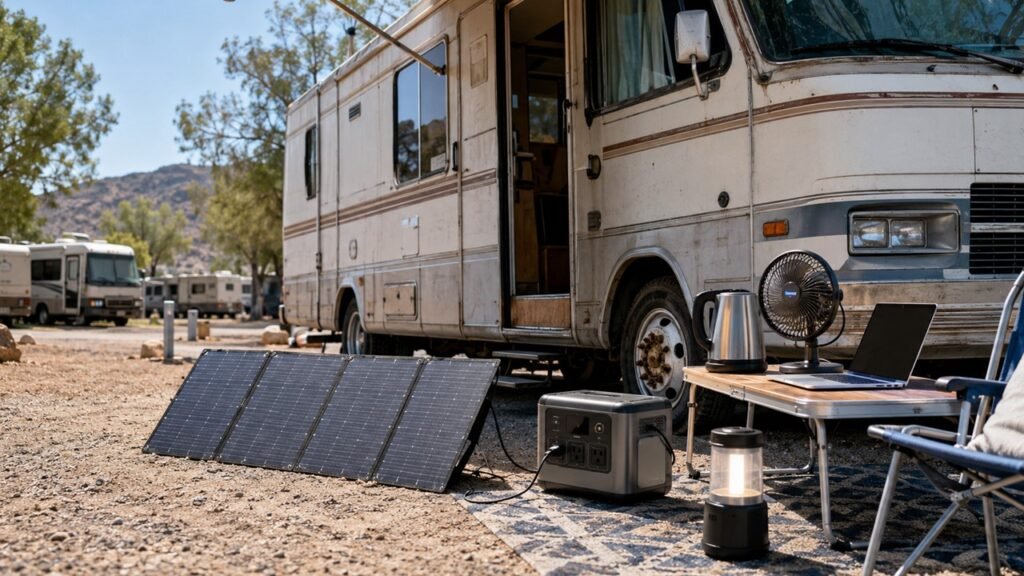
An RV can run off battery power for a few hours to several days. The real runtime depends on your battery size, battery type, appliance use, weather, and whether you have solar panels, a generator, or alternator charging.
A single 12V 100Ah lead-acid battery may only power basic RV loads for about one day. A larger lithium battery bank can support lights, fans, a water pump, a 12V fridge, a furnace blower, internet gear, and small electronics for much longer.
This guide shows you how RV battery runtime works, what drains power fastest, and how to estimate your own setup without guessing.
Key Takeaways
- Most RV batteries can run basic 12V essentials for 12 hours to 3 days.
- A 12V 100Ah lead-acid battery gives about 600Wh of usable power.
- A 12V 100Ah lithium battery gives about 1,000Wh to 1,200Wh of usable power.
- LED lights, fans, phone chargers, and water pumps use very little power.
- Furnaces, refrigerators, inverters, microwaves, coffee makers, and air conditioners drain batteries much faster.
- Battery runtime depends on usable capacity, appliance wattage, inverter losses, temperature, battery age, and recharge sources.
- The best way to estimate runtime is to calculate usable watt-hours and divide that by your daily power use.
How Long Can an RV Run Off Battery Power?
An RV can usually run for 1 to 3 days on battery power with light use. Light use means LED lights, phone charging, a water pump, roof vent fans, and limited furnace use.
With heavier loads, runtime can drop to several hours or one day. A 12V refrigerator, furnace blower, inverter, CPAP machine, Starlink, laptop charging, or microwave can drain your battery bank much faster.
Air conditioning is the biggest exception. Most standard RV battery setups cannot run an RV air conditioner for long. Running AC from batteries usually requires a large lithium battery bank, a powerful inverter, solar support, and a smart charging plan.
For most RVers, battery power works best for lights, fans, water pump use, fridge controls, furnace blower use, device charging, and small electronics.
Quick RV Battery Runtime Chart
These estimates assume normal RV use, not air conditioning. Light use means lights, fans, water pump, and device charging. Moderate use includes a fridge, laptops, furnace cycling, or internet. Heavy use includes frequent inverter use, furnace use, cooking appliances, or multiple devices.
| RV Battery Setup | Usable Power Estimate | Light Use Runtime | Moderate Use Runtime | Heavy Use Runtime |
| 12V 100Ah Lead-Acid | About 600Wh | 12-24 hours | 6-12 hours | A few hours |
| 12V 100Ah Lithium | About 1,000-1,200Wh | 1-2 days | 8-18 hours | A few hours |
| 12V 200Ah Lithium | About 2,000-2,400Wh | 2-4 days | 1-2 days | 6-12 hours |
| 12V 400Ah Lithium | About 4,000-4,800Wh | 4-7 days | 2-4 days | 12-24+ hours |
| 48V Large Battery System | Varies widely | Several days | Several days | Better for AC and inverter loads |
These numbers are estimates, not fixed promises. Your actual runtime depends on appliance usage, battery health, outside temperature, inverter efficiency, solar input, and how deeply your battery can safely discharge.
What Determines How Long an RV Battery Will Last?
RV battery runtime depends on how much usable energy your battery stores and how quickly your RV uses that energy. A larger battery bank lasts longer, but appliance use often matters more than battery size.
Battery Capacity
Battery capacity tells you how much energy your battery can store. RV batteries are often rated in amp-hours, or Ah. A 100Ah battery can deliver 100 amps for one hour, 10 amps for 10 hours, or 5 amps for 20 hours under ideal conditions.
Watt-hours are easier to use because most appliances are rated in watts.
Formula:
Watt-hours = Volts × Amp-hours
Example:
A 12V 100Ah battery stores about 1,200Wh of total energy before usable capacity limits.
12V × 100Ah = 1,200Wh
For simple RV math, 12V is close enough. Many lithium RV batteries are actually 12.8V nominal, so the real total watt-hours may be slightly higher.
Usable Battery Capacity
Total battery capacity and usable battery capacity are not always the same. Lead-acid batteries should not be deeply discharged often because it can shorten their life. Lithium batteries allow much deeper discharge, so more of the rated capacity is usable.
| Battery Type | Safe Usable Capacity | 12V 100Ah Usable Power |
| Flooded Lead-Acid | About 50% | About 600Wh |
| AGM Lead-Acid | About 50% | About 600Wh |
| Lithium LiFePO4 | About 80% to 100% | About 960Wh to 1,200Wh |
This is why a 100Ah lithium battery can run an RV longer than a 100Ah lead-acid battery. The amp-hour rating may look the same, but the usable energy is not the same.
Appliance Power Draw
Battery size matters, but appliance use matters more. A small battery can last for days if you only use LED lights and a water pump. The same battery can drain quickly if you run a furnace blower, refrigerator, inverter, microwave, or air conditioner.
Every appliance pulls power from the battery. Small loads drain slowly. High-watt loads drain quickly. Long-running loads, like fridges and furnace fans, can also use a lot of energy over time.
Inverter Losses
An inverter changes 12V DC battery power into 120V AC power. You need an inverter for household-style appliances like microwaves, coffee makers, TVs, residential refrigerators, and some laptop chargers.
The problem is that inverters waste some power during conversion. Many inverters also use power just by staying on, even when no appliance is running. This is called idle draw.
If you do not need 120V power overnight, turning off the inverter can save a surprising amount of battery capacity.
Weather and Temperature
Cold weather can reduce RV battery runtime in two ways. First, cold temperatures can reduce battery performance, especially with lead-acid batteries. Second, cold weather makes your furnace run more often.
The RV furnace burns propane for heat, but the blower fan uses battery power. If the furnace cycles all night, it can drain a small battery bank before morning.
Hot weather also matters. Heat makes refrigerators work harder. It also makes air conditioning tempting, and AC is one of the hardest appliances to run from batteries.
Battery Age and Condition
An older battery stores less energy than it did when new. A weak battery may show a full charge, then drop quickly under load.
This is why some RV batteries die overnight even when the math says they should last longer. The battery may be sulfated, undercharged, damaged, or simply near the end of its life.
How to Calculate How Long Your RV Battery Will Run
The easiest way to estimate RV battery runtime is to use watt-hours. This method works for lead-acid, AGM, lithium, 12V systems, 24V systems, and 48V systems.
Follow these steps:
- Find your battery voltage.
- Find your amp-hour rating.
- Multiply volts by amp-hours.
- Adjust for usable capacity.
- Add up your appliance watt-hours.
- Divide usable battery capacity by your daily power use.
Formula:
Runtime = Usable battery watt-hours ÷ total watts used
For daily use, the better version is:
Days of runtime = Usable battery watt-hours ÷ daily watt-hour use
Example: 12V 100Ah Lead-Acid Battery
A 12V 100Ah lead-acid battery stores about 1,200Wh of total energy.
Calculation:
- Battery capacity: 12V × 100Ah = 1,200Wh
- Usable capacity at 50%: about 600Wh
- If your RV uses 300Wh overnight, the battery may last about 2 nights.
- If your RV uses 600Wh overnight, the battery may last about 1 night.
- If your RV uses 1,000Wh overnight, the battery is too small for that load.
This is why a basic lead-acid battery can feel fine for lights and a water pump, but struggle with a furnace, fridge, inverter, or CPAP overnight.
Example: 12V 200Ah Lithium Battery
A 12V 200Ah lithium battery stores about 2,400Wh of total energy. If the battery allows 80% to 100% usable capacity, you may get about 2,000Wh to 2,400Wh of usable power.
Calculation:
- Battery capacity: 12V × 200Ah = 2,400Wh
- Usable capacity: about 2,000Wh to 2,400Wh
- If your RV uses 800Wh per day, it may last about 2 to 3 days.
- If your RV uses 2,000Wh per day, it may last about 1 day.
- If you run heavy inverter loads, runtime can drop quickly.
A 200Ah lithium battery is a much better starting point for boondocking than a single 100Ah lead-acid battery.
How Much Power Do Common RV Appliances Use?
RV appliances do not all drain batteries at the same speed. Some use small amounts of power for a long time. Others use huge amounts of power for only a few minutes.
| RV Appliance | Typical Power Use | Battery Impact |
| LED lights | 3W-10W each | Low |
| Water pump | 50W-100W while running | Low because it runs briefly |
| Roof vent fan | 20W-60W | Low to moderate |
| Phone charging | 10W-20W | Low |
| Laptop charging | 45W-100W | Moderate |
| CPAP machine | 30W-80W | Moderate overnight load |
| 12V refrigerator | 40W-100W cycling | Moderate to high |
| Furnace blower | 60W-120W cycling | High in cold weather |
| Starlink or satellite internet | 20W-75W+ | Moderate to high |
| Microwave | 1,000W-1,500W | Very high |
| Coffee maker | 800W-1,500W | Very high |
| RV air conditioner | 1,200W-2,000W+ | Extreme |
Small 12V appliances are battery-friendly. LED lights, roof fans, phone chargers, and water pumps usually do not drain a healthy battery bank quickly.
Heating, cooling, cooking, refrigeration, internet, and inverter loads shorten runtime fastest. Even if an appliance only runs for a short time, high wattage can remove a large amount of battery capacity.
How Long Will an RV Battery Last Overnight?
A healthy RV battery can usually last overnight if you only run light 12V loads. These include LED lights, a water pump, fridge controls, vent fans, phone chargers, and limited furnace cycles.
A small lead-acid battery may drain before morning if the furnace runs often, the inverter stays on all night, a 12V fridge cycles heavily, or internet equipment stays powered. Cold weather makes this problem more common because the furnace blower runs more.
If you keep waking up to a dead RV battery, the cause is usually one of three things: the battery is too small, the loads are too high, or the battery is old and weak.
Common Overnight Battery Drains
- Furnace blower
- 12V refrigerator
- Inverter idle draw
- CPAP machine
- Starlink or router
- Propane detector
- Carbon monoxide detector
- Fridge control board
- Stereo memory
- Lights left on
- Weak or aging battery
Parasitic loads are small, but they run all the time. A propane detector or control board may not seem like much, but it still uses battery power every hour.
How Long Can an RV Furnace Run on Battery?
An RV furnace can run on battery power overnight, but it can also drain a small battery fast. The furnace uses propane to make heat, but the blower fan and controls use 12V battery power.
A furnace blower may draw around 60W to 120W while running. The actual overnight power use depends on how often the furnace cycles. A well-insulated RV in mild weather may use much less power than a poorly insulated RV in freezing weather.
Simple example:
If your furnace blower uses 100W and runs for 6 total hours overnight, it uses about 600Wh.
That one load can drain most of the usable capacity from a 12V 100Ah lead-acid battery. With lithium, you have more usable capacity, but the furnace can still become one of the biggest overnight drains.
To reduce furnace battery use, lower the thermostat, use warm bedding, block drafts, insulate windows, and avoid heating unused areas when possible.
How Long Can an RV Refrigerator Run on Battery?
RV refrigerator runtime depends on the fridge type. A 12V compressor fridge, propane absorption fridge, and residential fridge all use battery power differently.
12V Compressor Refrigerator
A 12V compressor refrigerator can run from several hours to a couple of days on battery power. Runtime depends on battery size, fridge size, outside temperature, insulation, door openings, and how often the compressor cycles.
A 12V fridge is usually more battery-friendly than a residential fridge running through an inverter. Still, it can become one of your largest daily loads because it runs day and night.
A 100Ah lithium battery may run a small 12V fridge for a day or more with careful use. A 200Ah to 400Ah lithium setup is much better for regular boondocking with refrigeration.
Propane RV Refrigerator
A propane RV refrigerator uses propane for cooling, but it still needs 12V power for the control board and ignition. This makes the battery draw much lower than a 12V compressor fridge.
If you want to save battery power while camping without hookups, propane mode can help. The fridge will still use some battery power, but the cooling load does not come mainly from the battery.
Residential Refrigerator
A residential refrigerator usually runs on 120V AC power through an inverter. That means it needs more battery capacity than a propane fridge or many 12V compressor fridges.
The inverter also adds conversion losses and idle draw. If your RV has a residential fridge, you should plan for a larger lithium battery bank, a battery monitor, solar charging, and a backup charging source.
Can an RV Air Conditioner Run Off Battery Power?
Yes, an RV air conditioner can run off battery power, but not with a basic battery setup. A standard 12V 100Ah battery is not realistic for practical AC use.
An RV air conditioner usually needs a large lithium battery bank, a powerful inverter, a soft start device, and strong recharging from solar, alternator charging, shore power, or a generator.
Even with a large battery bank, AC runtime can be limited. The air conditioner may cycle on and off, but hot weather, poor insulation, direct sun, and low thermostat settings can make it run longer and drain batteries faster.
RV AC Battery Runtime Examples
| Battery Bank | Approx. Usable Power | Possible AC Runtime |
| 12V 100Ah Lithium | 1,000Wh-1,200Wh | Usually not practical |
| 12V 200Ah Lithium | 2,000Wh-2,400Wh | Around 1 hour or less |
| 12V 400Ah Lithium | 4,000Wh-4,800Wh | Around 2-3 hours |
| 48V 5kWh System | About 5,000Wh | Around 2-4 hours |
| 48V 10kWh System | About 10,000Wh | Around 5-8 hours |
Actual runtime depends on AC size, outdoor temperature, insulation, thermostat setting, inverter efficiency, battery voltage, and compressor cycling.
If you want battery-powered AC, start by calculating watt-hours. Then size the battery bank, inverter, solar array, alternator charging, and backup generator around that load.
Battery Runtime by RV Camping Style
Your camping style gives a better answer than battery size alone. A weekend camper, boondocker, and full-time RVer do not use battery power the same way.
Weekend Camping With Light Power Use
Weekend campers can often get by with 100Ah to 200Ah of battery capacity. This works best if you mainly use LED lights, phone charging, fans, the water pump, and occasional furnace heat.
If you stay at campgrounds with shore power, your battery may only need to support travel days, quick overnight stops, or short periods without hookups.
Boondocking for 2 to 3 Days
For 2 to 3 days of boondocking, 200Ah to 400Ah of lithium capacity is a more comfortable range. This gives you more room for a 12V fridge, laptops, fans, lights, water pump use, and device charging.
If you camp in cold weather, lean toward the larger side. Furnace blower use can double or triple your overnight power demand.
Full-Time Off-Grid RV Living
Full-time off-grid RV living usually needs a larger lithium battery bank, solar panels, a quality inverter, a battery monitor, and backup charging. A 400Ah to 800Ah lithium setup is common for RVers who want more comfort without relying on a generator every day.
Full-time RVers also need to think about work gear, internet, refrigeration, cooking habits, laundry, heating, cooling, and cloudy weather.
Running High-Power Appliances
High-power appliances need much larger systems. Microwaves, coffee makers, induction cooktops, hair dryers, electric heaters, and air conditioners can drain batteries quickly.
You can run some of these appliances for short bursts with the right inverter and battery bank. But if you want to use them often, you need a battery setup designed for heavy inverter loads.
Lead-Acid vs Lithium RV Battery Runtime
Lithium batteries usually make an RV run longer than lead-acid batteries of the same amp-hour rating. The main reason is usable capacity.
| Feature | Lead-Acid Battery | Lithium LiFePO4 Battery |
| Usable capacity | About 50% | About 80% to 100% |
| Weight | Heavier | Lighter |
| Deep discharge tolerance | Poor | Much better |
| Charging speed | Slower | Faster |
| Maintenance | More maintenance | Low maintenance |
| Voltage stability | Drops more under load | Stays more stable |
| Cold performance | Loses capacity in cold | Better discharge performance, but charging below freezing needs protection |
| Best for | Occasional camping | Boondocking and off-grid use |
A 100Ah lead-acid battery and a 100Ah lithium battery may look equal on paper. In real use, the lithium battery gives more usable energy.
Lithium batteries also recharge faster, weigh less, and handle deeper discharge better. Lead-acid batteries can still work for occasional camping, but lithium is usually better for boondocking and longer battery runtime.
How Solar Panels Change RV Battery Runtime
Solar panels do not technically increase battery capacity. Instead, solar panels replace some of the power you use during the day. This can make your RV battery last much longer while boondocking.
Solar output depends on panel wattage, peak sun hours, shade, clouds, panel angle, charge controller efficiency, dirty panels, wiring losses, and battery state of charge.
Simple Solar Example
A 400W solar array can make a useful difference on a sunny day.
Example:
- Solar array: 400W
- Peak sun: 4 hours
- Theoretical output: 400W × 4 hours = 1,600Wh
- Real-world output after losses: about 1,100Wh to 1,400Wh per day
That amount of solar may cover lights, fans, water pump use, phone charging, laptop charging, and part of a fridge load. It may not cover heavy air conditioning or frequent electric cooking.
Solar works best when you reduce waste first. A smaller power system can last much longer if you turn off unused loads, avoid unnecessary inverter use, and charge devices during peak sunlight.
How to Make Your RV Battery Last Longer
You can make your RV battery last longer by reducing power waste and using high-draw appliances carefully.
- Switch to LED lights.
- Turn off lights and fans when not needed.
- Use propane for heat, cooking, fridge cooling, and water heating when possible.
- Turn off the inverter when you do not need 120V power.
- Use a battery monitor instead of guessing from the factory meter.
- Avoid running the furnace constantly overnight.
- Lower the thermostat and use warm bedding in cold weather.
- Park in shade during summer to reduce cooling needs.
- Park in sun during winter to reduce furnace use.
- Charge laptops, phones, and power banks during peak solar hours.
- Keep lead-acid batteries above 50% charge when possible.
- Fully recharge lead-acid batteries after use.
- Upgrade to lithium if you boondock often.
- Add solar panels for daytime recharging.
- Add a DC-to-DC charger if you drive often.
- Check battery terminals, wiring, fuses, and connections.
- Replace weak batteries before long off-grid trips.
The biggest habit change is simple: know what is running. Many RVers drain batteries because they leave the inverter, router, lights, or furnace running longer than needed.
Common Mistakes That Drain RV Batteries Fast
Small mistakes can shorten battery runtime more than expected. These are the most common ones.
- Leaving the inverter on all night: The inverter can draw power even when no appliance is being used.
- Assuming propane appliances use no electricity: Propane furnaces and fridges still need 12V power for fans, controls, and ignition.
- Running a furnace heavily on a small battery: The blower fan can drain a 100Ah lead-acid battery overnight.
- Using a residential fridge without enough battery capacity: Residential fridges need inverter power and can run all day.
- Ignoring parasitic loads: Detectors, control boards, clocks, and standby electronics use power continuously.
- Trusting the factory battery meter: Many factory monitors are not accurate enough for boondocking.
- Deep-discharging lead-acid batteries: Repeated deep discharge can shorten battery life.
- Forgetting cold weather: Cold weather increases furnace use and can reduce battery performance.
- Using high-watt appliances without calculating load: Microwaves, coffee makers, and hair dryers drain batteries quickly.
- Not fully recharging batteries between trips: Partial charging can reduce lead-acid battery health over time.
A good battery monitor solves many of these problems. It helps you see how many amps are being used and how much capacity remains.
When Should You Add More RV Battery Capacity?
You should consider adding more battery capacity if your RV battery cannot last through the night, voltage drops quickly, or you regularly camp without hookups.
You may also need more battery capacity if you run a 12V fridge, residential fridge, furnace, CPAP machine, Starlink, laptops, or inverter-powered appliances.
Add more battery capacity if:
- You camp without hookups often.
- Your battery cannot last through the night.
- You run a 12V fridge or residential fridge.
- You use a furnace in cold weather.
- You need CPAP power overnight.
- You use Starlink, a router, or remote work gear.
- You charge laptops and camera batteries often.
- You want to use a microwave or coffee maker.
- You want to reduce generator use.
- You plan to add solar panels.
- You want more comfort while boondocking.
- You want backup power for cloudy days.
More battery capacity gives you more runtime, but it should match your charging setup. A large battery bank still needs solar, shore power, alternator charging, or a generator to recharge it.
Recommended RV Battery Setups by Use Case
There is no single perfect RV battery setup. The right size depends on how you camp, what you run, and how often you recharge.
| RV Use Case | Suggested Battery Setup | Solar Recommendation |
| Basic weekend camping | 100Ah-200Ah | 100W-300W |
| Light boondocking | 200Ah lithium | 300W-500W |
| 2-3 day off-grid camping | 300Ah-400Ah lithium | 400W-800W |
| Full-time boondocking | 400Ah-800Ah lithium | 800W-1,200W+ |
| AC or heavy inverter loads | Large lithium or 48V system | 1,000W+ plus backup charging |
These are starting points, not strict rules. Your best setup depends on your daily watt-hour use.
If you only need lights, water pump use, phone charging, and fans, a smaller setup may work. If you want refrigeration, internet, laptops, furnace use, microwave use, and air conditioning, plan for a much larger system.
Important Safety Note
RV batteries and inverters can supply a lot of current. Poor wiring, wrong fuse sizes, loose connections, or undersized cables can create fire and shock risks.
If you are adding lithium batteries, a large inverter, solar panels, or a DC-to-DC charger, follow the manufacturer instructions. For major electrical upgrades, use a qualified RV technician or electrician.
Final Verdict
An RV can run off battery power for a few hours to several days. A single 12V 100Ah lead-acid battery may last about one day with light use, while a 200Ah to 400Ah lithium setup can support normal RV essentials for several days.
Lights, fans, water pumps, and phone charging are easy on batteries. Furnaces, fridges, inverters, microwaves, coffee makers, Starlink, and air conditioners drain batteries much faster.
For casual camping, 100Ah to 200Ah may be enough. Moreover, for regular boondocking, 200Ah to 400Ah lithium with solar is a safer starting point. For air conditioning or full-time off-grid living, plan for a much larger lithium battery bank, inverter, solar array, and backup charging source.
Related FAQs
How long will a 12V RV battery last?
A 12V 100Ah lead-acid RV battery may last around 12 to 24 hours with light use. A 12V lithium battery can last longer because more of its rated capacity is usable.
How long will a 100Ah battery run an RV?
A 100Ah battery can run basic lights, fans, water pump use, and small electronics for about a day. Heavy loads like a furnace, fridge, inverter, microwave, or AC can drain it much faster.
Can an RV battery last all night?
Yes, an RV battery can last all night if it is healthy and the loads are light. A furnace blower, inverter, fridge, CPAP machine, or Starlink can drain a small battery overnight.
How long can an RV run on lithium batteries?
An RV can run on lithium batteries for one day to several days. Runtime depends on battery size, appliance use, weather, and whether solar or another charging source replaces power during the day.
Can I run my RV without shore power?
Yes, you can run an RV without shore power if your battery bank can support your loads. Solar panels, a generator, or alternator charging can help recharge the batteries when hookups are not available.
What drains an RV battery the fastest?
The biggest RV battery drains are usually the furnace blower, air conditioner, microwave, coffee maker, residential fridge, inverter, Starlink, and parasitic loads. Anything that creates heat or cooling uses power quickly.
Will solar panels keep my RV battery charged?
Solar panels can help keep your RV battery charged if the array is large enough for your daily power use. Shade, clouds, poor panel angle, and short winter days can reduce solar output.
Can an RV air conditioner run on battery power?
Yes, an RV air conditioner can run on battery power, but it needs a large lithium battery bank, strong inverter, and often a soft start device. A standard 100Ah RV battery is not enough for practical AC use.
How many batteries do I need to boondock?
For light boondocking, 200Ah of lithium may be enough. For longer trips, 300Ah to 400Ah or more is safer, especially if you run a fridge, furnace, laptops, fans, or internet gear.
Should I upgrade from lead-acid to lithium for RV battery power?
Yes, lithium is worth considering if you boondock often or need longer runtime. Lithium batteries provide more usable capacity, recharge faster, weigh less, and handle deeper discharge better than lead-acid batteries.

Daniel Brooks writes about RV living, gear, and travel planning with a focus on everyday usability. His guides break down complex topics into simple advice for real RV owners. He reviews products with long-term use in mind, not marketing hype.