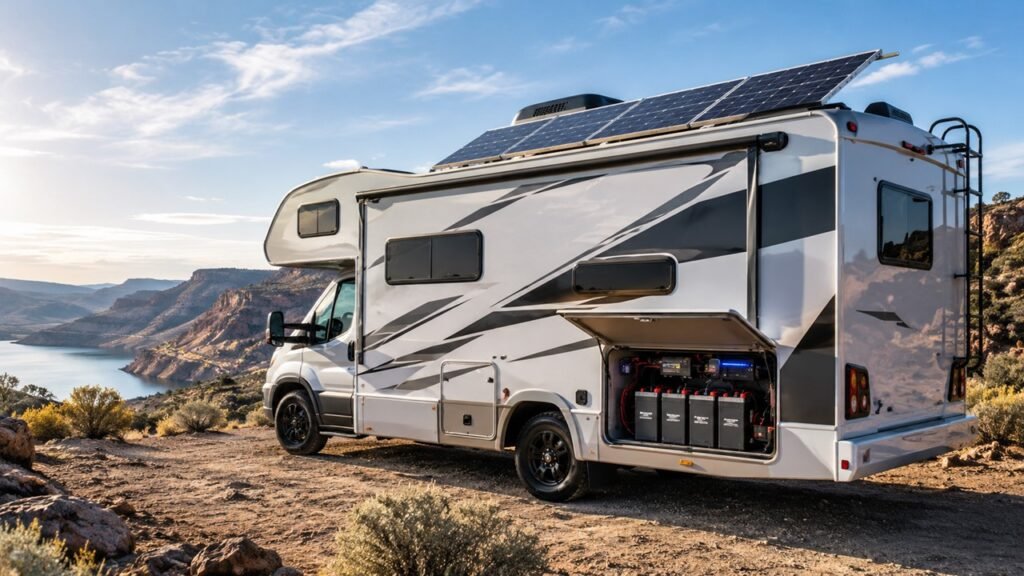
RV owners are switching to lithium batteries because they offer more usable power, faster charging, longer life, and less maintenance than traditional lead-acid or AGM batteries. As more RVers rely on 12V fridges, laptops, Starlink, inverters, and other electronics, older battery setups can start to feel limiting.
That’s where lithium batteries—especially LiFePO4—stand out. They’re lighter, more efficient, and better suited for off-grid camping and modern RV power needs.
In this guide, we’ll look at why so many RV owners are making the switch, the key benefits of lithium batteries, and what to consider before upgrading your RV battery system.
Key Takeaways
- RV owners are switching to lithium batteries because they provide more usable power, faster charging, longer lifespan, and less weight.
- A 100Ah lithium battery can often deliver nearly twice the practical usable energy of a 100Ah lead-acid battery.
- LiFePO4 batteries are the most common lithium option for RV house battery systems because they are stable, durable, and well-suited for deep-cycle use.
- Lithium batteries cost more upfront, but they can offer better long-term value for frequent campers, boondockers, and solar users.
- Before switching, RV owners should check the converter, solar charge controller, alternator charging path, wiring, fuses, and cold-weather charging protection.
What Are Lithium RV Batteries?
Lithium RV batteries are rechargeable deep-cycle batteries used to power an RV’s house electrical system. They store energy for lights, fans, water pumps, refrigerators, inverters, electronics, and other 12V loads.
Most RV lithium batteries use LiFePO4 chemistry. LiFePO4 stands for lithium iron phosphate. This chemistry is popular in RVs because it is stable, long-lasting, and better suited for repeated deep cycling than many older battery types.
A lithium RV battery is not the same as a small phone or laptop battery. A quality RV lithium battery usually includes a battery management system, also called a BMS. The BMS monitors and protects the battery from common problems such as overcharging, over-discharging, high current, short circuits, and unsafe temperatures.
In simple terms, a lithium RV battery stores more usable energy in a lighter package and delivers that energy more consistently than a traditional lead-acid battery.
Why Are RV Owners Switching to Lithium Batteries?
RV owners are not switching to lithium just because it is newer. They are switching because lithium batteries solve real problems that show up during camping, boondocking, and long road trips.
Lead-acid and AGM batteries can work for basic camping. However, they become limiting when you need steady overnight power, faster solar charging, less generator use, lower weight, and more reliable energy for modern RV appliances.
More Usable Battery Capacity
Lithium batteries provide more usable capacity than lead-acid batteries with the same amp-hour rating. This is one of the biggest reasons RV owners upgrade.
A lead-acid or AGM battery is often used more conservatively because deep discharging can shorten its life. Many RV owners treat 50% depth of discharge as the practical limit for lead-acid batteries. That means a 100Ah lead-acid battery may only provide about 50Ah of usable energy in normal deep-cycle use.
A LiFePO4 battery can usually handle deeper discharge. Depending on the battery model and manufacturer guidance, many lithium RV batteries allow 80% to 100% usable capacity.
Here is a simple example:
A 100Ah lead-acid battery may provide about 50Ah of practical usable power. A 100Ah LiFePO4 battery may provide about 80Ah to 100Ah of practical usable power.
That difference matters at night. It can help keep your 12V fridge running, your lights on, your fan moving air, and your devices charged without worrying as much about waking up to a low battery.
Longer Battery Lifespan
Lithium RV batteries usually last much longer than lead-acid batteries. This longer lifespan is another major reason RV owners are making the switch.
Battery lifespan is often measured in cycles. One cycle means the battery is discharged and then recharged. The deeper you discharge many batteries, the fewer total cycles they usually provide.
Typical cycle-life ranges look like this:
- Flooded lead-acid batteries often provide around 300 to 500 cycles.
- AGM batteries often provide around 500 to 1,000 cycles, depending on use and quality.
- LiFePO4 batteries often provide around 2,000 to 5,000+ cycles, depending on depth of discharge, temperature, charging habits, and battery quality.
This does not mean every lithium battery automatically lasts 15 years. Real lifespan depends on how the battery is used, stored, charged, and protected. Still, lithium usually gives RV owners a much longer service life than traditional deep-cycle batteries.
For frequent campers, that matters. Replacing lead-acid batteries every few years can become expensive and frustrating. A quality lithium battery bank can reduce replacement cycles and improve long-term value.
Faster Charging
Lithium batteries charge faster than traditional lead-acid batteries. This is a major advantage for RV owners who depend on solar panels, generators, alternator charging, or limited shore-power time.
Lead-acid batteries charge in stages. The final part of charging can be slow because the battery accepts less current as it gets closer to full. This can make generator charging inefficient because you may run the generator for a long time just to finish the last part of the charge.
Lithium batteries can accept higher charging current for more of the charging cycle. This helps them recover faster after heavy use.
Faster charging helps RV owners in several ways:
- Solar panels can refill the battery bank more effectively during daylight.
- Generator runtime can be shorter.
- Driving time can recharge the house battery bank more efficiently when a proper DC-DC charger is used.
- Campers can recover faster after running a fridge, fans, lights, inverter, or electronics overnight.
For boondockers, faster charging can be the difference between staying off-grid comfortably and needing to move, idle, or run a generator longer than planned.
Lighter Weight
Lithium batteries are much lighter than comparable lead-acid batteries. Many lithium RV batteries weigh around 40% to 60% less than similar lead-acid options.
This weight savings is important because RVs have cargo carrying limits. Every pound used by batteries is a pound you cannot use for water, food, tools, camping gear, bikes, or other travel items.
A lighter battery bank can help:
- Keep the RV closer to its payload rating.
- Reduce strain when installing or moving batteries.
- Free up weight for water, gear, or solar equipment.
- Make small trailers and camper vans easier to manage.
Weight matters even more for smaller rigs. Camper vans, Class B RVs, small travel trailers, and truck campers often have limited payload capacity. For these RV owners, lithium batteries offer a practical way to increase usable power without adding unnecessary weight.
More Consistent Voltage
Lithium batteries hold voltage more steadily as they discharge. This gives RV appliances more consistent power.
Lead-acid batteries gradually lose voltage as their state of charge drops. As voltage falls, some 12V appliances may perform weaker. Lights may dim, fans may slow, and inverters may shut down earlier because of low-voltage cutoff.
LiFePO4 batteries have a flatter voltage curve. They tend to maintain steadier voltage through most of their discharge cycle.
This helps RV owners run:
- 12V refrigerators
- Vent fans
- Water pumps
- LED lights
- Inverters
- Electronics
- Internet equipment
- Small DC appliances
Consistent voltage does not mean unlimited power. The battery still has a capacity limit. However, it does mean the RV power system often feels more stable until the battery is nearly empty.
Less Maintenance
Lithium batteries need less routine maintenance than flooded lead-acid batteries. This is another reason RV owners switch.
Flooded lead-acid batteries may require water checks, terminal cleaning, corrosion control, ventilation awareness, and careful charging. If they are neglected, their lifespan can drop quickly.
Lithium batteries remove many of those maintenance tasks.
With lithium, RV owners usually get:
- No adding distilled water
- No acid spills
- Less corrosion around terminals
- Less voltage babysitting
- No equalization charging
- Built-in BMS protection in most quality batteries
This makes lithium especially attractive for full-time RVers, seasonal travelers, and anyone who wants a simpler electrical system.
Lithium vs AGM vs Lead-Acid RV Batteries
Lithium, AGM, and flooded lead-acid batteries can all power an RV. The best option depends on your budget, camping style, charging system, and power needs.
| Feature | Flooded Lead-Acid | AGM | Lithium LiFePO4 |
| Usable capacity | Around 50% | Around 50% | Often 80% to 100% |
| Cycle life | Lower | Moderate | Much higher |
| Weight | Heavy | Heavy | Much lighter |
| Charging speed | Slow | Moderate | Fast |
| Maintenance | Higher | Low | Very low |
| Voltage stability | Drops as it drains | Drops as it drains | Stays steadier |
| Upfront cost | Lowest | Medium | Highest |
| Long-term value | Lower for heavy use | Moderate | Strong for frequent use |
Lithium is not always the cheapest choice upfront. A flooded lead-acid battery is usually cheaper to buy. AGM batteries also cost less than many lithium batteries and require less maintenance than flooded batteries.
However, lithium usually wins for RV owners who camp off-grid often. The extra usable capacity, faster charging, lighter weight, and longer lifespan can make lithium a better long-term investment.
Who Benefits Most From Switching to Lithium RV Batteries?
Lithium batteries are most useful for RV owners who need dependable off-grid power. They are not only for luxury RVs or expensive solar builds. They can help any camper who regularly uses battery power away from hookups.
RV owners who benefit most include:
- Boondockers who camp without hookups
- Full-time RVers
- RV owners with solar panels
- People running a 12V fridge
- RVers using an inverter for laptops, coffee makers, microwaves, or tools
- Owners who want to reduce generator use
- Travelers with weight-sensitive rigs
- Camper van owners with limited space
- Families using more lights, fans, and device chargers
- Anyone tired of replacing lead-acid batteries every few years
Weekend campers with hookups may not need a large lithium battery bank. If you usually stay at campgrounds with shore power, a smaller lithium setup may be enough. Still, lithium can make sense if you want lighter weight, easier maintenance, and more reliable battery performance between hookups.
When Lithium Batteries May Not Be Worth It
Lithium batteries are useful, but they are not the perfect upgrade for every RV owner. A balanced battery decision should consider cost, travel style, charging equipment, and climate.
Lithium may not be worth it right now if:
- You mostly camp at full-hookup sites.
- You rarely use your RV.
- Your current lead-acid or AGM batteries are still healthy.
- Your budget is tight.
- Your charging system is not lithium-ready.
- You camp in freezing weather without heated batteries or low-temperature protection.
- You do not use many 12V appliances.
- You do not plan to add solar, an inverter, or more off-grid capacity.
In these cases, it may be smarter to wait until your current batteries wear out. You can also plan the upgrade in stages by checking your converter, solar controller, wiring, and battery compartment before buying the battery.
Lithium is most valuable when the RV owner actually uses the battery bank often. If your RV spends most of its time plugged into shore power, the payback may be slower.
What to Check Before Switching to Lithium Batteries
Switching to lithium is not always as simple as dropping in a new battery and driving away. Some RVs can accept a lithium battery with minor changes. Others need charging or wiring upgrades.
This section is important because the battery is only one part of the power system. A good lithium upgrade matches the battery, charger, solar controller, alternator charging path, wiring, fuse protection, and inverter demand.
Converter or Charger Compatibility
Your RV converter charges the house battery when you are connected to shore power or running a generator. Many older RV converters were designed for lead-acid batteries, not lithium.
An older converter may still put energy into a lithium battery, but it may not charge it fully or efficiently. Some converters use charging profiles that are better suited for flooded or AGM batteries. Lithium batteries often need a specific charging voltage and profile.
Before switching, check whether your converter has:
- A lithium charging mode
- Adjustable charging settings
- Proper voltage for your battery brand
- Enough charging current for your battery bank
If your converter does not support lithium, you may need to replace it with a lithium-compatible converter or inverter charger.
Solar Charge Controller Settings
Solar panels work well with lithium batteries, but the solar charge controller needs the right settings.
A lithium-compatible solar controller should have a LiFePO4 setting or custom voltage settings. This helps the solar system charge the battery correctly and avoid unnecessary float behavior.
Before upgrading, check your solar charge controller manual. Look for settings such as bulk voltage, absorption voltage, float voltage, low-voltage disconnect, and temperature compensation.
If your controller only supports lead-acid charging and cannot be adjusted, it may need to be replaced.
Alternator Charging and DC-DC Charger
Many RV owners want their lithium batteries to charge while driving. This can work well, but it needs proper control.
Lithium batteries have low internal resistance. That means they can pull high current from the alternator if connected directly. In some systems, this can stress the alternator, overload wiring, or create unstable charging.
A DC-DC charger helps solve this problem. It controls the charging current, protects the alternator, and gives the lithium battery a proper charging profile.
A DC-DC charger is especially important if:
- You have a large lithium battery bank.
- You drive a motorhome, camper van, or truck camper.
- You rely on alternator charging often.
- Your alternator was not designed for high continuous charging loads.
- You want predictable charging while driving.
Battery Management System
A quality lithium RV battery should include a battery management system. The BMS is one of the most important safety and performance features in a lithium battery.
A good BMS helps protect the battery from:
- Overcharging
- Over-discharging
- Overcurrent
- Short circuits
- High temperature
- Low-temperature charging
- Cell imbalance
Some batteries also include Bluetooth monitoring. This can help you check state of charge, voltage, current, temperature, and battery health from your phone.
Do not choose a lithium battery based only on price. Check the BMS ratings, continuous discharge limit, peak discharge limit, temperature protections, warranty, and support quality.
Cold-Weather Charging Protection
Cold-weather charging is one of the most important lithium battery concerns for RV owners.
Most LiFePO4 batteries should not be charged below freezing unless they have low-temperature charging protection or built-in heating. Charging a cold lithium battery can damage the cells over time.
This does not mean lithium batteries are bad for winter camping. It means you need the right setup.
If you camp in cold weather, look for:
- Low-temperature charge cutoff
- Built-in battery heater
- Insulated battery compartment
- Interior battery installation
- A warming strategy before charging
- Clear manufacturer temperature limits
Discharging lithium batteries in cold weather is usually less of a problem than charging them. Still, always follow the battery manufacturer’s temperature guidelines.
Wiring, Fuses, and Battery Compartment Fit
Lithium batteries can deliver high current. This is useful for inverters and heavy loads, but it also means wiring and protection must be correct.
Before switching, check the basics:
- Check battery dimensions.
- Confirm cable size for inverter and charging current.
- Install proper fuses near the battery.
- Secure the battery against road vibration.
- Make sure the compartment stays dry and protected.
- Confirm that the battery terminals and cables are clean and tight.
- Match inverter demand to the battery’s continuous discharge rating.
A safe lithium upgrade is not just about more capacity. It is about building a system that can handle the current safely.
How Much Lithium Battery Capacity Does an RV Need?
The right lithium battery capacity depends on daily power use, not just RV size. A small camper with a 12V fridge and inverter may need more battery than a large RV that stays plugged into shore power.
A good way to size your battery bank is to list your daily loads. Include your fridge, lights, fans, water pump, device chargers, internet equipment, furnace fan, and inverter appliances. Then estimate how many hours each item runs per day.
Here is a simple starting point:
| RV Use Style | Suggested Lithium Capacity |
| Weekend camping with light 12V use | 100Ah |
| 12V fridge, lights, fans, water pump | 200Ah |
| Boondocking with solar and inverter use | 300Ah to 400Ah |
| Full-time RV living | 400Ah to 600Ah+ |
| Running heavy inverter loads often | 600Ah+ |
These are general estimates. Your actual needs may be higher or lower.
Air conditioners, electric heaters, induction cooktops, microwaves, and coffee makers require much larger systems because they use a lot of power. These appliances also require a properly sized inverter, heavy wiring, and enough battery discharge capacity.
If you are unsure, start with your daily watt-hour use. Battery capacity should match your real loads, your charging sources, and how many days you want to camp without plugging in.
100Ah Lead-Acid vs 100Ah Lithium
Battery ratings can be confusing because two batteries with the same amp-hour rating may not provide the same practical usable power.
A 100Ah lead-acid battery and a 100Ah lithium battery both say 100Ah on the label. But in real RV use, the lithium battery usually gives you more usable energy.
| Battery Type | Rated Capacity | Practical Usable Capacity | Best For |
| 100Ah lead-acid | 100Ah | About 50Ah | Light use, budget setups |
| 100Ah AGM | 100Ah | About 50Ah | Low-maintenance basic use |
| 100Ah LiFePO4 | 100Ah | About 80Ah to 100Ah | Off-grid, solar, deeper cycling |
This is why many RV owners say lithium feels like a bigger upgrade than expected. They are not just buying the same capacity in a lighter case. They are gaining more practical usable power from the same amp-hour rating.
For example, if your old 100Ah lead-acid battery struggled to run your fridge, lights, and fan overnight, a 100Ah LiFePO4 battery may handle the same loads with more reserve capacity.
Are Lithium RV Batteries Safe?
Lithium RV batteries can be safe when they use quality LiFePO4 chemistry, a reliable BMS, correct wiring, proper fusing, and manufacturer-approved charging settings.
LiFePO4 is widely used in RV house battery systems because it is more thermally stable than some other lithium chemistries. It is designed for deep-cycle energy storage and is commonly used in solar, marine, van life, and RV applications.
However, no battery is automatically safe in every situation. Safety depends on system design and installation quality.
A safe lithium RV setup should include:
- A reputable LiFePO4 battery
- Built-in BMS protection
- Correct charger settings
- Proper cable size
- Proper fuse protection
- Secure battery mounting
- Dry and protected installation area
- Temperature protection for cold-weather charging
Avoid cheap batteries with unclear specifications. Always check the continuous discharge rating, warranty terms, temperature limits, and safety features before buying.
How Much Do Lithium RV Batteries Cost?
Lithium RV batteries cost more upfront than flooded lead-acid or AGM batteries. This higher initial cost is the biggest reason some RV owners delay the upgrade.
However, the full cost comparison should include more than the purchase price. Lithium batteries usually provide more usable capacity, longer lifespan, faster charging, lower weight, and less maintenance. For frequent RV users, these benefits can make lithium more cost-effective over time.
Lithium battery cost depends on:
- Battery capacity
- Brand quality
- BMS features
- Bluetooth monitoring
- Heated or non-heated design
- Warranty length
- Continuous discharge rating
- Safety certifications
- Installation upgrades needed
A full lithium conversion may cost more than just the battery. You may also need a lithium-compatible converter, solar charge controller, DC-DC charger, battery monitor, larger cables, or upgraded fuse protection.
This is why RV owners should budget for the full system, not just the battery price.
Common Mistakes RV Owners Make When Switching to Lithium
A lithium upgrade can make RV power easier, but mistakes can reduce performance or create safety problems.
Common mistakes include:
- Buying lithium without checking the RV converter
- Ignoring alternator charging protection
- Installing too little capacity
- Using old or undersized wiring
- Forgetting proper fuses
- Charging in freezing temperatures without protection
- Mixing old lead-acid batteries with new lithium batteries
- Choosing the cheapest battery without checking BMS specs
- Forgetting to check inverter draw
- Assuming all lithium batteries have the same safety features
- Skipping a real power-use estimate before buying
The smartest lithium upgrade starts with your actual camping habits. Think about what you run, how long you run it, how you recharge, and how many off-grid days you want.
Is Switching to Lithium Batteries Worth It for RV Owners?
Switching to lithium batteries is worth it for many RV owners, especially those who camp off-grid, use solar, travel often, run a 12V fridge, use an inverter, or want less battery maintenance.
Lithium gives RV owners more usable power, faster charging, lighter weight, steadier voltage, and longer battery life. These benefits are easy to notice if you boondock often or depend on your battery bank every day.
Lithium may not be urgent if you mostly camp at full-hookup sites or only use your RV a few weekends per year. In that case, your current lead-acid or AGM setup may be good enough until it wears out.
A good time to switch is when your current batteries are weak, when you are adding solar, when you are upgrading your inverter, or when you want more reliable off-grid power.
In simple terms, lithium is most worth it when your RV lifestyle depends on battery power.
Final Thoughts
RV owners are switching to lithium batteries because lithium makes RV power easier, lighter, faster, and more dependable. Compared with traditional lead-acid and AGM batteries, LiFePO4 batteries provide more usable capacity, longer lifespan, faster charging, steadier voltage, and less maintenance.
The smartest lithium upgrade is not simply buying the biggest battery you can afford. It is choosing a battery system that matches your RV, your travel style, your charging sources, and your real power needs.
Before replacing your battery bank, check your converter, solar controller, alternator charging path, wiring, fuses, inverter demand, and battery manufacturer’s installation requirements. A well-planned lithium upgrade can help you camp longer, reduce generator use, and enjoy more comfortable off-grid RV travel.
Related FAQs
Can I replace my RV lead-acid battery with lithium?
Yes, you can replace an RV lead-acid battery with lithium, but you should check your converter, solar controller, alternator charging setup, wiring, and fuse protection first. Some RVs need charger upgrades to properly support lithium batteries.
Do I need a new converter for lithium RV batteries?
You may need a new converter if your current RV converter does not have a lithium charging profile. Older converters may charge lithium batteries, but they often do not charge them fully or efficiently.
How long do lithium RV batteries last?
Many LiFePO4 RV batteries can last 2,000 to 5,000+ cycles depending on battery quality, depth of discharge, temperature, charging habits, and storage conditions. For many RV owners, that can mean 8 to 15 years of use.
Are lithium batteries better than AGM for RVs?
Lithium batteries are usually better than AGM batteries for off-grid RV use because they provide more usable capacity, faster charging, lighter weight, and longer lifespan. AGM batteries cost less upfront, but they are less efficient for heavy battery use.
Can lithium RV batteries be charged with solar panels?
Yes, lithium RV batteries work very well with solar panels when the solar charge controller has a LiFePO4 setting or adjustable charging profile. Correct settings help the battery charge safely and efficiently.
Can I use lithium batteries in cold weather?
Yes, you can use lithium batteries in cold weather, but most LiFePO4 batteries should not be charged below freezing unless they have low-temperature cutoff or built-in heating. Discharging in cold weather is usually less of a problem than charging.
How many lithium batteries do I need for my RV?
Light weekend camping may only need 100Ah, while boondocking or full-time RV living may need 300Ah to 600Ah or more. The right size depends on your daily power use, inverter loads, solar input, and how many days you want to camp without hookups.
Are lithium RV batteries worth the higher price?
Lithium RV batteries are worth the higher price for RV owners who camp off-grid, use solar, run a fridge or inverter, or want longer battery life. They may not be necessary for owners who mostly stay at full-hookup campgrounds.
What is the best lithium battery type for an RV?
LiFePO4 is usually the best lithium battery type for RV house power because it is stable, long-lasting, and designed for deep-cycle use. Look for a strong BMS, clear specs, good warranty, and low-temperature protection if you camp in cold weather.
Can I mix lithium and lead-acid batteries in my RV?
It is generally not recommended to mix lithium and lead-acid batteries in the same battery bank. They have different charging profiles, voltage behavior, and discharge characteristics, which can cause poor performance or system problems.

Daniel Brooks writes about RV living, gear, and travel planning with a focus on everyday usability. His guides break down complex topics into simple advice for real RV owners. He reviews products with long-term use in mind, not marketing hype.