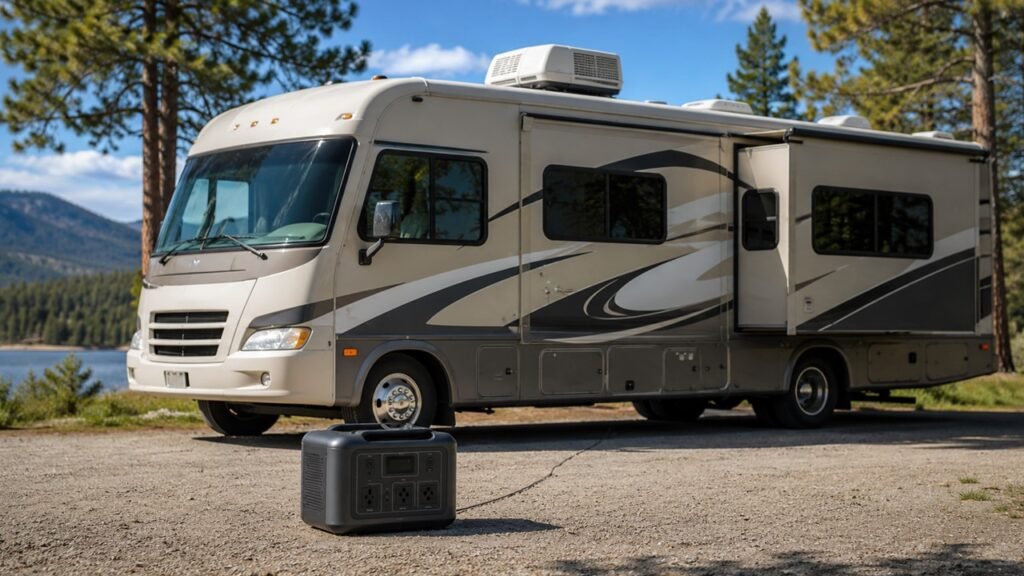
A 3000-watt generator can power most essential RV appliances, including one air conditioner, refrigerator, lights, TV, water pump, and small chargers. It’s a practical choice for many 30-amp RVs, offering a good balance of power and portability.
However, it cannot run everything at once. High-wattage appliances like microwaves, coffee makers, and space heaters must be used carefully to avoid overload.
In general, a 3000-watt generator can run one 13,500 BTU AC along with basic appliances, but larger items should be used one at a time. Understanding running vs. starting watts helps you manage power safely.
Key Takeaways
- Can run one RV air conditioner plus essential appliances
- Best suited for 30-amp RVs
- Cannot handle multiple high-watt appliances at once
- Requires basic load management for safe use
- Knowing starting vs. running watts is important
Quick Answer: What Can a 3000-Watt Generator Run in an RV?
A 3000-watt generator can usually run a 30-amp RV with one air conditioner and several smaller appliances. It is commonly enough for normal camping loads, especially when you avoid running multiple high-draw appliances together.
A 3000-watt generator can usually run:
- One 13,500 BTU RV air conditioner
- Some 15,000 BTU RV air conditioners
- RV refrigerator
- LED lights
- TV
- Roof vent fan
- Water pump
- Phone chargers
- Laptop chargers
- Small kitchen appliances one at a time
- Battery converter or charger, depending on load
A 3000-watt generator usually cannot run:
- Two RV air conditioners at once
- Air conditioner and microwave together
- Air conditioner and electric space heater together
- Microwave, coffee maker, and toaster together
- Full 50-amp RV power
- Washer and dryer units in larger RVs
- Multiple high-wattage appliances at the same time
For most RV owners, the simple rule is this: a 3000-watt generator can run one major appliance plus several small loads. It struggles when two or more major appliances run together.
Understanding 3000 Watts in RV Terms
Before deciding what a 3000-watt generator can run, you need to understand how RV power works. RV appliances use different amounts of electricity, and some appliances need a large surge of power when they start.
This is why two RV owners can use the same size generator and get different results. One setup may run smoothly, while another trips the breaker every time the air conditioner starts.
How Many Amps Is a 3000-Watt Generator?
Most RVs in North America use 120-volt AC power. To convert watts into amps, use this simple formula:
Watts ÷ Volts = Amps
For a 3000-watt generator:
3000 watts ÷ 120 volts = 25 amps
So, a 3000-watt generator provides about 25 amps of power at 120 volts.
A 30-amp RV hookup can provide up to:
30 amps × 120 volts = 3600 watts
That means a 3000-watt generator can run many 30-amp RV loads, but it does not provide the full capacity of a 30-amp shore power connection.
Can a 3000-Watt Generator Run a 30-Amp RV?
Yes, a 3000-watt generator can run a 30-amp RV, but it requires smart power management. A 30-amp RV can theoretically use up to 3600 watts, while a 3000-watt generator gives you about 25 amps.
That does not mean the generator is too small. Most RVs do not use the full 30 amps all the time. Your air conditioner, fridge, lights, TV, and chargers may use far less than 3000 watts once everything is running.
The problem usually happens when high-draw appliances overlap. For example, the air conditioner may already be running, and then someone turns on the microwave. That combination can push the load above the generator’s limit.
3000 Starting Watts vs 3000 Running Watts
This is one of the most important details when choosing a generator. Some generators advertise 3000 watts, but that number may refer to starting watts, not running watts.
Starting watts are the short burst of power available for a few seconds. Running watts are the continuous power the generator can provide.
For example:
- A generator may have 3000 starting watts and 2600 running watts
- Another generator may have 3500 starting watts and 3000 running watts
- A stronger RV generator may offer 3000 continuous watts or more
For RV use, running watts matter more because your appliances need steady power. Starting watts still matter because air conditioners and refrigerators need extra power when their compressors turn on.
If you want to run an RV air conditioner, always check both ratings before buying or using the generator.
RV Appliance Wattage Chart for a 3000-Watt Generator
The exact wattage of each appliance depends on its size, age, brand, and efficiency. However, the table below gives a practical estimate for common RV appliances.
| RV Appliance | Typical Running Watts | Starting/Surge Watts | Can a 3000W Generator Run It? |
| 13,500 BTU RV air conditioner | 1,300–1,800W | 2,500–3,000W+ | Yes, usually |
| 15,000 BTU RV air conditioner | 1,500–2,000W | 3,000–3,500W+ | Usually, but close |
| RV refrigerator | 200–600W | 600–1,200W | Yes |
| Microwave | 900–1,500W | Similar | Yes, one at a time |
| Coffee maker | 600–1,200W | Similar | Yes, one at a time |
| TV | 50–200W | Minimal | Yes |
| LED lights | 10–100W | Minimal | Yes |
| Water pump | 50–150W | 300–600W | Yes |
| Roof vent fan | 20–80W | Minimal | Yes |
| Laptop charger | 45–100W | Minimal | Yes |
| Phone charger | 5–20W | Minimal | Yes |
| Hair dryer | 1,200–1,875W | Similar | Yes, but not with AC |
| Space heater | 750–1,500W | Similar | Yes, but not with AC |
| Toaster | 800–1,500W | Similar | Yes, one at a time |
| Electric skillet | 1,000–1,500W | Similar | Yes, one at a time |
| Converter/charger | 300–1,000W | Varies | Yes, but affects total load |
This chart shows why a 3000-watt generator is useful but limited. Small appliances are easy to run together. Large heating and cooking appliances must be managed carefully.
What Can a 3000-Watt Generator Run at the Same Time in an RV?
A 3000-watt generator can run several RV appliances together when the total load stays under the generator’s running watt capacity. The safest way to understand this is by looking at real-world RV load examples.
Example 1: Normal Summer Camping Load
This is a common setup for warm-weather camping.
- 13,500 BTU RV air conditioner: 1,500W
- RV refrigerator: 300W
- LED lights: 50W
- TV: 100W
- Phone and laptop charging: 100W
- Roof vent fan: 50W
Estimated total: 2,100 watts
This load is usually safe for a 3000-watt generator. It leaves about 900 watts of breathing room, depending on the generator’s real running watt rating.
However, the air conditioner may need a large surge when it starts. For this reason, it is better to start the air conditioner first before adding other appliances.
Example 2: Cooking With the Air Conditioner Off
This setup works better when preparing food inside the RV.
- Microwave: 1,200W
- RV refrigerator: 300W
- LED lights: 50W
- TV: 100W
- Chargers: 100W
Estimated total: 1,750 watts
This is usually fine for a 3000-watt generator. The key difference is that the air conditioner is off while the microwave is running.
After the microwave finishes, you can turn the air conditioner back on. This simple habit helps prevent overloads.
Example 3: Morning Coffee Load
A morning setup may include lights, charging devices, and a coffee maker.
- Coffee maker: 1,000W
- RV refrigerator: 300W
- LED lights: 50W
- Water pump: 100W
- Phone chargers: 50W
- Laptop charger: 100W
Estimated total: 1,600 watts
This is normally safe. However, problems may happen if the air conditioner starts while the coffee maker is running.
If you are close to the generator’s limit, make coffee before turning on the AC.
Example 4: Heavy Load That May Overload the Generator
This setup is too much for most 3000-watt generators.
- 15,000 BTU RV air conditioner: 1,800W
- Microwave: 1,300W
- RV refrigerator: 300W
- Converter/charger: 500W
- Lights and TV: 150W
Estimated total: 4,050 watts
This exceeds the generator’s capacity. The generator may bog down, trip its breaker, flash an overload warning, or shut off.
This example shows why appliance timing matters so much. The generator may run each item separately, but not all together.
Can a 3000-Watt Generator Run an RV Air Conditioner?
Yes, a 3000-watt generator can run many RV air conditioners, especially 13,500 BTU models. It may also run some 15,000 BTU units, but the result depends on the AC’s startup surge and the generator’s actual rating.
The air conditioner is usually the largest power draw in an RV. It also creates the biggest challenge because the compressor needs extra power when it starts.
13,500 BTU RV Air Conditioner
A 3000-watt generator can usually run a 13,500 BTU RV air conditioner. Once the AC is running, it may use around 1,300 to 1,800 watts.
That leaves enough power for smaller appliances, such as lights, TV, fridge, roof fan, and device chargers. This is why many 30-amp RV owners use 3000-watt generators for summer camping.
The main issue is startup surge. If the air conditioner needs close to 3000 watts to start, you should reduce other loads before turning it on.
15,000 BTU RV Air Conditioner
A 3000-watt generator may run a 15,000 BTU RV air conditioner, but it is closer to the limit. Many 15,000 BTU units need 1,500 to 2,000 watts while running and 3,000 watts or more when starting.
This does not mean it will never work. Some efficient AC units start fine on a strong 3000-watt inverter generator. Others may trip the overload protection, especially in hot weather.
A 15,000 BTU air conditioner may struggle more when:
- The generator has only 3000 starting watts
- The AC is older or less efficient
- The outside temperature is very high
- The RV is parked at high altitude
- Other appliances are already running
- The converter is charging low batteries
- The generator has poor maintenance
If you have a 15,000 BTU AC, a soft starter can make the setup more reliable.
Should You Use a Soft Starter?
A soft starter reduces the startup surge of an RV air conditioner. It helps the compressor start more smoothly and lowers the chance of tripping the generator.
A soft starter can help because it:
- Reduces AC startup surge
- Helps smaller generators start RV AC units
- Reduces breaker trips
- Makes compressor startup smoother
- Helps with 15,000 BTU air conditioners
- Helps in hot weather
- Helps at higher elevations
- Reduces stress on the generator
A soft starter is not always required for a 13,500 BTU AC. However, it can be very helpful when using a 3000-watt generator near its limit.
What Appliances Should You Run One at a Time?
Some RV appliances are too power-hungry to combine with other major appliances. A 3000-watt generator can run many of them, but not all at once.
You should usually run these appliances one at a time:
- Microwave: use it when the air conditioner is off
- Coffee maker: avoid using it during AC startup
- Hair dryer: use it with only small background loads
- Toaster: avoid combining it with microwave or coffee maker
- Electric skillet: check wattage before using with AC
- Space heater: do not run it with air conditioning
- Air fryer: often uses 1,200 to 1,800 watts
- Instant Pot: usually manageable, but avoid stacking loads
- Electric water heater: use propane mode when possible
- Battery charger/converter: remember it may quietly use power
These appliances are not a problem by themselves. The issue comes when you stack two or three high-wattage appliances together.
For example, a microwave and coffee maker may each run fine alone. But together, they may use more than 2,000 watts before the air conditioner, fridge, or converter are counted.
What a 3000-Watt Generator Cannot Run in an RV
A 3000-watt generator is powerful enough for many camping needs. Still, it is not designed to run every RV appliance at once.
A 3000-watt generator usually cannot run:
- Two rooftop AC units at the same time
- A full 50-amp RV load
- AC, microwave, and water heater together
- AC and electric space heater together
- Microwave, toaster, and coffee maker together
- Washer and dryer units in larger RVs
- Multiple kitchen appliances at once
- Large battery chargers with air conditioning
- Electric water heater plus several major loads
- Residential-style appliances in large RVs
If your RV has propane appliances, use them to reduce electrical demand. Running the refrigerator or water heater on propane can free up generator power for the air conditioner and outlets.
This is especially useful when boondocking or camping without shore power.
3000-Watt Generator for 30-Amp vs 50-Amp RVs
A 3000-watt generator works best with smaller and mid-size RVs. It is most practical for 30-amp RVs, travel trailers, and Class C motorhomes with one air conditioner.
It can connect to some 50-amp RVs through the correct adapter, but it will not provide full 50-amp power.
| RV Type | Can a 3000W Generator Work? | Best Use Case |
| Small travel trailer | Yes | AC, fridge, lights, small appliances |
| 30-amp RV | Yes | Most essential loads with management |
| Class C RV | Usually | One AC and normal camping loads |
| Fifth wheel | Sometimes | Limited loads only |
| 50-amp RV | Limited | One AC and selected circuits only |
| Large Class A motorhome | Usually not ideal | Emergency or light backup use |
A 50-amp RV can theoretically use much more power than a 3000-watt generator can provide. Many 50-amp RVs also have two air conditioners, large converters, residential refrigerators, and more electric appliances.
So, a 3000-watt generator can be used with a 50-amp RV for limited loads, but it is not a full-power solution.
How to Manage Power With a 3000-Watt RV Generator
A 3000-watt generator works best when you use appliances in the right order. You do not need to make camping uncomfortable. You only need to avoid stacking the biggest loads together.
Start the Air Conditioner First
The air conditioner usually has the highest startup surge in an RV. Start the AC before turning on other major appliances.
Once the AC compressor is running, the power demand drops. Then you can add smaller loads like lights, TV, fridge, and chargers.
If the generator struggles, turn off unnecessary appliances before restarting the AC.
Stagger High-Wattage Appliances
Staggering means using high-wattage appliances at different times. This is the easiest way to avoid overload.
Use these habits:
- Turn off the AC before using the microwave
- Brew coffee before starting the air conditioner
- Avoid using a hair dryer while cooking
- Use propane for water heating when possible
- Run the fridge on propane if available
- Avoid using electric heat with other large loads
- Do not use microwave and toaster together
- Avoid using air fryer and coffee maker together
These small habits make a 3000-watt generator much more useful in real camping situations.
Watch the Converter/Charger Load
Your RV converter changes AC power into DC power to charge the batteries and run 12-volt systems. Many RV owners forget about this hidden load.
If your batteries are low, the converter may draw several hundred watts. In some cases, it may pull close to 1,000 watts, depending on the charger size.
That reduces the power available for the air conditioner, microwave, or other appliances. If your generator keeps overloading, the converter may be part of the reason.
Use Eco Mode Carefully
Many inverter generators have eco mode. Eco mode lowers engine speed when the load is light, saving fuel and reducing noise.
However, eco mode may respond slower to sudden loads. This can matter when the air conditioner compressor starts.
If your AC struggles to start, turn eco mode off before starting the air conditioner. After the AC is running, you may turn eco mode back on if the generator handles it well.
Real-World Factors That Affect Generator Performance
A 3000-watt generator does not always produce the same real-world performance. Weather, elevation, fuel quality, and maintenance can all affect output.
This is why a setup that works perfectly one weekend may struggle on another trip.
Altitude
Generators lose power at higher elevations because engines get less oxygen. As altitude increases, combustion becomes less efficient.
That means a 3000-watt generator may act like a smaller generator in the mountains. If you camp at high elevation, leave extra wattage room and avoid running near the limit.
Hot Weather
Hot weather makes RV air conditioners work harder. The compressor may cycle more often, and startup may become more difficult.
This matters because many RV owners use generators most during summer camping. If the outside temperature is very high, reduce other loads before starting the AC.
Keeping the RV shaded can also reduce air conditioner demand.
Generator Age and Maintenance
A poorly maintained generator may not deliver full power. Even a good generator can struggle if basic maintenance is ignored.
Performance can drop because of:
- Dirty air filter
- Old spark plug
- Bad fuel
- Low oil
- Clogged carburetor
- Weak battery on electric-start models
- Dirty fuel filter
- Poor ventilation
- Overdue maintenance
Regular maintenance helps the generator run smoother and carry loads more reliably.
Extension Cord and Adapter Quality
Poor cords and adapters can cause voltage drop. Voltage drop can make appliances run poorly and may create heat at the connection points.
Use a proper RV-rated cord and the correct adapter for your setup. Avoid light-duty household extension cords for RV generator use.
If a cord or adapter feels hot, stop using it and check the load.
Inverter vs Conventional 3000-Watt Generator for RV Use
Both inverter and conventional generators can power RV appliances. However, inverter generators are usually better for camping because they are quieter, cleaner, and more fuel-efficient.
| Feature | Inverter Generator | Conventional Generator |
| Noise | Quieter | Louder |
| Fuel use | More efficient | Usually higher |
| Power quality | Cleaner power | Less stable |
| Electronics safety | Better for sensitive devices | Less ideal |
| Weight | Often lighter | Often heavier |
| Price | Usually higher | Usually cheaper |
| RV comfort | Better | Acceptable but louder |
An inverter generator is usually the better choice for RV owners who use laptops, phones, TVs, and sensitive electronics. It also produces cleaner power and adjusts engine speed based on demand.
A conventional generator can still work, but it is often louder and less comfortable for campgrounds.
Is a 3000-Watt Generator Enough for Boondocking?
Yes, a 3000-watt generator is enough for many boondocking setups. It can keep your batteries charged, run one AC unit, and power daily appliances when used wisely.
A 3000-watt generator is good for boondocking if you want to run:
- One RV air conditioner
- Refrigerator
- Battery charger
- LED lights
- Water pump
- Roof vent fan
- TV
- Phones and laptops
- Occasional microwave
- Occasional coffee maker
However, it may feel limited if you want to run:
- Two AC units
- Electric water heater
- Washer and dryer
- Multiple cooking appliances
- Large battery chargers
- Space heater and microwave together
- Full 50-amp RV power
For boondocking, propane can make a big difference. Using propane for cooking, heating, refrigeration, and water heating reduces electrical demand.
This allows the generator to focus on air conditioning, charging, and outlet power.
How Long Will a 3000-Watt Generator Run in an RV?
The runtime of a 3000-watt generator depends on fuel tank size, fuel type, load level, weather, and eco mode. A generator running at half load will usually run longer than one running near full capacity.
For example, a light load with lights, fridge, TV, and chargers may use far less fuel. Running an air conditioner for hours will increase fuel use.
Common factors that affect runtime include:
- Fuel tank size
- Gasoline, propane, or dual-fuel operation
- Eco mode use
- Air conditioner load
- Outside temperature
- Generator age
- Maintenance condition
- Altitude
- Total appliance wattage
For the most accurate runtime, check the manufacturer’s runtime rating for your exact model. Generator runtime can vary a lot between brands and fuel types.
Safety Tips for Running a 3000-Watt Generator With an RV
Generator safety is just as important as generator size. A 3000-watt generator can make RV camping more comfortable, but it must be used correctly.
Follow these safety tips:
- Never run a generator inside the RV
- Never run it inside a storage bay
- Keep it away from windows, doors, and vents
- Use a working carbon monoxide detector
- Keep the generator dry
- Use proper RV-rated cords and adapters
- Do not overload the generator
- Let the generator cool before refueling
- Follow the manufacturer’s grounding instructions
- Check oil before long use
- Keep children and pets away from the generator
- Respect campground quiet hours
- Place the generator on a stable surface
- Do not cover it while running
- Keep exhaust pointed away from the RV
Carbon monoxide is dangerous because it cannot be seen or smelled. Always place the generator outside and far from openings where fumes can enter the RV.
Signs You Are Overloading a 3000-Watt Generator
Overloading happens when your RV demands more power than the generator can supply. Most modern generators have overload protection, but you should still know the warning signs.
Signs of overload include:
- Generator bogs down
- Breaker trips
- Overload light turns on
- Air conditioner struggles to start
- Lights flicker
- Microwave runs weakly
- Generator shuts off
- Cords or adapters feel hot
- Appliances sound weak
- Voltage drops
- Generator runs rough under load
If this happens, turn off major appliances and reduce the load. Then restart the generator and add appliances one at a time.
Start with the air conditioner first, then add smaller loads after it is running.
Should You Choose a 3000-Watt or Larger Generator?
A 3000-watt generator is a smart choice for many RV owners. But it is not the right size for every RV or camping style.
Your choice depends on how much power you want and how much load management you accept.
Choose a 3000-Watt Generator If
A 3000-watt generator may be right for you if:
- You have a 30-amp RV
- You run one AC unit
- You can manage appliance timing
- You want a portable generator
- You care about fuel efficiency
- You do not need everything at once
- You mostly camp in small or mid-size RVs
- You use propane for some appliances
- You want a quieter inverter generator
For many travel trailers and Class C RVs, 3000 watts is a practical balance between power, portability, and fuel use.
Choose a Larger Generator If
You may need a larger generator if:
- You have a 50-amp RV
- You have two AC units
- You want to run AC and microwave together
- You use electric heat often
- You have a washer and dryer
- You dislike managing loads
- You camp often in extreme heat
- You have a residential refrigerator
- You use large battery chargers
- You want a home-like RV experience off-grid
A larger generator gives more comfort and flexibility. However, it also costs more, weighs more, and usually uses more fuel.
Final Verdict
A 3000-watt generator can run most essential RV appliances and is often enough for a 30-amp RV. It can usually run one RV air conditioner, refrigerator, LED lights, TV, roof vent fan, water pump, and phone or laptop chargers at the same time.
It can also run appliances like a microwave, coffee maker, toaster, hair dryer, electric skillet, or space heater. However, those high-wattage appliances should usually be used one at a time.
The main limitation is not whether a 3000-watt generator can run RV appliances. The real limitation is whether it can run several large appliances together.
For most 30-amp RV owners, a 3000-watt generator is a strong and practical choice. It is powerful enough for normal camping, especially with smart load management.
But if you have two air conditioners, a 50-amp RV, or want to run everything at once, you should consider a larger generator.
Related FAQs
Will a 3000-watt generator run a 30-amp RV?
Yes, a 3000-watt generator can run many 30-amp RVs. However, it provides about 25 amps at 120 volts, so you still need to manage high-wattage appliances.
Can a 3000-watt generator run a 15,000 BTU RV air conditioner?
A 3000-watt generator can often run a 15,000 BTU RV air conditioner, but startup surge may be close to the limit. A soft starter can make the setup more reliable.
Can I run my RV AC and microwave on a 3000-watt generator?
Usually, you should not run the RV AC and microwave together. This combination can overload a 3000-watt generator, especially when the AC compressor starts.
Can a 3000-watt generator run two RV air conditioners?
No, a 3000-watt generator is usually not enough for two RV air conditioners. Most dual-AC RVs need a larger generator with higher running and surge capacity.
Is a 3000-watt inverter generator good for RV camping?
Yes, a 3000-watt inverter generator is a good RV camping choice. It is usually quieter, more fuel-efficient, and safer for sensitive electronics than a conventional generator.
What size RV is best for a 3000-watt generator?
A 3000-watt generator is best for small to mid-size 30-amp RVs. It works well for travel trailers and Class C motorhomes with one air conditioner.
Can I use a 3000-watt generator with a 50-amp RV?
Yes, but only for limited loads. A 3000-watt generator will not power a full 50-amp RV setup or multiple large appliances at the same time.
What should I turn off before using the microwave?
Turn off the air conditioner, electric water heater, space heater, or other high-wattage appliances before using the microwave. This helps prevent overload.
Is 3000 watts enough for boondocking?
Yes, 3000 watts is enough for many boondocking setups. It works best when you use one major appliance at a time and run some appliances on propane.
What is the biggest mistake with a 3000-watt RV generator?
The biggest mistake is assuming 3000 watts can run everything at once. It can run essentials, but heavy appliances must be managed carefully.

Daniel Brooks writes about RV living, gear, and travel planning with a focus on everyday usability. His guides break down complex topics into simple advice for real RV owners. He reviews products with long-term use in mind, not marketing hype.