
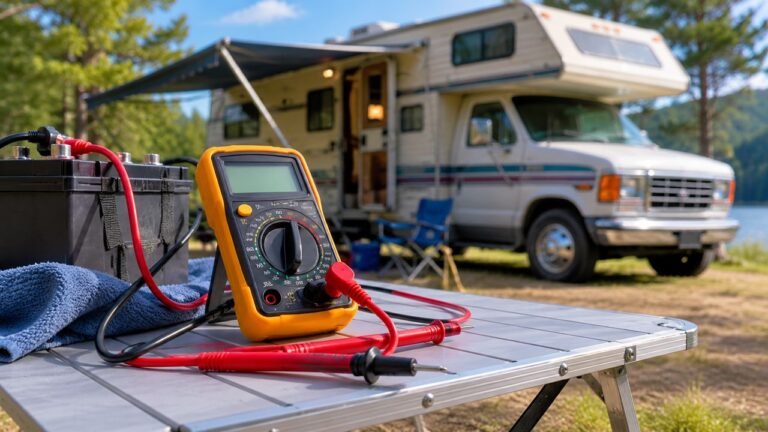
Knowing your RV battery voltage can help you avoid unexpected power problems on the road. In general, a fully charged 12V lead-acid battery should read around 12.6 to 12.8 volts at rest, while a...

Yes, most RV owners benefit from a battery monitor, especially when camping off-grid, using lithium batteries, solar power, or an inverter. A battery monitor acts like a fuel gauge for your RV battery...

An RV battery monitor is a device that tracks your RV battery bank’s charge level, power usage, charging input, and remaining battery capacity. Think of it as a fuel gauge for your RV’s electrical...

To keep RV batteries healthy in winter, store them at the correct charge level, disconnect hidden power drains, and keep them clean and dry. Lead-acid and AGM batteries are typically stored fully...

RV batteries typically take 2 to 12+ hours to charge, depending on the battery type, capacity, depth of discharge, charger output, and power source. Lithium batteries generally charge the fastest...

RV lithium batteries charge differently from lead-acid and AGM batteries. Most use LiFePO4 chemistry, which charges faster, lasts longer, and provides more usable capacity, but requires compatible...

Lithium batteries usually do not damage older RVs directly. The bigger issue is compatibility. Older RVs were often built around flooded lead-acid or AGM batteries, so their converters, alternator...

Yes, lithium batteries are safe in RVs when you use the right type of battery, install it correctly, and charge it with compatible equipment. For RV use, the safest and most common lithium option is...

Yes, you can replace AGM batteries with lithium in an RV, but it is not always a simple drop-in swap. A lithium battery may connect to the same 12V house battery system, but your RV’s charging...