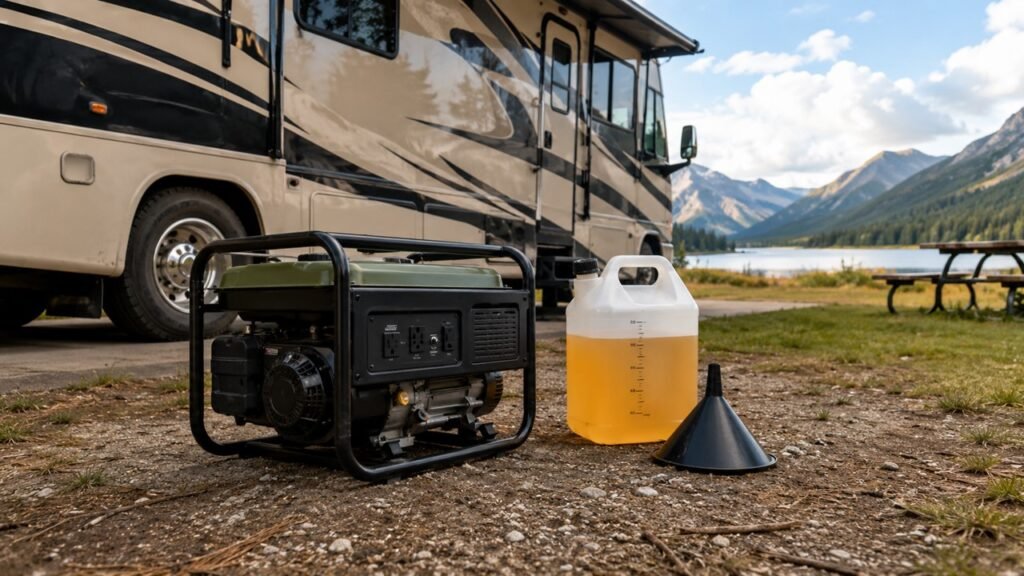
An RV generator typically uses 0.2 to 1.0 gallons of fuel per hour, depending on size, load, and fuel type. Small inverter generators may use as little as 0.1 to 0.3 GPH, while larger built-in units running air conditioners can reach 0.8 to 1.3+ GPH.
For most RV setups, a realistic estimate is 0.3 to 0.7 gallons per hour during normal use. Fuel consumption increases with heavier loads, especially when running air conditioning or multiple appliances.
Key Takeaways
- Most RV generators use 0.2–1.0 gallons per hour
- Typical camping use averages 0.3–0.7 GPH
- Small inverter generators use less fuel than large built-in units
- Running air conditioners significantly increases fuel use
- Fuel type (gas, diesel, propane) affects efficiency and runtime
How Much Fuel Does an RV Generator Use?
RV generator fuel consumption is usually measured in gallons per hour, also called GPH. This number tells you how many gallons of gas, diesel, or propane your generator burns in one hour.
For most RV setups, fuel use increases as electrical load increases. That means your generator burns less fuel when powering lights, fans, and chargers. It burns more fuel when running an air conditioner, microwave, electric water heater, or space heater.
| Generator Size | Common RV Use | Light Load | Half Load | Heavy Load |
| 2,000–3,000 watts | Camper vans, small trailers, battery charging | 0.1–0.25 GPH | 0.2–0.4 GPH | 0.4+ GPH |
| 3,500–4,500 watts | 30-amp RVs, one A/C unit | 0.2–0.4 GPH | 0.4–0.6 GPH | 0.6–0.8 GPH |
| 5,500–7,000 watts | Class C/Class A, one or two A/C units | 0.4–0.6 GPH | 0.6–0.9 GPH | 0.9–1.2 GPH |
| 8,000–12,000 watts | Large Class A motorhomes | 0.5–0.8 GPH | 0.8–1.2 GPH | 1.2+ GPH |
These are practical planning estimates, not exact numbers for every generator. Your owner’s manual may show a more accurate fuel chart for your specific model. Still, this table gives you a reliable starting point for planning fuel, runtime, and boondocking trips.
A small generator may run for several hours on one gallon when lightly loaded. However, a large built-in generator can burn through that same gallon much faster when running an RV air conditioner.
Quick Fuel Use Formula for RV Generators
The easiest way to estimate RV generator runtime is to divide the fuel you have by the generator’s hourly fuel use.
Runtime = Fuel available ÷ Generator fuel use per hour
For example, if your generator burns 0.5 gallons per hour and you have 5 gallons of fuel, your estimated runtime is:
5 ÷ 0.5 = 10 hours
Here are a few simple examples:
- 1 gallon at 0.25 GPH = about 4 hours
- 5 gallons at 0.5 GPH = about 10 hours
- 10 gallons at 0.75 GPH = about 13 hours
- 20 gallons at 1.0 GPH = about 20 hours
You can also calculate how much fuel you need for a planned runtime.
Fuel needed = Hours of runtime × Gallons per hour
For example, if you want to run your RV generator for 8 hours and it uses 0.6 GPH, you need:
8 × 0.6 = 4.8 gallons
This formula is useful, but real-world runtime can be lower. Hot weather, heavy loads, old fuel, dirty filters, and air conditioner cycling can all change fuel use.
RV Generator Fuel Consumption by Fuel Type
RV generators commonly run on gasoline, diesel, or propane. Some portable generators are dual-fuel, meaning they can run on gasoline or propane. Built-in motorhome generators usually use the same fuel as the RV engine or the RV’s propane system.
Each fuel type has advantages. Gasoline is easy to find. Diesel is efficient under heavy load. Propane stores well and burns cleaner. However, they do not produce the same runtime per gallon.
Gasoline RV Generator Fuel Use
Gasoline generators are common in portable inverter generators, Class C motorhomes, and gas-powered Class A RVs. Moreover, gasoline is easy to find at almost any fuel station, which makes it convenient for road trips.
A small gasoline inverter generator can be very fuel-efficient under light load. For example, it may use only 0.1 to 0.3 gallons per hour when charging batteries, running lights, or powering a few small devices.
However, gasoline use increases quickly under heavy load. Running an RV air conditioner, microwave, coffee maker, or battery charger can push a generator into medium or heavy load. At that point, fuel use may rise to 0.5 gallons per hour or more.
The main downside of gasoline is storage life. Gas can go stale over time, especially when stored in a generator tank or fuel can. If your generator sits unused for long periods, use fresh fuel and consider a fuel stabilizer.
Diesel RV Generator Fuel Use
Diesel generators are common in diesel pushers and larger Class A motorhomes. They are often built for long runtime and heavy electrical loads. Diesel engines usually perform well when powering large air conditioners, battery chargers, and residential-style RV appliances.
Diesel generators may use less fuel than gasoline generators under similar heavy-load conditions. That makes diesel a strong option for large RVs that need long generator sessions.
However, diesel generators are usually heavier, louder, and more expensive than smaller gasoline inverter generators. They also need regular maintenance, including oil changes, fuel filter care, and proper exercise under load.
For large motorhomes, diesel can be a practical and efficient choice. For small trailers or camper vans, it is usually more generator than most owners need.
Propane RV Generator Fuel Use
Propane generators are popular with RVers because propane stores well and burns cleaner than gasoline. Moreover, propane is also useful because many RVs already carry it for cooking, heating, and water heating.
The downside is fuel economy. Propane has lower energy density than gasoline or diesel. That means a propane generator often uses more fuel volume to make the same power.
A propane RV generator may use around 0.3 to 1.2 gallons per hour, depending on generator size and load. Under light use, propane can last a long time. Under heavy air conditioner use, a standard 20-pound propane tank can drain faster than many RVers expect.
Propane is best when you want clean storage, backup flexibility, or occasional generator use. For long air conditioner runtime, gasoline or diesel usually provides better runtime per gallon.
| Fuel Type | Best For | Fuel Efficiency | Storage | Main Drawback |
| Gasoline | Portable generators, small to mid-size RVs | Good | Shorter storage life | Goes stale faster |
| Diesel | Large motorhomes, long runtimes | Very good under load | Better than gas | Higher generator cost |
| Propane | Cleaner use, backup power, long storage | Lower per gallon | Excellent | Uses more fuel volume |
The right fuel type depends on your RV, camping style, and power demand. Weekend campers may prefer propane or gasoline. Full-time RVers with large motorhomes may benefit more from diesel.
How Long Will an RV Generator Run on One Gallon of Fuel?
One gallon of fuel can last anywhere from 1 hour to 10+ hours in an RV generator. The exact runtime depends on generator size and load.
A 2,000-watt inverter generator may run many hours on one gallon when powering small loads. A 5,500-watt built-in RV generator running an air conditioner may use one gallon much faster.
| Generator Type | Light Load Runtime | Half Load Runtime | Heavy Load Runtime |
| 2,000-watt inverter | 6–10 hours | 3–5 hours | 2–3 hours |
| 3,500–4,500-watt inverter | 3–5 hours | 2–3 hours | 1.5–2 hours |
| 5,500-watt built-in RV generator | 2–3 hours | 1.5–2 hours | 1 hour or less |
| 8,000-watt diesel generator | 1.5–2.5 hours | 1–1.5 hours | Around 1 hour |
Manufacturer runtime ratings can be helpful, but read them carefully. Many ratings are based on 25% load or 50% load, not full RV use. If your RV generator is running an air conditioner, the real runtime may be shorter than the advertised number.
How Much Fuel Does an RV Generator Use Overnight?
Overnight fuel use depends mostly on whether you are running an RV air conditioner. If you only need lights, fans, a fridge control board, and battery charging, fuel use can stay low. If you need air conditioning all night, fuel use increases a lot.
A typical overnight period is about 8 hours. At 0.25 GPH, your generator would use around 2 gallons overnight. At 0.75 GPH, it would use around 6 gallons overnight.
Overnight Use Without Air Conditioning
If you are not running the air conditioner, your generator may only need to support small loads. These can include LED lights, phone chargers, a laptop, a fan, a TV, and battery charging.
In this case, many small inverter generators can run efficiently. Fuel use may stay around 0.1 to 0.3 gallons per hour, depending on the generator and battery charging demand.
However, many RVers do not need to run a generator all night for light loads. A good battery bank can power small overnight loads quietly. Then the generator can run during the day to recharge the batteries.
Overnight Use With One RV Air Conditioner
Running one RV air conditioner changes the fuel estimate. A 13,500 or 15,000 BTU rooftop A/C can place a steady load on the generator. In hot weather, the compressor may cycle often or run for long periods.
Typical fuel use with one A/C may look like this:
- Small inverter generator with soft start: often 0.3–0.6 GPH
- 4,000-watt generator with one A/C: often 0.4–0.7 GPH
- 5,500-watt built-in generator: often 0.5–0.9 GPH
For an 8-hour night, that can mean roughly 3 to 7 gallons of fuel, depending on weather and load.
A cooler night may use less fuel because the A/C cycles off more often. A hot, humid night may use more fuel because the A/C runs longer.
Overnight Use With Two Air Conditioners
Two RV air conditioners can push fuel use close to or above 1 gallon per hour. This is common in larger Class A motorhomes, large fifth wheels, and RVs with 50-amp electrical systems.
If your generator uses 1.0 GPH, an 8-hour night could require about 8 gallons of fuel. If it uses 1.2 GPH, that same night could require almost 10 gallons.
This is why large RV owners often combine generator use with shade, insulation, window covers, fans, and careful thermostat settings.
What Affects RV Generator Fuel Consumption?
RV generator fuel use is not fixed. The same generator may use very little fuel one day and much more the next day. The biggest difference is usually electrical load.
Generator Load
Generator load means how much electricity your RV is using. A generator at light load uses less fuel. A generator near maximum output uses more fuel.
Common high-draw RV appliances include:
- RV air conditioner
- Microwave
- Electric water heater
- Coffee maker
- Hair dryer
- Space heater
- Toaster
- Electric skillet
- Converter/charger charging low batteries
The RV air conditioner is usually the largest regular load. However, an electric water heater, microwave, or space heater can also increase fuel use quickly.
Generator Size
Larger generators usually burn more fuel than smaller ones. A 7,000-watt generator may use more fuel than a 2,000-watt inverter generator, even when both are powering small loads.
However, choosing a generator that is too small can also be inefficient. If a generator constantly runs near maximum load, it may burn more fuel, run hotter, and wear faster.
The best setup is a generator that matches your real RV power needs. It should handle your largest planned loads without being much bigger than necessary.
Fuel Type
Fuel type affects runtime because gasoline, diesel, and propane have different energy density. Diesel is often efficient under heavy loads. Gasoline is convenient and powerful. Propane stores well but usually gives shorter runtime per gallon.
If you are comparing generator fuel use, do not only compare gallons. Also consider local fuel prices, storage, refill access, and how often you run the generator.
Air Conditioner Use
Air conditioning is one of the biggest reasons RV generator fuel use increases. A rooftop RV air conditioner needs a large startup surge and steady running wattage.
Outside temperature also matters. On a mild day, the A/C may cycle off often. On a hot day, it may run almost nonstop. Poor insulation, direct sun, and open windows can make the generator burn more fuel because the A/C works harder.
Eco Mode or Variable Speed
Many inverter generators have eco mode or variable engine speed. This allows the engine to slow down when power demand is low.
Eco mode can save fuel when running lights, chargers, fans, or small appliances. It can also reduce noise. However, when running heavy loads like air conditioners, the generator may need higher RPM, so fuel savings become smaller.
Altitude and Temperature
Generators can lose power at high elevations and in very hot weather. Thin air at altitude can reduce engine performance. High heat can make the generator and air conditioner work harder.
When the generator works harder to provide the same power, fuel efficiency may drop. Some generators also need carburetor jet changes or high-altitude settings for best performance.
Maintenance Condition
A poorly maintained generator can use more fuel and produce less power. It may also run rough, shut down, or struggle to start.
Common problems that increase fuel use include:
- Dirty air filter
- Old spark plug
- Low oil
- Bad fuel
- Carburetor issues
- Overloaded generator
- Poor ventilation
- Blocked cooling areas
Regular maintenance helps your generator burn fuel more efficiently. It also reduces the chance of failure during hot weather or off-grid camping.
How Much Fuel Does a Built-In Onan RV Generator Use?
Built-in RV generators, including common Onan-style units, are popular in Class C and Class A motorhomes. They are convenient because they are wired into the RV and often start from inside the coach.
Many built-in generators pull fuel from the RV’s main fuel tank. This makes them easy to use while parked or driving. However, they are often less fuel-efficient than small portable inverter generators when running light loads.
| Built-In Generator Size | Typical RV Type | Estimated Fuel Use |
| 2,800 watts | Class B / small Class C | 0.2–0.4 GPH |
| 4,000 watts | 30-amp Class C | 0.3–0.7 GPH |
| 5,500 watts | Larger Class C / Class A | 0.5–1.0 GPH |
| 7,000+ watts | Large Class A | 0.7–1.3+ GPH |
A 4,000-watt built-in RV generator may use around 0.3 to 0.7 gallons per hour. A 5,500-watt generator may use 0.5 to 1.0 gallons per hour, especially when running air conditioning.
Always check your generator owner’s manual for model-specific fuel consumption. Some manuals show fuel use at no load, half load, and full load. That chart gives the most accurate estimate for your generator.
How Much Propane Does an RV Generator Use?
Propane generator fuel use can be confusing because propane tanks are often listed in pounds, while generator fuel use is often estimated in gallons per hour.
A standard 20-pound propane tank holds about 4.6 to 4.7 gallons of propane when full. A 30-pound tank holds about 7 gallons. A 40-pound tank holds about 9.4 gallons.
| Propane Tank Size | Approx. Propane Available | Light Load | Medium Load | Heavy Load |
| 20 lb tank | 4.6–4.7 gallons | 10–18 hours | 6–10 hours | 3–6 hours |
| 30 lb tank | 7 gallons | 15–27 hours | 9–15 hours | 5–9 hours |
| 40 lb tank | 9.4 gallons | 20–36 hours | 12–20 hours | 6–12 hours |
| 100 lb tank | 23–25 gallons | 50–90 hours | 30–55 hours | 15–30 hours |
These estimates depend heavily on generator size and load. A small propane inverter generator running light loads may last a long time. A larger propane generator running an RV air conditioner may drain a tank much faster.
Also remember that your RV may use propane for other appliances. If your furnace, water heater, refrigerator, or stove also uses propane, your generator is not the only thing using the tank.
How Much Diesel Does an RV Generator Use?
Diesel RV generators are common in larger motorhomes, especially diesel pushers. They are often designed for longer runtimes and heavier electrical loads.
A diesel generator may be efficient when running air conditioners and battery chargers for long periods. However, larger diesel generators still use a noticeable amount of fuel when heavily loaded.
| Diesel Generator Size | Light Load | Half Load | Heavy Load |
| 5,000–6,000 watts | 0.3–0.5 GPH | 0.5–0.7 GPH | 0.8–1.0 GPH |
| 7,500–8,000 watts | 0.4–0.7 GPH | 0.7–1.0 GPH | 1.0–1.3 GPH |
| 10,000–12,000 watts | 0.6–0.9 GPH | 1.0–1.4 GPH | 1.5+ GPH |
Diesel can be efficient under load, but it is not always cheaper. Diesel prices vary by location. Maintenance can also cost more than basic gasoline generator maintenance.
For a large RV, diesel is often the most practical built-in generator option. For a small trailer, a compact gasoline or dual-fuel inverter generator usually makes more sense.
Does Running the RV Air Conditioner Use More Generator Fuel?
Yes, running an RV air conditioner uses more generator fuel. The air conditioner is usually the largest regular electrical load in an RV.
A generator running only lights, fans, and chargers may stay at light load. Once the air conditioner starts, the generator has to handle both the startup surge and the running wattage.
One RV Air Conditioner
One RV air conditioner commonly uses around 1,200 to 1,800 running watts, depending on size, age, and conditions. A 13,500 BTU unit often uses less than a 15,000 BTU unit, but both can be heavy loads for small generators.
When one A/C is running, a 3,500 to 4,500-watt generator may use around 0.4 to 0.7 gallons per hour. The exact number depends on temperature, thermostat setting, and what else is running inside the RV.
Two RV Air Conditioners
Two RV air conditioners need much more power. Many RVs require a 5,500-watt or larger generator to run two rooftop units reliably.
With two A/C units running, fuel use can reach 0.8 to 1.3+ gallons per hour. If the microwave, water heater, or battery charger is also running, the generator may work even harder.
This is why 50-amp RV owners should plan fuel more carefully during summer camping.
Soft Start and Fuel Use
A soft start device reduces the startup surge of an RV air conditioner. This can help a smaller generator start the A/C more smoothly.
However, a soft start does not magically remove the running wattage of the air conditioner. Once the A/C is running, it still needs steady power. So, a soft start may improve starting and reduce overload problems, but it may not dramatically reduce hourly fuel use.
The main benefit is that it can allow a smaller inverter generator to run an A/C without tripping or struggling during compressor startup.
RV Generator Runtime by Fuel Tank Size
Many RVers want to know how long a generator will run on 1 gallon, 5 gallons, or 10 gallons of fuel. The answer depends on gallons per hour.
Use this table as a quick planning guide.
| Fuel Amount | At 0.25 GPH | At 0.5 GPH | At 0.75 GPH | At 1.0 GPH |
| 1 gallon | 4 hours | 2 hours | 1.3 hours | 1 hour |
| 2 gallons | 8 hours | 4 hours | 2.6 hours | 2 hours |
| 5 gallons | 20 hours | 10 hours | 6.6 hours | 5 hours |
| 10 gallons | 40 hours | 20 hours | 13.3 hours | 10 hours |
| 20 gallons | 80 hours | 40 hours | 26.6 hours | 20 hours |
If your generator uses 0.5 GPH, five gallons should last about 10 hours. If your generator uses 1.0 GPH, five gallons only lasts about 5 hours.
This table works well for gasoline and diesel estimates. For propane, remember that tanks are often listed in pounds, so you may need to convert tank size into gallons first.
The 1/4 Tank Rule for Built-In RV Generators
Many built-in RV generators pull fuel from the motorhome’s main fuel tank. However, the generator usually cannot use every gallon in that tank.
Many motorhomes are designed so the generator fuel pickup stops drawing fuel when the main tank drops near one-quarter full. This is often called the 1/4 tank rule.
The purpose is simple. It prevents the generator from using all the fuel and leaving your motorhome stranded at a campsite.
For example, if your motorhome has an 80-gallon fuel tank, the generator may only access about 60 gallons before the fuel pickup stops feeding it. The exact amount depends on the RV design.
This rule matters when planning long generator sessions. Your dashboard may show fuel in the tank, but the generator may shut off if the fuel level is too low.
How to Reduce RV Generator Fuel Use
Small habits can save a surprising amount of fuel during a camping trip. The goal is to reduce high-wattage loads and help the generator run efficiently.
Here are practical ways to lower RV generator fuel consumption:
- Use eco mode when running light loads
- Turn off the electric water heater when using the A/C
- Avoid using the microwave and A/C at the same time
- Charge batteries during the day instead of overnight
- Use propane mode for the RV refrigerator when possible
- Keep the air filter clean
- Change oil on schedule
- Use LED lights
- Park in shade to reduce A/C runtime
- Use reflective window covers in hot weather
- Improve RV insulation where possible
- Use roof vent fans before turning on the air conditioner
- Install a soft start if your A/C struggles to start
- Do not oversize the generator more than necessary
- Avoid electric space heaters on generator power
- Run heavy appliances one at a time
The biggest fuel-saving move is reducing air conditioner runtime. Shade, fans, window covers, and better insulation can all help your generator burn less fuel.
Portable vs Built-In RV Generator Fuel Use
Portable and built-in RV generators both have advantages. Inverter generators are often more fuel-efficient at light loads. Built-in generators are more convenient and are already connected to the RV electrical system.
| Generator Type | Fuel Use | Convenience | Best For |
| Portable inverter generator | Usually lower at light loads | Must refuel and set up outside | Small RVs, trailers, fuel savings |
| Built-in RV generator | Usually higher, especially older models | Starts from inside the RV | Class C/Class A motorhomes |
| Dual-fuel portable generator | Flexible fuel options | Requires gas or propane setup | Boondocking flexibility |
| Diesel built-in generator | Efficient under heavy loads | Built into diesel motorhomes | Large RVs and long runtimes |
A portable inverter generator is often a good choice for travel trailers, camper vans, and small RVs. It can run quietly and save fuel during light use.
A built-in generator is better for convenience. You can often start it from inside the RV, and it may be connected to the RV’s main fuel supply. This is useful for motorhomes and larger rigs.
The best option depends on your RV type, camping style, and power needs.
How Much Does It Cost to Run an RV Generator?
To estimate generator running cost, multiply fuel use by the local fuel price.
Hourly cost = Fuel use per hour × Fuel price per gallon
For example, if your generator burns 0.5 GPH and gas costs $4 per gallon, your generator costs:
0.5 × $4 = $2 per hour
| Fuel Use | $3/Gallon | $4/Gallon | $5/Gallon |
| 0.25 GPH | $0.75/hr | $1.00/hr | $1.25/hr |
| 0.5 GPH | $1.50/hr | $2.00/hr | $2.50/hr |
| 0.75 GPH | $2.25/hr | $3.00/hr | $3.75/hr |
| 1.0 GPH | $3.00/hr | $4.00/hr | $5.00/hr |
If you run a generator for 8 hours at $2 per hour, the total fuel cost is about $16. If you run it for 8 hours at $4 per hour, the cost becomes about $32.
Propane and diesel prices vary by location. So, always use your local fuel cost for a realistic estimate.
Can You Run an RV Generator All Night?
Yes, you can run many RV generators all night if they have enough fuel, proper oil level, safe ventilation, and no mechanical issues. Built-in RV generators are commonly used overnight for air conditioning in hot weather.
However, you should think about safety, campground rules, and carbon monoxide risk before running a generator overnight.
Follow these safety tips:
- Never run a portable generator inside the RV
- Never run a portable generator under the RV
- Keep exhaust pointed away from windows and doors
- Use working carbon monoxide detectors
- Follow campground generator quiet hours
- Check oil level before long runtime
- Keep the generator away from dry grass
- Do not place the generator near flammable items
- Do not refuel a hot generator
- Keep the generator dry and well-ventilated
Carbon monoxide is the biggest safety concern. It is invisible and dangerous. Always keep detectors working inside your RV.
Also remember that many campgrounds limit generator hours. Even if your generator can run all night, the campground may not allow it.
RV Generator Fuel Use Examples
Real examples make fuel planning easier. These estimates show how different RV setups may use fuel in normal camping conditions.
Example 1: Small Travel Trailer Without A/C
A small travel trailer may use a 2,000-watt inverter generator for lights, fans, battery charging, a TV, and phone chargers.
In this setup, fuel use may stay around 0.1 to 0.3 gallons per hour. If the generator has a 1-gallon tank, it may run for several hours under light load.
This setup is best for mild weather camping, short trips, and battery charging. It is not ideal for running a large RV air conditioner without the right generator and soft start setup.
Example 2: 30-Amp Class C With One A/C
A 30-amp Class C motorhome may have a 4,000-watt built-in generator. This generator may run one rooftop air conditioner, the converter/charger, lights, TV, and small appliances.
Fuel use may range from 0.4 to 0.8 gallons per hour, depending on temperature and appliance use.
If the A/C runs most of the time, fuel use will be closer to the higher end. If the A/C cycles on and off, fuel use may stay lower.
Example 3: Large Class A With Two A/C Units
A large Class A motorhome may use a 5,500 to 8,000-watt generator. It may power two air conditioners, a battery charger, refrigerator controls, entertainment devices, and other household-style loads.
Fuel use may range from 0.8 to 1.3+ gallons per hour. In very hot weather, with both A/C units running often, fuel use can be high.
This kind of RV needs more careful fuel planning. A long overnight run may require several gallons of fuel.
RV Generator Fuel Use Calculator
You can estimate your RV generator fuel use with a simple step-by-step method.
- Find your generator’s fuel use per hour
- Estimate your average electrical load
- Check how much fuel you have available
- Divide fuel available by hourly fuel use
- Reduce the estimate by 10–20% for real-world conditions
Here is the basic runtime formula again:
Runtime = Fuel available ÷ Gallons per hour
Here is the fuel-needed formula:
Fuel needed = Hours of runtime × Gallons per hour
Example:
You want to run your RV generator for 8 hours. Your generator uses about 0.6 GPH.
8 × 0.6 = 4.8 gallons
So, you should plan for at least 5 gallons of fuel. It is smart to carry extra fuel or reduce the estimate slightly for real-world conditions.
Common Mistakes That Increase Generator Fuel Use
Some RV owners burn more generator fuel than necessary because of simple power mistakes. These mistakes are easy to fix once you know what causes the problem.
Common mistakes include:
- Running the A/C with windows open
- Running electric heat from the generator
- Leaving the water heater on electric mode
- Charging deeply depleted batteries during heavy appliance use
- Ignoring dirty filters and old spark plugs
- Running a large generator for tiny loads
- Not using eco mode
- Buying more generator than the RV actually needs
- Running the generator during the hottest part of the day
- Using the microwave while the A/C is already working hard
- Letting old fuel sit in the generator
- Blocking generator ventilation
- Ignoring oil change intervals
- Running too many appliances at once
The biggest mistake is treating generator power like unlimited shore power. A generator can power many RV appliances, but fuel use rises when you run high-draw appliances together.
Generator Fuel Use vs Solar and Batteries
A generator is useful because it can produce strong power anytime you have fuel. It is especially helpful for air conditioning, microwaves, and fast battery charging.
However, generators have downsides. They use fuel, make noise, need maintenance, and may be restricted by campground rules.
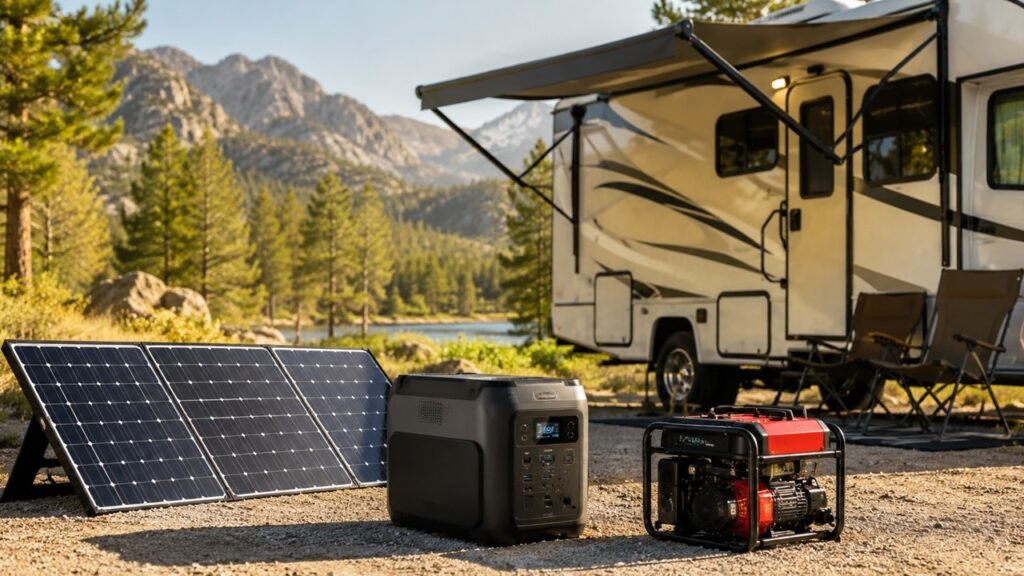
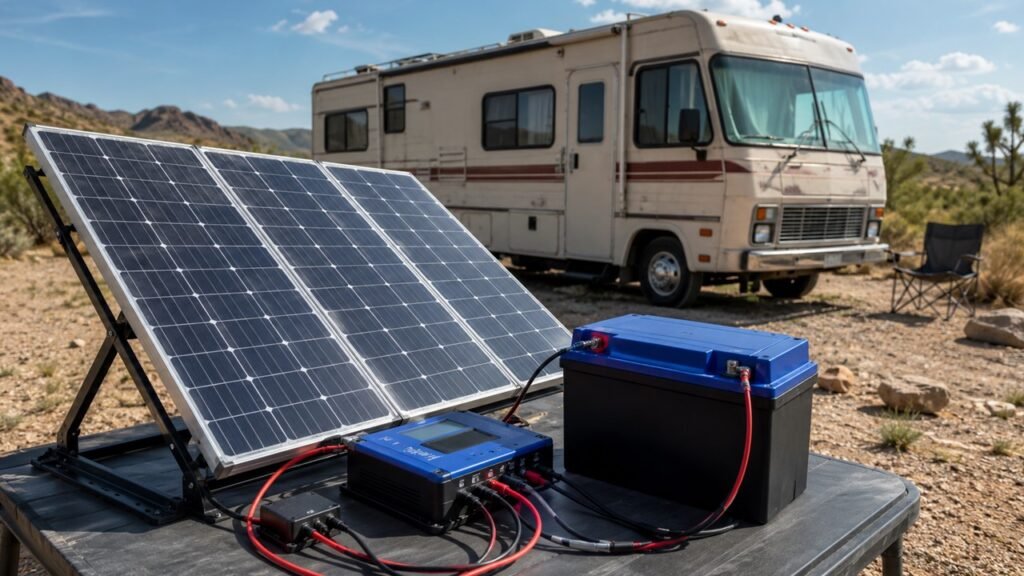
Solar panels and batteries are better for quiet daily loads. They can run lights, fans, laptops, phones, water pumps, and small appliances without fuel. But they may not handle air conditioning unless you have a large solar and lithium battery system.
| Power Source | Best For | Fuel Use | Limitation |
| RV generator | A/C, microwave, fast charging | Yes | Noise, fuel cost, maintenance |
| Solar panels | Daytime charging | No | Weather dependent |
| Lithium batteries | Overnight quiet power | No | Limited capacity |
| Power station | Small appliances, backup use | No direct fuel | Limited output/runtime |
Many boondockers use a mixed setup. Solar handles small daily loads. Batteries provide quiet overnight power. The generator runs when batteries are low, weather is cloudy, or air conditioning is needed.
This approach can reduce fuel use while keeping the RV comfortable.
Safety and Maintenance Tips for Lower Fuel Use
A well-maintained generator usually runs smoother and uses fuel more efficiently. It is also safer and more reliable during long camping trips.
Check Oil Before Long Runs
Always check the oil before running your RV generator for several hours. Low oil can damage the engine and may trigger an automatic shutdown.
Some generators have low-oil protection, but you should not rely on that alone. Make oil checks part of your regular camping routine.
Clean or Replace the Air Filter
A dirty air filter restricts airflow. When the engine cannot breathe properly, it may run rough and use more fuel.
Check the air filter often if you camp in dusty areas. Clean or replace it based on your generator manual.
Use Fresh Fuel
Old gasoline can cause hard starts, rough running, and poor combustion. If fuel sits too long, it can create gum and varnish inside the fuel system.
Use fresh fuel whenever possible. If the generator will sit unused, follow the storage instructions in the owner’s manual.
Exercise the Generator Monthly
Built-in RV generators should be exercised regularly. Running the generator under load helps keep the engine, fuel system, and electrical components in better condition.
A common practice is to run the generator monthly with a moderate load. Check your generator manual for the correct exercise schedule.
Final Verdict
Most RV generators use 0.2 to 1.0 gallons of fuel per hour. Small inverter generators may use only 0.1 to 0.3 GPH under light load. Mid-size RV generators often use 0.3 to 0.7 GPH. Large built-in generators can use 0.8 to 1.3+ GPH when running multiple air conditioners.
For normal RV camping, a safe estimate is 0.3 to 0.7 gallons per hour. If you are running one air conditioner, plan closer to the middle or higher end. If you are running two air conditioners, plan for much higher fuel use.
The best way to estimate runtime is simple:
Runtime = Fuel available ÷ Gallons per hour
If you know your generator size, fuel type, and average load, you can plan fuel much more accurately. For the most accurate number, check your generator owner’s manual and look for the fuel consumption chart at different load levels.
Related FAQs
How much gas does an RV generator use per hour?
Most gas RV generators use around 0.2 to 1.0 gallons per hour. Small inverter generators use less, while large built-in generators running air conditioners use more.
How long will 5 gallons of gas last in an RV generator?
Five gallons may last 5 to 20 hours, depending on generator size and load. At 0.5 GPH, 5 gallons gives about 10 hours of runtime.
How much propane does an RV generator use?
A propane RV generator may use about 0.3 to 1.2 gallons per hour, depending on size and load. Propane burns cleaner but usually provides shorter runtime than gasoline.
Does an RV generator use more fuel when running the air conditioner?
Yes. The RV air conditioner is one of the biggest generator loads. Running one or two A/C units can increase fuel use quickly, especially in hot weather.
Is it cheaper to run an RV generator on gas or propane?
Gasoline usually gives longer runtime per gallon, but propane stores longer and burns cleaner. The cheaper option depends on local fuel prices and your generator’s efficiency.
Can I run my RV generator all night?
Yes, if it has enough fuel, oil, and safe ventilation. Always use carbon monoxide detectors and follow campground quiet-hour rules.
Why does my RV generator shut off when the fuel tank is low?
Many built-in RV generators stop drawing fuel when the main RV tank reaches about one-quarter full. This helps prevent the RV from being stranded without driving fuel.
Do inverter generators use less fuel?
Usually, yes. Inverter generators can adjust engine speed based on load, especially in eco mode. This helps save fuel when powering light loads.
How much fuel does a 4,000-watt RV generator use?
A 4,000-watt RV generator commonly uses about 0.3 to 0.7 gallons per hour. Fuel use increases when running the air conditioner, microwave, or battery charger.
How can I make my RV generator use less fuel?
Use eco mode, reduce A/C runtime, avoid running multiple high-wattage appliances together, keep filters clean, and maintain the generator on schedule.

Daniel Brooks writes about RV living, gear, and travel planning with a focus on everyday usability. His guides break down complex topics into simple advice for real RV owners. He reviews products with long-term use in mind, not marketing hype.