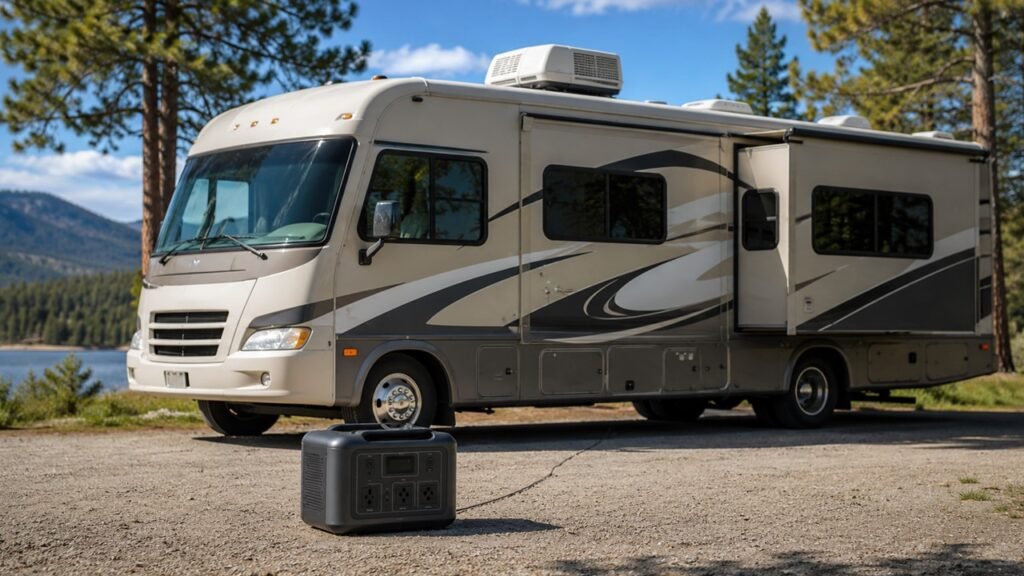
Knowing your RV battery voltage can help you avoid unexpected power problems on the road. In general, a fully charged 12V lead-acid battery should read around 12.6 to 12.8 volts at rest, while a lithium battery typically sits around 13.2 to 13.4 volts.
But voltage readings can vary depending on whether the battery is charging, under load, or affected by temperature and age. In this guide, I’ll walk you through the voltage ranges that matter, how to read them correctly, and what they tell you about your RV battery’s health.
What Is a Good RV Battery Voltage?
If you’re trying to figure out whether your RV battery is healthy or needs charging, voltage is one of the quickest indicators to check. The exact number depends on the battery type, but knowing a few key voltage ranges can help you avoid unexpected power problems on the road.
A good resting voltage for a healthy 12V lead-acid RV battery is usually 12.6 to 12.8 volts when fully charged. Around 12.4 to 12.5 volts is still a good charge level. Around 12.2 volts means the battery is near 50% charged and should be recharged soon.
For lithium RV batteries, the voltage range is different. A 12V LiFePO4 battery often sits around 13.2 to 13.4 volts at rest. However, lithium voltage stays flatter, so voltage alone is not always the best way to measure charge level.
Key voltage ranges:
- 12.6–12.8V = fully charged lead-acid battery
- 12.4–12.5V = good charge level
- 12.2–12.3V = about 50% charged
- 12.0V or lower = recharge recommended
- 13.2–13.8V = normal float or maintenance charging range
- 13.2–13.4V = common resting range for lithium RV batteries
RV Battery Voltage Chart by State of Charge
Before you compare your battery reading, it’s important to know that these numbers apply to a battery that has been resting. If the battery is charging or powering appliances, the voltage can look different.
Use this chart for a standard 12V lead-acid RV battery. These numbers are based on resting voltage, not charging voltage or voltage under load.
| Resting Voltage | Approx. State of Charge | Battery Status |
| 12.7V–12.8V | 100% | Fully charged |
| 12.5V–12.6V | 90% | Very good |
| 12.4V | 75% | Good |
| 12.2V–12.3V | 50% | Recharge soon |
| 12.0V–12.1V | 40% | Low |
| 11.9V | 20% | Very low |
| 11.8V or lower | Near empty | Recharge immediately |
| 10.5V | 0% | Fully discharged |
These figures can vary slightly based on battery age, temperature, chemistry, and manufacturer recommendations. For the most accurate reading, test the battery after it has rested without chargers or heavy loads.
Good RV Battery Voltage While Charging
When your RV battery is actively charging, the voltage will naturally be higher than its resting voltage. That’s completely normal, and understanding these charging ranges can help you tell whether your charging system is working properly.
Voltage on Shore Power
When your RV is plugged into shore power, the battery voltage will usually read higher than resting voltage. This happens because the RV converter or battery charger is actively charging the battery.
Common charging ranges include:
- 13.2–13.8V for float or maintenance charging
- 14.2–14.8V for bulk or absorption charging
- Above 13V usually means the charger is active
A higher voltage while plugged in does not always mean the battery is fully charged. It may only mean the charger is supplying power.
Voltage While Using a Generator
A generator does not usually charge the RV battery directly. Instead, it powers the RV converter or charger, which then charges the battery.
If the generator is running and the battery voltage rises above 13 volts, the charging system is likely working. If the battery stays near 12 volts, check the converter, breaker, fuse, or charging connection.
Voltage While Solar Charging
Solar charging voltage depends on the charge controller and charging stage. A solar controller may hold the battery around 13.2 to 13.8 volts during float charging. During bulk charging, the voltage may rise above 14 volts.
Lithium, AGM, gel, and flooded batteries need different solar charge settings. Always match your controller settings to your battery type.
Good RV Battery Voltage by Battery Type
Not all RV batteries behave the same way. That’s why it’s important to know which battery type you have before comparing voltage readings.
Different RV batteries have different voltage ranges. This is why one voltage chart does not apply to every RV battery.
Flooded Lead-Acid Battery Voltage
A flooded lead-acid battery is one of the most common RV battery types. A fully charged 12V flooded lead-acid battery usually rests around 12.6 to 12.8 volts.
Important points:
- Fully charged: around 12.6–12.8V
- Recharge soon: around 12.2V
- Low charge: around 12.0V or below
- Avoid regularly draining below 50%
- Check water levels when required
- Keep terminals clean and tight
Flooded batteries can be damaged by deep discharges, overcharging, and low water levels.
AGM Battery Voltage
AGM batteries are sealed lead-acid batteries. Their resting voltage is usually close to flooded lead-acid batteries, although some AGM batteries may rest slightly higher when fully charged.
A good AGM RV battery voltage is usually around 12.7 to 12.9 volts when fully charged. Around 12.2 volts is still near 50% charge, so it is usually time to recharge.
Always follow the manufacturer’s charging voltage recommendations because AGM batteries can be sensitive to incorrect charging profiles.
Gel Battery Voltage
Gel batteries are another sealed lead-acid option. They need proper charger settings because they are sensitive to overcharging.
A good gel battery voltage depends on the battery design and charger profile. Using the wrong charger setting can shorten battery life. If your RV uses gel batteries, check the manufacturer’s voltage chart and recommended charging range.
Lithium LiFePO4 RV Battery Voltage
Lithium RV batteries behave differently from lead-acid batteries. A 12V LiFePO4 battery holds a steady voltage for much of its discharge cycle. Because of this, voltage alone is less accurate for estimating the battery’s true state of charge.
| Resting Voltage | Approx. State of Charge | Status |
| 13.4V–13.6V | 100% | Full |
| 13.3V | 90% | Very high |
| 13.2V | 70%–80% | Good |
| 13.1V | 40%–60% | Moderate |
| 13.0V | 20%–30% | Low |
| 12.8V or lower | Very low | Recharge soon |
For lithium RV batteries, a shunt-based battery monitor is usually more accurate than voltage alone.
Resting Voltage vs Charging Voltage vs Load Voltage
When checking battery voltage, the number you see only tells part of the story. The reading can change depending on whether the battery is resting, charging, or powering equipment.
What Resting Voltage Means
Resting voltage is the battery voltage when the battery is not charging and not powering heavy loads. This is the best voltage reading for estimating state of charge.
For better accuracy, disconnect chargers and heavy loads before testing. Wait at least 15–30 minutes before checking voltage. If possible, wait 2–3 hours after charging for a more accurate resting reading.
What Charging Voltage Means
Charging voltage is higher than resting voltage. If your RV battery reads between 13 and 14.8 volts while plugged into shore power, solar, or a generator, that may be normal.
Charging voltage shows what the charger is doing. It does not always show the battery’s true resting charge level.
What Load Voltage Means
Load voltage is the reading you see while the battery is powering lights, fans, pumps, inverters, or appliances. Voltage often drops temporarily under load.
A healthy battery may recover after the load is removed. A weak battery may sag quickly and stay low.
How to Check RV Battery Voltage Correctly
Checking your RV battery voltage is simple and only takes a few minutes if you have a multimeter. Following the right steps will help you get a more accurate reading.
Follow these steps to check RV battery voltage with a multimeter:
- Turn off large 12V loads.
- Disconnect shore power, generator, and solar charging if possible.
- Let the battery rest for at least 15–30 minutes.
- Set your multimeter to DC volts.
- Touch the red probe to the positive battery terminal.
- Touch the black probe to the negative battery terminal.
- Read the voltage on the multimeter.
- Compare the reading with the correct voltage chart.
Use caution when testing batteries. Wear eye protection around flooded batteries. Avoid touching both terminals with metal tools. Also, inspect cables and terminals for corrosion or loose connections.
What Voltage Is Too Low for an RV Battery?
Knowing when your battery voltage is too low can help prevent permanent battery damage and unexpected power loss during a trip.
For a standard 12V lead-acid RV battery, 12.2 volts is already around 50% charged. That is usually the point where you should recharge the battery. Around 12.0 volts is low, and 11.8 to 11.9 volts is very low.
Low-voltage guide:
- 12.2V = recharge soon for lead-acid batteries
- 12.0V = low battery
- 11.9V or lower = very low battery
- 10.5V = fully discharged lead-acid battery
- Below 10.5V = possible damage or failed cell
Lithium batteries can usually use more of their capacity than lead-acid batteries. However, you should still follow the battery manufacturer’s low-voltage cutoff recommendations.
What Voltage Is Too High for an RV Battery?
High voltage is not always a problem, especially during charging. However, excessively high voltage can indicate overcharging and may shorten battery life.
High Voltage While Charging
Voltage above 14 volts can be normal during bulk charging. Many lead-acid batteries charge around 14.2 to 14.8 volts during certain charging stages.
However, the correct voltage depends on battery type. AGM, gel, flooded, and lithium batteries need different charging settings.
High Voltage at Rest
A lead-acid battery may read above 13 volts right after charging. This is often surface charge, not the true resting voltage.
Let the battery rest before judging its charge level. If the voltage stays unusually high at rest, check the charger settings.
Overcharging Warning Signs
Watch for these warning signs:
- Battery gets unusually hot
- Rotten egg smell from flooded lead-acid battery
- Bulging battery case
- Excessive water loss
- Charger voltage stays too high for too long
- Battery vents or leaks
If you notice these signs, stop charging and inspect the system safely.
Why Your RV Battery Voltage Drops Overnight
If you’ve ever gone to bed with a healthy battery and woken up to a lower voltage reading, you’re not alone. Several small power draws can slowly drain the battery overnight.
RV battery voltage can drop overnight because several small loads may keep running while you sleep. Even when lights are off, your RV may still use battery power.
Common causes include:
- Furnace fan running at night
- Propane detector
- Refrigerator control board
- Water pump use
- Inverter left on
- Cold weather
- Old or sulfated battery
- Battery bank too small for your usage
A small overnight voltage drop can be normal. However, a large drop from 12.6V to 12.1V may mean the battery is aging, undersized, or supporting too many loads.
Why Voltage Alone Does Not Always Show True Battery Health
A voltage reading is useful, but it doesn’t tell the whole story. Sometimes a battery can look healthy on paper and still perform poorly in real-world use.
Surface Charge Can Make Voltage Look Higher
A recently charged battery may show a higher voltage than its true charge level. This is called surface charge. Let the battery rest before testing.
Loads Can Make Voltage Look Lower
When appliances or 12V devices are running, voltage may drop temporarily. This does not always mean the battery is dead.
Temperature Changes Voltage
Cold weather can reduce battery performance. A cold battery may show lower usable capacity, especially under load.
Old Batteries Can Show Good Voltage but Fail Under Load
An old battery may show a decent resting voltage but drop quickly when the furnace fan, lights, or inverter starts. This is why a load test can reveal problems that a voltage reading misses.
How to Tell If Your RV Battery Is Healthy
Besides checking voltage, there are a few other signs that can help you determine whether your RV battery is still in good condition.
A healthy RV battery should hold charge, accept charging, and support normal RV loads without a fast voltage drop.
Signs of a healthy RV battery include:
- Holds charge after resting
- Does not drop quickly under normal loads
- Charges to the expected voltage
- Terminals are clean and tight
- No swelling, leaking, or strong odor
- Flooded battery water level is correct
- Battery monitor shows stable capacity
- Load test results are acceptable
A battery can show acceptable voltage and still be weak. If voltage drops quickly under a small load, the battery may be near the end of its life.
RV Battery Voltage Problems and What They Mean
When your voltage readings don’t look right, the issue could be the battery itself or another part of the charging system. This quick troubleshooting table can help point you in the right direction.
| Voltage Problem | Possible Cause | What to Do |
| Battery reads 12.0V or lower at rest | Battery is discharged | Recharge soon |
| Battery drops fast under load | Weak battery or heavy load | Load test battery |
| Battery stays under 12V after charging | Bad battery or charger issue | Test charger and battery |
| Battery reads over 13V after charging | Surface charge | Let battery rest and retest |
| Battery does not rise when plugged in | Converter or charger issue | Check breaker, fuse, and converter |
| Battery gets hot while charging | Overcharging or internal fault | Stop charging and inspect |
| Lithium battery suddenly shuts off | BMS low-voltage cutoff | Recharge and check settings |
This troubleshooting table can help identify whether the problem is the battery, charger, converter, load, or battery management system.
Should You Use a Battery Monitor Instead of Voltage?
If you rely heavily on your RV’s electrical system, voltage readings alone may not give you enough information. That’s where a battery monitor can make a big difference.
Voltage gives a quick estimate, but it does not always show the full picture. A battery monitor is more accurate because it tracks how much current goes in and out of the battery.
A shunt-based battery monitor is especially useful for lithium batteries. Lithium batteries hold a steady voltage for a long time, so voltage charts are less helpful.
A battery monitor is worth using if:
- You boondock often
- You use lithium batteries
- You run an inverter
- You depend on solar power
- You want accurate amp-hour tracking
- You want to avoid accidental over-discharge
For serious RV power use, a battery monitor is one of the best upgrades.
Quick RV Battery Voltage Rules of Thumb
If you just want the highlights, these quick rules can help you remember the most important RV battery voltage numbers.
- A full 12V lead-acid RV battery rests around 12.6–12.8V.
- Recharge lead-acid batteries near 12.2V.
- Avoid draining lead-acid batteries below 50% regularly.
- A plugged-in RV may show 13.2–14.8V while charging.
- Lithium RV batteries often rest around 13.2–13.4V.
- Voltage is less accurate for lithium batteries.
- Let the battery rest before judging its true charge.
- Fast voltage drops usually mean a weak battery or large load.
- Cold weather can reduce battery performance.
- A battery monitor is more accurate than voltage alone.
Conclusion
Now that you know what the numbers mean, checking your RV battery voltage becomes much easier. A quick voltage check can help you catch charging issues early and keep your RV powered when you need it most.
A good RV battery voltage depends on battery type and testing condition. For a standard 12V lead-acid RV battery, 12.6 to 12.8 volts usually means fully charged at rest. Around 12.2 volts means the battery is near 50% charged and should be recharged soon.
Charging voltage is different from resting voltage. When plugged into shore power, solar, or a generator, your RV battery may show 13.2 to 14.8 volts. That usually means the charger is working.
Lithium batteries follow a different voltage pattern and often rest around 13.2 to 13.4 volts. However, voltage alone is less accurate for lithium batteries.
The safest approach is to compare your reading with the correct battery type, test at rest, and recharge before the battery gets too low.
Related FAQs About Good RV Battery Voltage
Is 12.4 volts good for an RV battery?
Yes, 12.4 volts is generally good for a 12V lead-acid RV battery. It usually means the battery is around 75% charged at rest.
Is 12.2 volts too low for an RV battery?
For a lead-acid RV battery, 12.2 volts is around 50% charged. It is not dead, but it should be recharged soon.
Is 13 volts good for an RV battery?
It depends on the battery type and condition. A lead-acid battery reading 13 volts may have surface charge or may be charging. A lithium battery can rest near 13 volts and still have usable capacity.
What should RV battery voltage be when plugged in?
When plugged into shore power, many RV batteries read around 13.2 to 13.8 volts during float charging. During bulk charging, voltage may rise above 14 volts.
At what voltage is a 12V RV battery dead?
A 12V lead-acid battery is generally considered fully discharged near 10.5 volts. However, you should recharge long before it reaches that point.
What is a good lithium RV battery voltage?
A 12V LiFePO4 RV battery often rests around 13.2 to 13.4 volts. However, lithium voltage stays flat, so a battery monitor is more accurate.
Can RV battery voltage look good but the battery still be bad?
Yes. An old or damaged battery may show decent resting voltage but drop quickly under load. A load test or shunt-based battery monitor gives a better picture.

Daniel Brooks writes about RV living, gear, and travel planning with a focus on everyday usability. His guides break down complex topics into simple advice for real RV owners. He reviews products with long-term use in mind, not marketing hype.