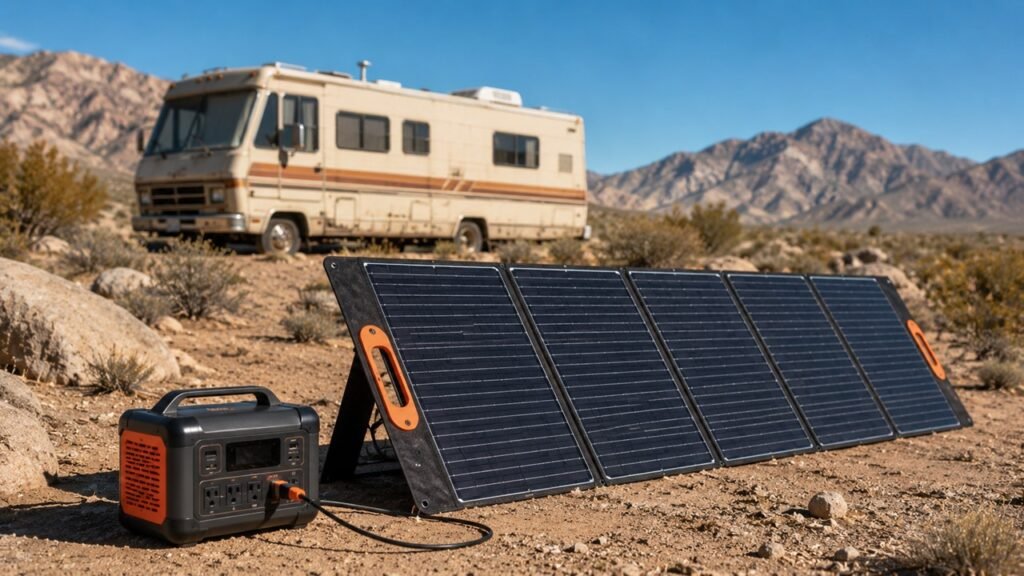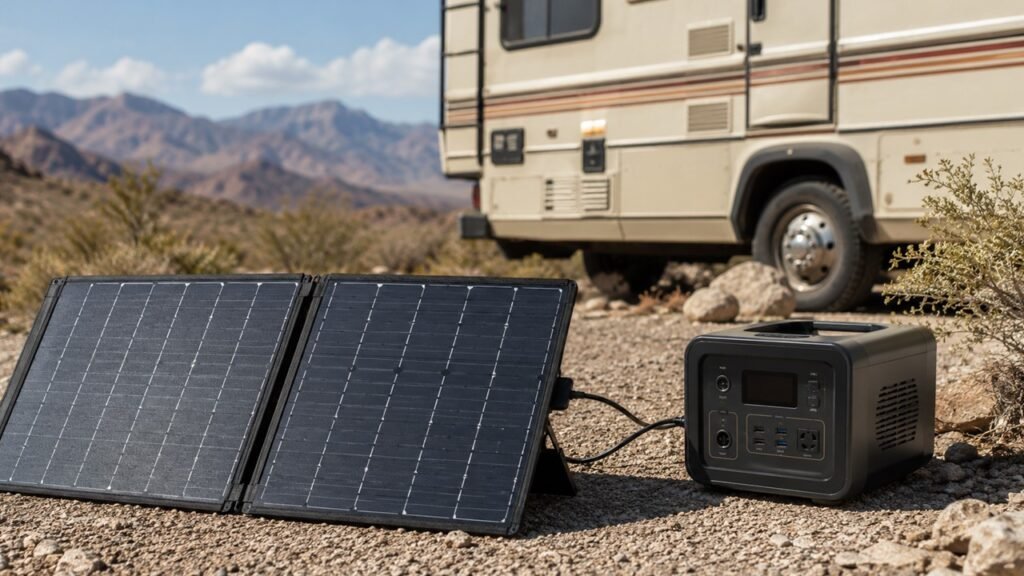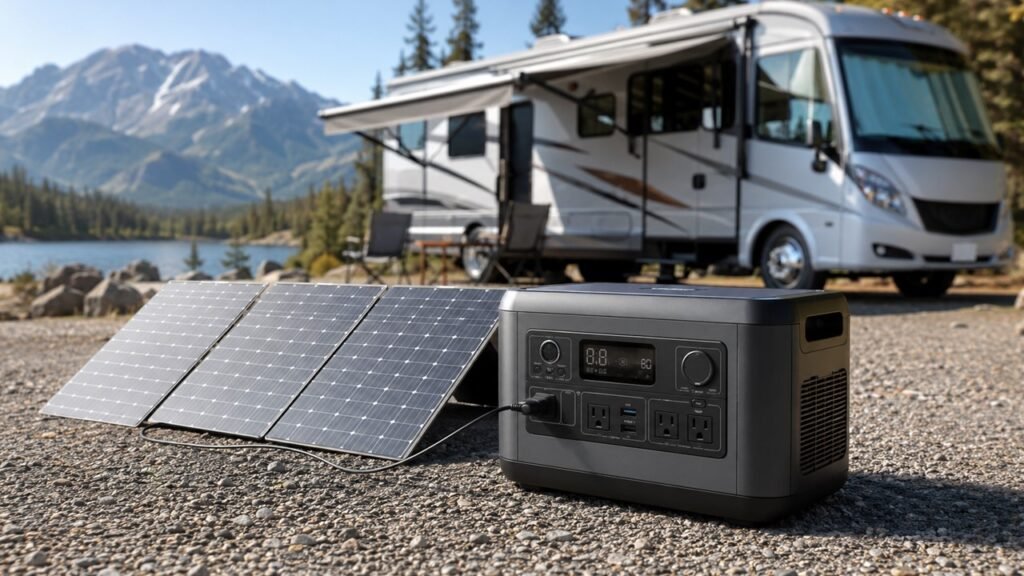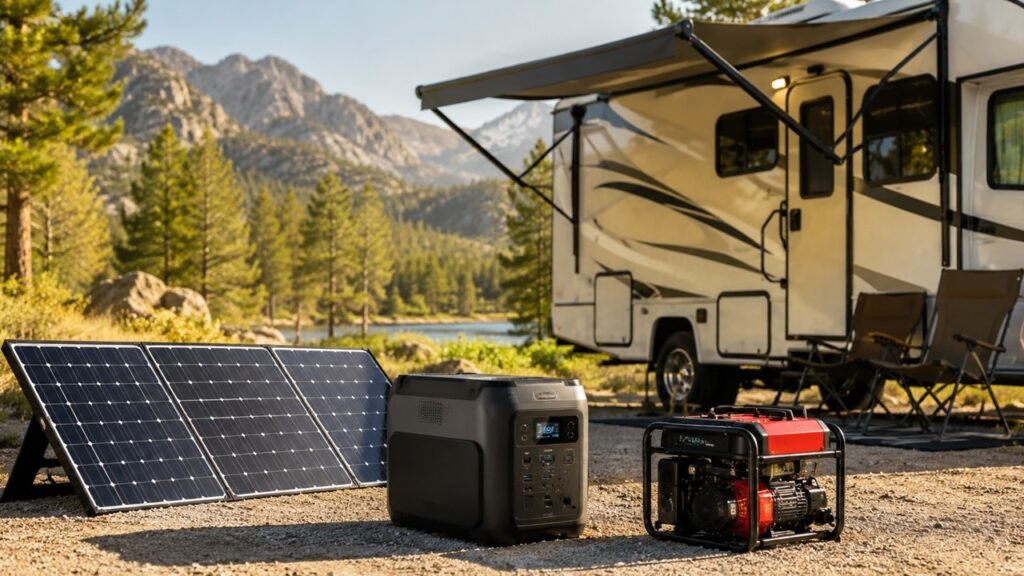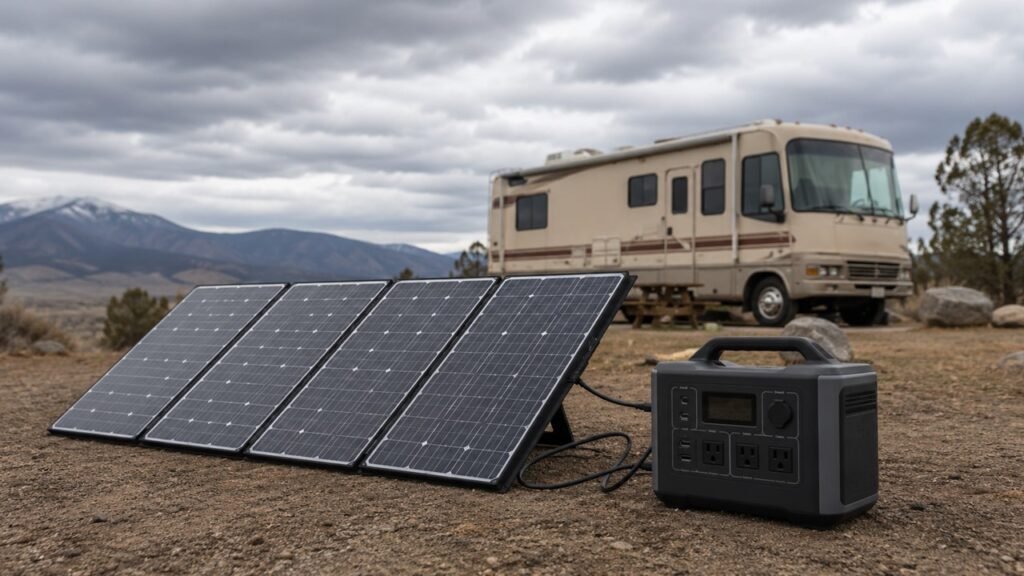
Yes, an RV solar generator can work on cloudy days, but it will not charge as fast as it does in direct sunlight. Solar panels use daylight, not heat, so they can still collect diffused sunlight through clouds and send power to your RV battery or portable power station.
If you camp in cloudy weather, the main thing to understand is reduced output. Your RV solar generator may still handle small essentials like lights, phones, fans, and a 12V fridge support load, but heavy appliances like an RV air conditioner, microwave, or electric heater will need a larger battery bank and a backup charging plan.
Key Summary
- An RV solar generator works on cloudy days because solar panels use daylight, not heat, to create electricity.
- Cloudy weather reduces RV solar panel output, often to about 10% to 40% of rated wattage.
- A 400W solar setup may only produce 40W to 160W during heavy overcast conditions.
- Cloudy-day charging works best for small RV loads, battery maintenance, and slow recharging.
- A larger battery, MPPT controller, portable panels, and backup charging source make cloudy camping easier.
Can an RV Solar Generator Work on Cloudy Days?
Yes, an RV solar generator can work on cloudy days, but you should expect slower charging and lower solar output. It can still collect daylight through cloud cover, but it will not perform like it does under strong direct sun.
Solar panels do not need heat to create electricity. They need light. Even when the sky looks gray, some sunlight still passes through the clouds and reaches your RV solar panels. That indirect sunlight can still produce power and charge your RV battery or portable power station.
The limitation is charging speed. Your RV solar generator may still “work,” but that does not mean it will charge quickly. On a sunny day, a 400W solar array may produce strong input for several hours. On a cloudy day, that same 400W setup may only trickle charge the battery, especially if the clouds are thick or the panels are flat on the roof.
So, the simple answer is yes, RV solar generators work on cloudy days. But cloudy-day solar is better for small loads, battery maintenance, and slow recharging than for running heavy RV appliances.
How RV Solar Generators Produce Power in Cloudy Weather
An RV solar generator works the same way in cloudy weather as it does in full sun. The difference is that the panels receive less light, so the system produces less power.
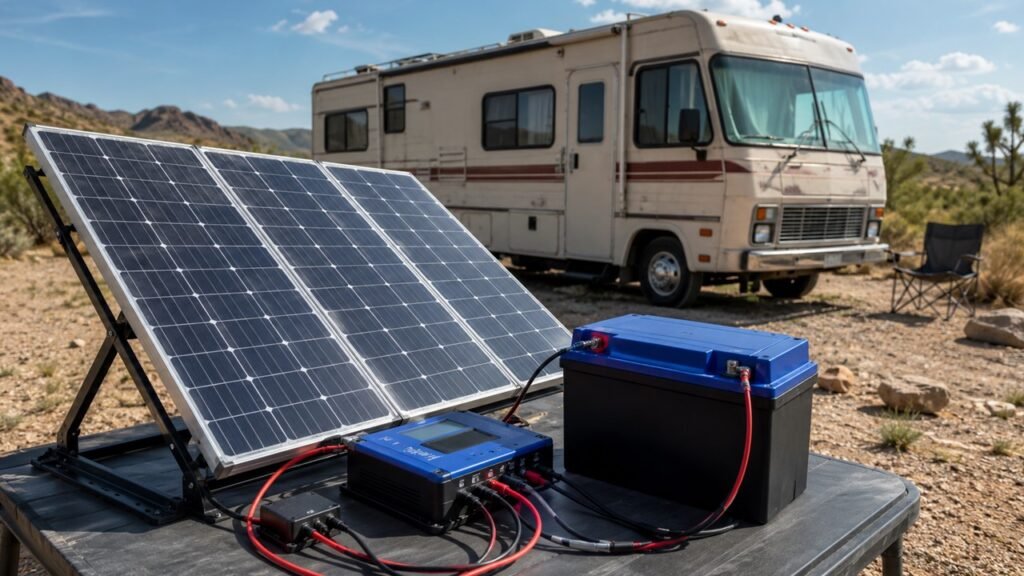
Solar panels collect daylight and turn it into DC electricity. That power then goes through a charge controller before reaching the battery or portable power station. When you plug in an AC appliance, the inverter converts stored DC battery power into AC power.
- Solar panel collects direct or diffused sunlight.
- Charge controller manages voltage and charging efficiency.
- Battery or power station stores the collected energy.
- Inverter powers AC devices from stored battery power.
This is why the charge controller matters. An MPPT charge controller usually performs better than a basic PWM controller in changing light because it can adjust to shifting voltage and pull more usable power from the panels.
For RVers, this can make a real difference on days when clouds keep moving across the sun. The system may still charge slowly, but MPPT charging helps you collect as much available power as possible.
How Much Power Do RV Solar Panels Make on Cloudy Days?
Cloudy-day solar output depends mostly on cloud thickness. Light clouds may still allow decent charging, while heavy overcast or rainy skies can reduce solar production sharply.
As a general rule, RV solar panels may produce around 10% to 70% of their rated wattage depending on the weather. Thin clouds can still provide useful power. Dark storm clouds may only give you a weak trickle charge.
| Solar Panel Size | Light Clouds | Heavy Overcast | Rainy or Dark Sky |
| 100W | 40W to 70W | 10W to 30W | 5W to 15W |
| 200W | 80W to 140W | 20W to 60W | 10W to 30W |
| 400W | 160W to 280W | 40W to 120W | 20W to 60W |
| 600W | 240W to 420W | 60W to 180W | 30W to 90W |
| 800W | 320W to 560W | 80W to 240W | 40W to 120W |
These numbers are estimates, not fixed guarantees. Real output can change based on panel quality, temperature, shading, cable losses, charge controller type, and how much power the battery can accept at that moment.
For example, a 400W solar setup might still produce 100W or more in bright cloudy weather. But under dark rain clouds, that same setup may fall closer to 20W to 60W.
Sunny Day vs Cloudy Day RV Solar Charging
The easiest way to understand cloudy-day RV solar is to compare it with full sun. Your solar generator may still charge in cloudy weather, but the charging speed changes a lot.
A sunny day can quickly refill a portable power station or RV battery. A cloudy day may only slow the battery drain or add a small amount of charge during daylight hours.
| Condition | Expected Solar Output | Charging Speed | RV Use Case |
| Full sun | 80% to 100% of rated output | Fast | Recharging power stations, running small appliances, topping off batteries |
| Partly cloudy | 40% to 70% of rated output | Moderate | Phones, fans, lights, fridge support, slow charging |
| Overcast | 10% to 40% of rated output | Slow | Trickle charging, small electronics, battery maintenance |
| Rainy or stormy | 5% to 20% of rated output | Very slow | Emergency trickle charge only |
| Night | 0% | No solar charging | Battery-only use |
At night, the solar panels stop producing power completely. Your RV solar generator can still run devices at night, but only from the energy already stored in the battery.
That is why battery capacity matters so much. Solar panels collect power during the day, but the battery decides how long you can keep using that power after sunset or during poor weather.
What Affects RV Solar Generator Performance on Cloudy Days?
Cloudy-day solar is not controlled by one thing only. Your real output depends on the weather, solar panel size, battery condition, campsite location, and the quality of your charging system.
If you understand these factors, you can predict your power better and avoid draining your RV solar generator too quickly.
Cloud Thickness Reduces Solar Input
Thin clouds may only reduce solar output moderately. You may still see useful charging on your power station display, especially around midday.
Thick overcast skies can cut production heavily. This is why two cloudy days can feel very different. One gray day may still charge your battery slowly, while another may barely produce enough power to matter.
Solar Panel Wattage Sets the Charging Limit
A bigger solar array gives you more cloudy-day charging headroom. For example, 600W of solar at 20% output still gives around 120W of input.
A small 100W panel at the same 20% output only gives around 20W. That may be enough for trickle charging, but it will not recharge a large power station quickly.
Panel Angle Changes Low-Light Performance
Flat roof panels are convenient because they charge automatically while your RV is parked. The downside is that they are harder to aim toward the best light.
Portable solar panels can help on cloudy days because you can move and tilt them toward the brightest part of the sky. This is especially useful when the sun briefly breaks through the clouds.
Shade Can Hurt More Than Clouds
Shade can be worse than cloud cover. Tree branches, RV roof vents, antennas, AC shrouds, awnings, and nearby campers can all block light from reaching your panels.
Even partial shading can lower solar output sharply, especially when panels are wired in series. Before blaming the weather, check whether something is blocking part of your solar array.
Battery Size Decides How Long You Can Keep Going
Cloudy weather matters less when your solar generator has a large battery. A bigger battery lets you store extra power from sunny days and use it slowly during cloudy periods.
A small battery gives you less room for mistakes. If the battery is already low before cloudy weather starts, your solar panels may not recover fast enough to keep up with daily RV power use.
MPPT Controllers Help in Changing Light
An MPPT controller can adjust better when clouds move across the sun. This helps the system collect more usable energy during inconsistent light conditions.
This does not make cloudy weather equal to full sun. But it can improve real-world charging compared with a basic PWM controller, especially when sunlight keeps changing throughout the day.
Cold Weather Can Slightly Improve Panel Efficiency
Solar panels often work more efficiently in cooler weather. Heat can reduce panel voltage, so a cool day can sometimes help the panel perform better per unit of light.
That does not cancel out heavy cloud losses. But a cool, bright cloudy day may perform better than a hot, hazy cloudy day with the same solar setup.
What Can an RV Solar Generator Run on Cloudy Days?
On cloudy days, your RV solar generator is best used for small and moderate loads. It can still support everyday essentials, but you should be careful with high-wattage appliances.
The key is to separate what solar can recharge slowly from what your battery can power for a short time.
| RV Device | Typical Power Use | Cloudy-Day Solar Suitability |
| Phone charging | 10W to 20W | Easy |
| LED lights | 5W to 30W | Easy |
| Roof vent fan | 20W to 60W | Usually manageable |
| WiFi router | 10W to 30W | Usually manageable |
| 12V compressor fridge | 40W to 80W while running | Possible with enough battery |
| Laptop | 45W to 100W | Possible, but drains battery faster |
| Coffee maker | 600W to 1,200W | Not ideal on cloudy solar alone |
| Microwave | 900W to 1,500W | Battery use only, not cloudy solar dependent |
| RV air conditioner | 1,200W to 2,000W+ | Not practical on cloudy solar alone |
| Electric heater | 750W to 1,500W | Not recommended for solar generator use |
On cloudy days, think of solar as support power, not unlimited power. It can help recharge the battery slowly and cover smaller loads during the day.
For short high-wattage tasks, you are mostly using stored battery energy. That is fine for quick use, but it can drain your solar generator fast if the panels are not bringing in much power.
How Long Does an RV Solar Generator Take to Charge on a Cloudy Day?
Cloudy weather can stretch charging time a lot. A power station that normally charges in a few hours may take all day or more when solar output drops.
Charging time depends on three things: battery capacity, solar input, and efficiency loss. If clouds reduce your 400W solar array to 100W of real input, your charging time becomes much longer.
| Power Station Size | 400W Solar in Full Sun | 400W Solar in Heavy Cloud |
| 500Wh | 1.5 to 2 hours | 5 to 12 hours |
| 1,000Wh | 3 to 4 hours | 10 to 24 hours |
| 2,000Wh | 6 to 8 hours | 20 to 48 hours |
| 3,000Wh | 9 to 12 hours | 30 to 72 hours |
This table assumes cloudy-day output drops to roughly 15% to 40% of rated solar wattage. Real charging time may be longer if the sky is dark, the panels are shaded, or the power station has a limited solar input rating.
Also remember that “20 hours of charging” does not mean one calendar day. You only get useful solar charging during daylight hours, so a large battery may need multiple cloudy days to fully recharge.
How to Maximize RV Solar Charging on Cloudy Days
You cannot control the weather, but you can improve how much cloudy-day solar power your system collects. Small adjustments can make a noticeable difference when light is limited.
The goal is simple: give your panels the clearest view of the brightest available sky and reduce unnecessary power use.
- Tilt the panels toward the brightest part of the sky.
- Move portable panels away from trees, roof shadows, and awnings.
- Clean dust, pollen, leaves, and water spots from the panel surface.
- Use portable ground panels to supplement fixed roof panels.
- Park in open areas instead of under trees when solar matters.
- Use an MPPT controller when possible.
- Reduce high-wattage appliance use during cloudy hours.
- Charge phones, laptops, and small devices during the brightest part of the day.
- Keep your battery topped off before bad weather arrives.
- Carry a backup charging option for multi-day cloudy trips.
The biggest mistake is waiting until the battery is already low. If the forecast shows several cloudy days, start conserving power early and recharge whenever you get a break in the clouds.
Fixed RV Solar Panels vs Portable Panels on Cloudy Days
Both fixed and portable solar panels can work on cloudy days. The better option depends on how you camp and how much effort you want to put into adjusting your setup.
Fixed panels are easier because they charge passively. Portable panels are more flexible because you can move them into better light.
| Setup Type | Strength | Weakness | Cloudy-Day Advantage |
| Fixed roof panels | Always connected and charging | Hard to angle or reposition | Good for passive charging |
| Portable panels | Easy to aim and move | Require setup and storage | Better for chasing low light |
| Mixed setup | Combines roof and ground solar | Costs more and needs more wiring | Best balance for cloudy camping |
For cloudy-day camping, the best setup is often a combination of fixed roof panels and portable panels. The roof panels collect whatever light is available all day, while portable panels let you aim for better exposure.
This mixed setup is especially helpful for boondocking. You can park the RV where it is comfortable, then place portable panels where the light is stronger.
Do You Need a Bigger Battery for Cloudy-Day RV Solar?
A bigger battery will not make your solar panels produce more power, but it will give you more stored energy to use when solar charging is weak. That makes cloudy camping much easier.
Cloudy weather is less stressful when your battery bank is sized for more than one day of use. Instead of depending on the panels to fully recharge every day, you can use stored power more slowly.
- Weekend campers may be fine with 500Wh to 1,500Wh.
- Light RV users may prefer 1,500Wh to 3,000Wh.
- Boondockers often need 3,000Wh to 6,000Wh or more.
- RVers running air conditioners need a much larger system and backup plan.
LiFePO4 batteries are usually better for RV solar generators because they allow deeper discharge, faster charging, longer cycle life, and more usable capacity than traditional lead-acid batteries.
For cloudy-day RV camping, battery size is often more important than panel size alone. Solar collects the power, but the battery gives you the buffer to stay comfortable when the weather changes.
When Cloudy-Day Solar Is Enough for RV Camping
Cloudy-day solar can still be enough if your power needs are light. It works best when you are using efficient RV appliances and already have some battery charge stored.
In this situation, your solar generator does not need to fully recharge every day. It only needs to slow down battery drain and support small daily loads.
- You only need lights, phones, fans, and small electronics.
- Your RV fridge runs on propane or uses low 12V power.
- You have a large battery already charged before cloudy weather.
- You camp for short weekends instead of long off-grid stays.
- You conserve power during low-sun hours.
- You have 400W to 800W of solar instead of only one small panel.
If this sounds like your camping style, an RV solar generator can still be useful in cloudy weather. You just need to manage expectations and avoid treating it like full-sun charging.
When Cloudy-Day Solar Is Not Enough
Cloudy-day solar is not enough when your daily power use is higher than your panels can replace. This usually happens with heating, cooling, cooking, or long off-grid stays.
The problem is not that the solar generator stops working. The problem is that it cannot recover battery power fast enough during poor weather.
- You need to run an RV air conditioner for hours.
- You use an electric heater, induction cooktop, or microwave often.
- You have several days of heavy clouds or rain.
- Your solar array is only 100W to 200W.
- Your battery is already low before cloudy weather starts.
- Your campsite has shade from trees or nearby RVs.
- Your power station has limited solar input.
If you camp this way, you need more than cloudy-day solar. A larger battery bank, more panel wattage, DC charging from the vehicle, shore power access, or a backup generator can make your RV power setup much safer and more reliable.
Should You Bring a Backup Charging Source?
A backup charging source is a smart idea if you camp off-grid for more than a weekend. Cloudy-day solar can help, but it may not replace the power you use each day.
You should be even more careful if you travel during rainy seasons or depend on electricity for work, medical devices, refrigeration, or climate control. In those cases, solar should be part of your RV power plan, not the only charging option.
Backup charging can come from shore power, campground hookups, a vehicle alternator charger, a DC-to-DC charger, or a gas inverter generator. Solar is quiet, clean, and useful, but it should not be your only plan for long cloudy stretches.
If your battery gets low after two or three cloudy days, a backup source gives you a safety net. It also helps you protect your food, stay connected, and avoid draining your power station too deeply.
RV Solar Generator Setup for Cloudy Days
The best RV solar generator setup for cloudy days depends on how much power you use. A weekend camper does not need the same system as a full-time boondocker or someone running Starlink, a fridge, and kitchen appliances.
The goal is to match your solar panel wattage, battery capacity, and backup charging option to your real camping style.
For Weekend Campers
For weekend campers, a 300W to 500W solar setup and a 500Wh to 1,500Wh power station is usually enough. This works well for lights, phones, fans, cameras, small electronics, and basic charging.
This type of setup is easy to carry, simple to use, and more affordable. It will not run heavy RV appliances for long, but it can keep your basic devices powered during short cloudy trips.
For Regular Boondockers
For regular boondockers, a 600W to 1,000W solar setup and a 2,000Wh to 4,000Wh battery system is a better range. This gives you more cloudy-day recovery and more stored power for overnight use.
This setup is more realistic if you use a 12V fridge, laptops, fans, lights, water pump, router, and small kitchen devices. It also gives you more breathing room when one or two cloudy days reduce solar charging.
For Heavy Power Users
For heavy power users, look for 1,000W or more of solar input, 4,000Wh to 6,000Wh or more of battery capacity, and a backup charging source. This is the safer setup if you run laptops, Starlink, a 12V fridge, inverter loads, kitchen appliances, or occasional AC support.
Heavy RV power use drains batteries quickly, especially when clouds reduce solar input. If you camp this way, a larger system is not just about comfort. It helps prevent your battery from falling behind during poor weather.
Common Mistakes RVers Make With Solar on Cloudy Days
Cloudy-day solar problems often come from wrong expectations, not broken equipment. Many RVers expect their solar panels to produce full rated wattage, even when the sky is dark.
Avoiding these mistakes can help your RV solar generator perform better and last longer.
- Expecting rated panel wattage during overcast weather.
- Buying a large power station but pairing it with too little solar.
- Parking under trees and blaming the weather.
- Forgetting that roof panels may be shaded by vents or AC units.
- Running high-wattage appliances before the battery is fully charged.
- Not checking the solar input limit of the power station.
- Depending on solar alone during multi-day rain.
- Ignoring panel cleaning and cable connection losses.
The biggest mistake is oversizing the battery but undersizing the solar panels. A large power station is useful, but it still needs enough solar input to recharge in real-world conditions.
Quick Calculation: Cloudy-Day RV Solar Output Example
A simple calculation can help you understand what cloudy-day solar really means. Once you estimate your reduced solar output, you can compare it with your daily RV power use.
Let’s say your RV has 400W of solar, and cloudy weather reduces output to around 25%.
Formula:
400W × 25% = 100W
That means your 400W solar array may only bring in about 100W under cloudy conditions.
If you get 5 usable daylight hours, the daily energy would look like this:
100W × 5 hours = 500Wh per day
That 500Wh may be enough for phones, LED lights, a roof vent fan, and some laptop use. But it is not enough to run an RV air conditioner, microwave, coffee maker, or electric heater for long.
This is why cloudy-day solar is best treated as support power. It can slow down battery drain, but it may not fully replace the energy you use each day.
Safety Tips for Using an RV Solar Generator in Cloudy or Rainy Weather
Cloudy weather often comes with moisture, rain, and wet ground. Your solar panels may be built for outdoor use, but your power station and connectors still need careful handling.
Good safety habits protect your equipment and reduce the risk of electrical problems while camping.
- Keep the power station dry and protected from rain.
- Use weather-rated solar panels and cables.
- Do not place portable power stations in standing water or wet grass.
- Check connector ratings before leaving panels outside.
- Avoid damaged cables, cracked panels, or loose plugs.
- Do not overload the inverter during low-battery conditions.
- Follow the manufacturer’s solar input voltage and wattage limits.
Also, do not assume every portable power station is safe to leave outside. Many solar panels can handle outdoor weather, but the battery unit usually needs to stay dry, shaded, and well-ventilated.
Final Verdict
Yes, an RV solar generator can work on cloudy days, but you should expect slower charging and lower solar output. In many cases, your panels may only produce 10% to 40% of their rated power, so cloudy-day solar is better for topping off batteries and running small essentials than powering heavy RV appliances.
For casual camping, a charged power station with 400W to 600W of solar can still be very useful in cloudy weather. For longer boondocking trips, a larger battery, more solar panels, MPPT charging, and a backup charging source will make your setup much more reliable.
If your RV power needs are light, cloudy-day solar can still keep you comfortable. If you need air conditioning, electric cooking, or multi-day off-grid power, plan for more battery capacity and a backup source.
Related FAQs
Can RV Solar Panels Charge on Cloudy Days?
Yes, RV solar panels can charge on cloudy days, but the output is much lower than full sun. Many setups produce about 10% to 40% of rated capacity depending on cloud cover.
Will an RV Solar Generator Work in the Rain?
An RV solar generator can still receive a small amount of solar input during rain if daylight is present. However, charging is usually very slow, and the power station itself should stay dry.
Can an RV Solar Generator Work at Night?
No, the solar panels cannot generate power at night. The solar generator can only run devices at night from energy already stored in the battery.
How Much Solar Do I Need for Cloudy RV Camping?
For light RV use, 400W to 600W of solar is a good starting point. For regular boondocking in cloudy areas, 800W to 1,200W or more is much safer.
Are Portable Solar Panels Better on Cloudy Days?
Portable solar panels can be better on cloudy days because you can move and angle them toward brighter parts of the sky. Fixed roof panels are easier, but they cannot be adjusted as well.
Can Cloudy-Day Solar Run an RV Air Conditioner?
Usually, no. Cloudy-day solar output is too low for most RV air conditioners. You need a large battery bank, high inverter output, strong solar input, and often a backup charging source.
Is an MPPT Controller Better for Cloudy Days?
Yes, an MPPT controller is usually better for cloudy days because it can optimize changing solar input more efficiently than a basic PWM controller.
Is RV Solar Worth It in Cloudy Climates?
Yes, RV solar can still be worth it in cloudy climates if you size the system correctly. It works best when paired with enough battery storage and a backup charging option.

Daniel Brooks writes about RV living, gear, and travel planning with a focus on everyday usability. His guides break down complex topics into simple advice for real RV owners. He reviews products with long-term use in mind, not marketing hype.