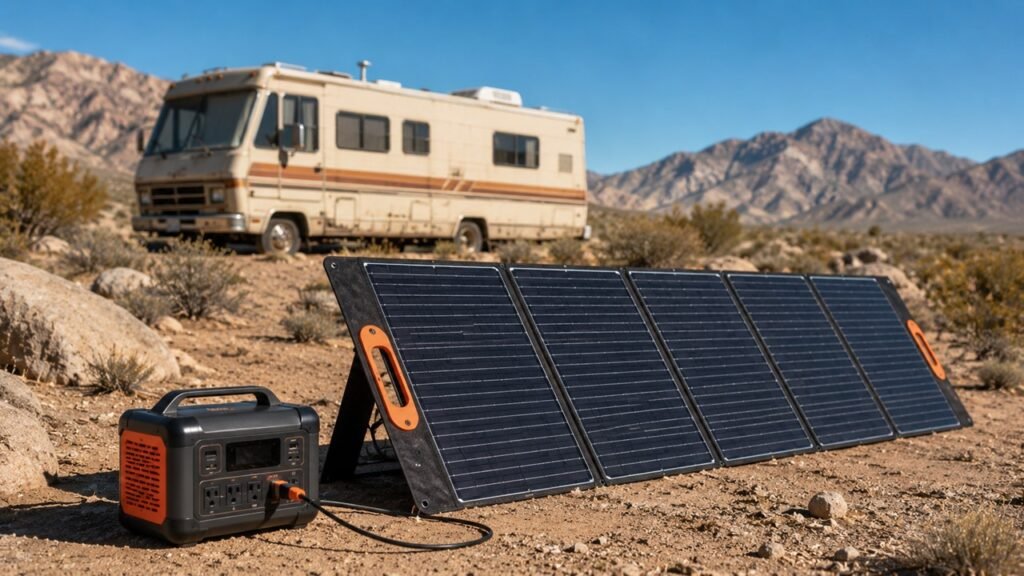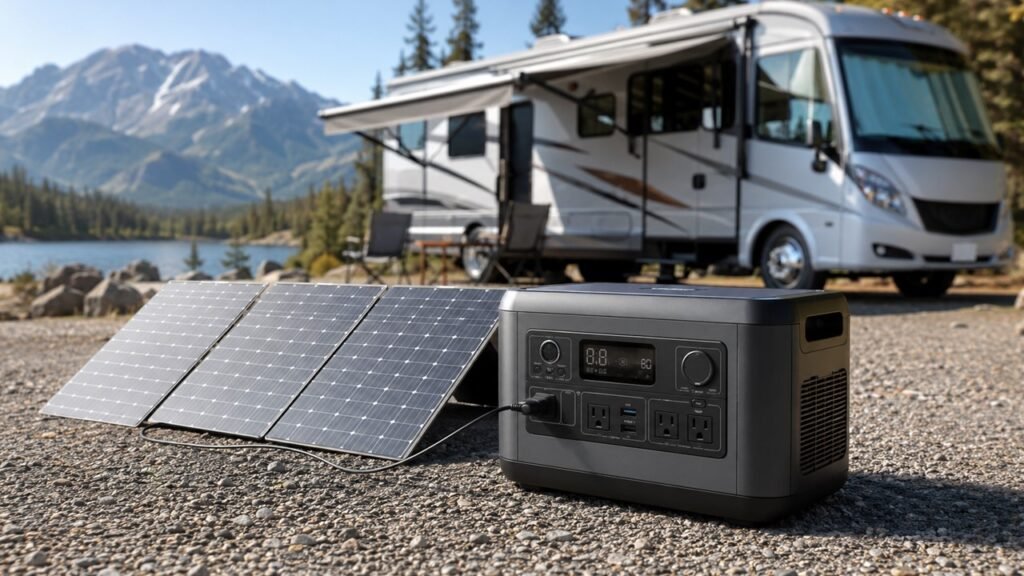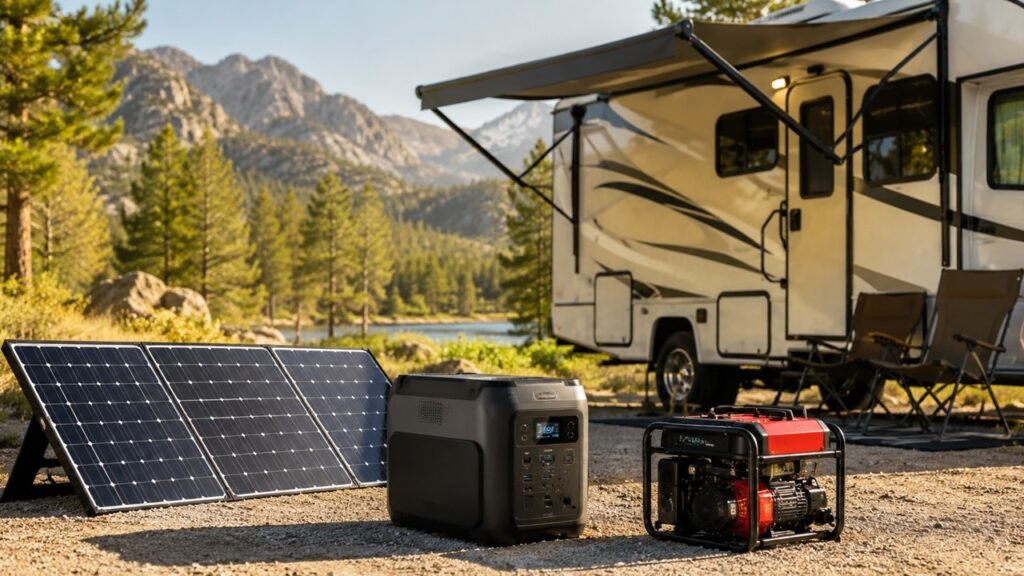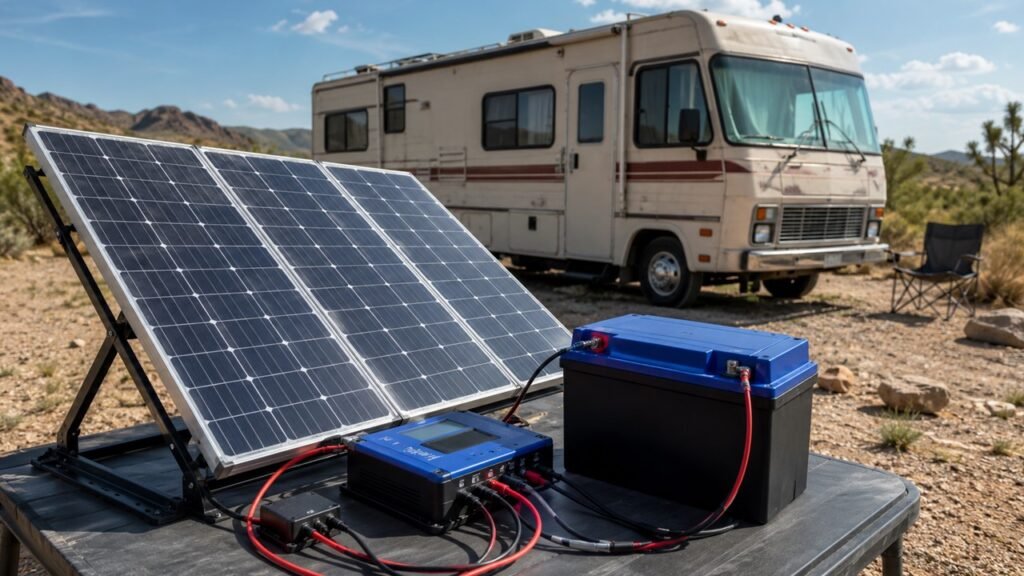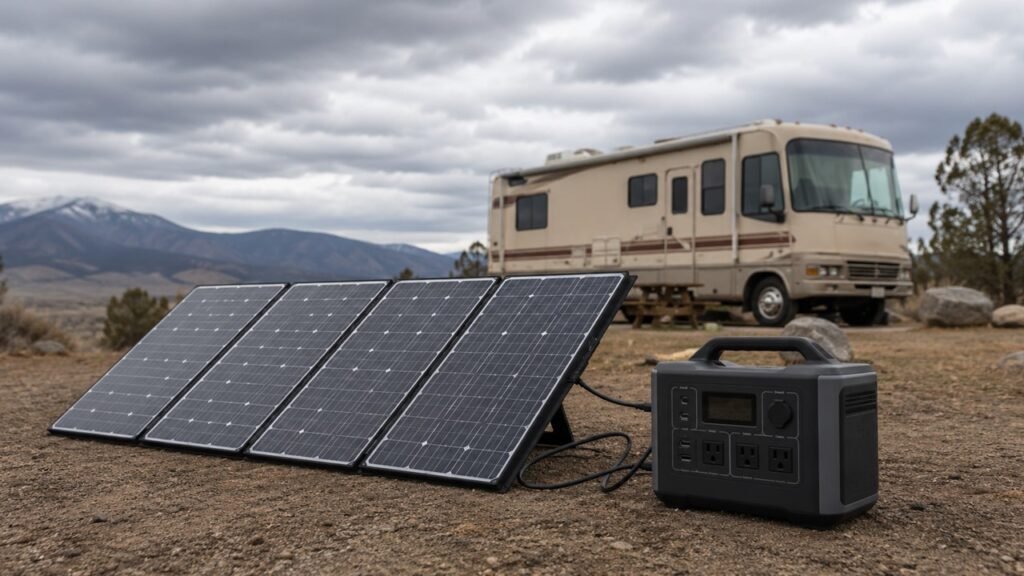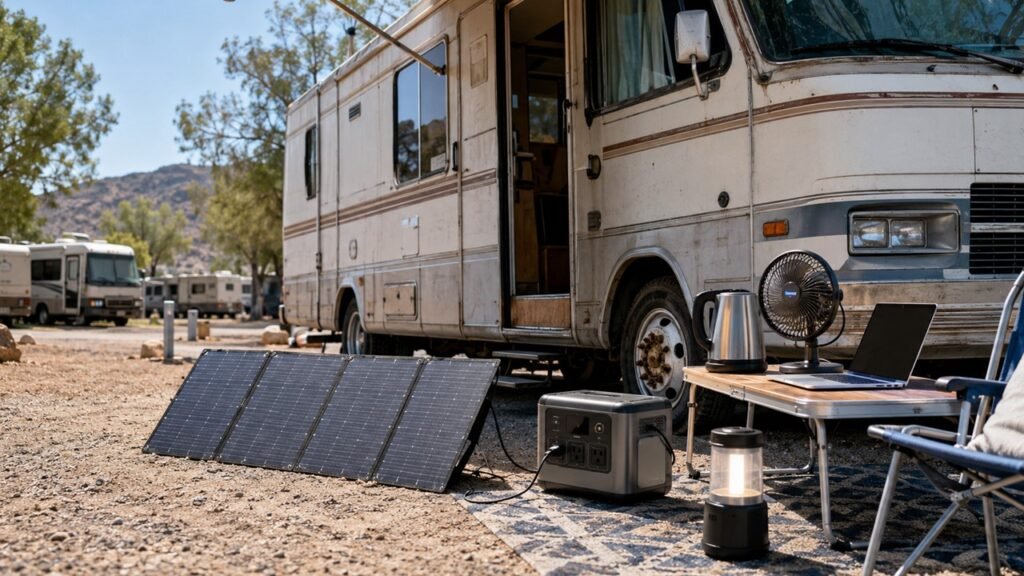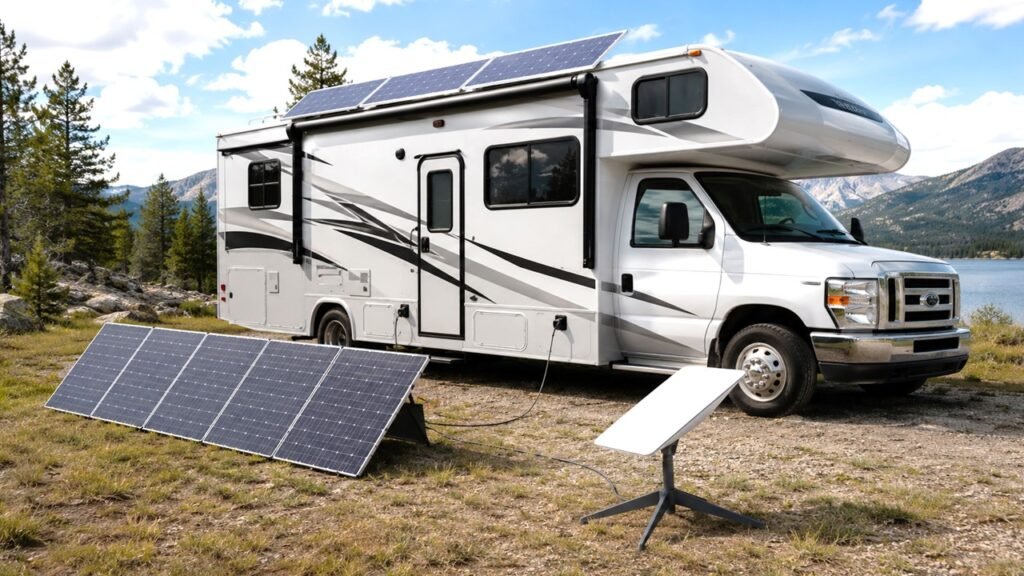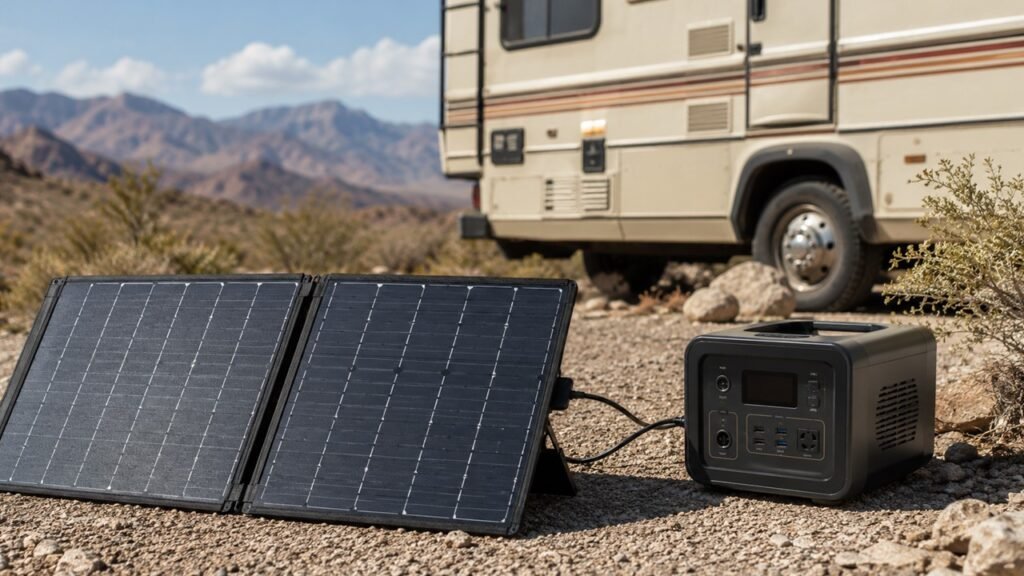
Most RVs need 2 to 6 solar panels, or roughly 400W to 1,200W of solar power, depending on how much electricity you use each day.
If you only use lights, a fan, phone chargers, and a water pump, a 200W to 400W setup is often enough. If you also run a 12V fridge, laptop, CPAP machine, or Starlink, you’ll likely need 400W to 800W. For full-time off-grid RV living, 800W to 1,200W or more is usually a better fit.
Keep in mind that solar panels mainly charge your RV batteries during the day. Your batteries then power your RV at night, on cloudy days, or whenever your appliances need more power than the panels can produce. That’s why the right setup depends on your daily power use, battery capacity, available sunlight, and camping style.
Key Summary
- Most RV owners need 2 to 6 solar panels, usually equal to 400W to 1,200W of total solar capacity.
- A weekend RV setup may only need 200W to 400W for lights, phone charging, fans, and a water pump.
- A moderate boondocking setup usually needs 400W to 600W for a 12V fridge, lights, fans, laptops, and small electronics.
- Full-time off-grid RVers often need 800W to 1,200W or more, especially when using Starlink, microwaves, CPAP machines, or larger battery banks.
- The best way to calculate RV solar panel needs is to estimate daily watt-hours, divide by peak sun hours, and add a 25% to 35% real-world loss buffer.
- RV air conditioners usually need a large lithium battery bank and inverter. Solar panels alone rarely power an RV air conditioner directly for long periods.
How Many Solar Panels Does an RV Really Need?
Most RVs need 2 to 6 solar panels, but the better answer is based on total solar wattage, not panel count alone. Two 200W panels and four 100W panels both create a 400W RV solar array. For most RV owners, 400W to 600W is a practical starting point, while full-time boondockers often need 800W to 1,200W+ for stronger daily battery charging.
| RV Usage Type | Recommended Solar Size | 100W Panels | 200W Panels | 400W Panels | Best For |
| Light weekend camping | 200W to 400W | 2 to 4 | 1 to 2 | 1 | Lights, phone charging, water pump, roof vent fan |
| Moderate RV use | 400W to 600W | 4 to 6 | 2 to 3 | 1 to 2 | 12V fridge, fans, laptop, TV, small electronics |
| Regular boondocking | 600W to 800W | 6 to 8 | 3 to 4 | 2 | Fridge, CPAP, Starlink, longer off-grid stays |
| Full-time off-grid RVing | 800W to 1,200W+ | 8 to 12+ | 4 to 6+ | 2 to 3+ | Larger battery banks, inverter use, heavy daily charging |
This table gives a practical starting range, but your exact RV solar panel count depends on four things: daily power consumption, average peak sun hours, battery capacity, and available roof or portable panel space. A low-power RV with propane appliances may need fewer panels, while an electric-heavy RV with a refrigerator, internet system, microwave, or CPAP machine will need more solar and more battery storage.
RV Solar Needs by Camping Style
Your RV solar needs depend on how you camp. A weekend camper uses less power than a full-time boondocker, so the right solar setup should match your daily appliances, battery size, and time away from shore power.
Weekend Camping: 200W to 400W
A weekend RV solar setup usually needs 200W to 400W of solar power. This range is enough for basic camping loads, especially when you only stay off-grid for one or two nights.
A 200W to 400W solar setup can support LED lights, phone charging, a roof vent fan, a water pump, and small electronics. It works best when propane handles cooking, heating, and refrigeration.
This setup is ideal for RV owners who camp lightly and do not run large inverter appliances. If you only need to keep your batteries topped off between short trips, 200W to 400W is usually a practical starting point.
Moderate Boondocking: 400W to 600W
A moderate RV boondocking setup usually needs 400W to 600W of solar power. This is the most practical range for many RV owners because it supports daily essentials without requiring a very large roof layout.
A 400W to 600W solar setup can support a 12V fridge, LED lights, roof vent fans, laptops, phone charging, a water pump, and small entertainment devices. It gives your battery bank more recovery power during the day, especially when you camp for several days without shore power.
This range is a good fit if you want to reduce generator use and stay off-grid more comfortably. It also gives you more flexibility when cloudy weather or partial shade lowers solar output.
Full-Time Off-Grid RVing: 800W to 1,200W+
A full-time off-grid RV setup usually needs 800W to 1,200W or more of solar power. This range is better for RVers who depend on solar as a main charging source instead of using shore power regularly.
An 800W to 1,200W solar setup can support larger battery banks, 12V refrigeration, Starlink, CPAP machines, multiple laptops, fans, lights, and short microwave use. It also helps lithium batteries recharge faster after heavy overnight use.
At this level, roof space and battery capacity become very important. A large solar array only works well when your RV has enough clear mounting space, a properly sized charge controller, and enough battery storage to hold the energy your panels produce.
How to Calculate How Many RV Solar Panels You Need
The best way to calculate RV solar panel needs is to start with daily energy use. Your solar panels must replace the watt-hours your RV consumes each day.
Use this simple formula:
Daily Watt-Hours ÷ Peak Sun Hours = Minimum Solar Watts
Then add a real-world buffer for heat, shade, wiring loss, charge controller loss, and cloudy conditions:
Minimum Solar Watts × 1.25 to 1.35 = Recommended Solar Array Size
For example, if your RV uses 2,000Wh per day and your campsite receives 5 peak sun hours, your minimum solar size is 400W. After adding a 30% buffer, the recommended solar array becomes about 520W. In real use, that means a 600W solar setup is the safer choice.
| Calculation Step | Example |
| Daily energy use | 2,000Wh |
| Peak sun hours | 5 hours |
| Minimum solar size | 400W |
| Add 30% buffer | 520W |
| Practical recommendation | 600W solar array |
To turn solar watts into panel count, divide the recommended solar array size by the wattage of each panel.
- A 600W solar array equals six 100W panels.
- A 600W solar array equals three 200W panels.
- A 600W solar array can also equal two 300W panels.
- An 800W solar array can equal two 400W panels.
Panel count changes by panel size, but total wattage is what matters most.
Estimate Your Daily RV Power Use
Your daily RV power use is measured in watt-hours. A watt-hour shows how much energy an appliance uses over time. To estimate it, multiply the appliance wattage by the number of hours you use it each day.
| RV Appliance | Typical Wattage | Estimated Daily Use |
| LED lights | 20W to 50W | 80Wh to 300Wh |
| Roof vent fan | 20W to 40W | 80Wh to 320Wh |
| Water pump | 60W to 100W | 10Wh to 50Wh |
| 12V fridge | 45W to 70W | 300Wh to 700Wh |
| Laptop | 45W to 90W | 90Wh to 450Wh |
| TV | 50W to 120W | 100Wh to 480Wh |
| CPAP machine | 30W to 60W | 180Wh to 480Wh |
| Starlink/router | 50W to 75W | 200Wh to 600Wh |
| Microwave | 900W to 1,500W | 75Wh to 375Wh |
High-watt appliances do not always use the most energy if they run for only a few minutes. A microwave may use 1,200W while running, but a short 10-minute use may only consume about 200Wh. Still, high-watt appliances need a capable inverter and battery bank because they require strong instant power.
Low-watt appliances can use more daily energy when they run for many hours. A 12V fridge may only draw 45W to 70W when active, but because it cycles throughout the day, it can become one of the biggest daily loads in an RV solar system.
What Affects RV Solar Panel Output?
RV solar panel output depends on sunlight, panel placement, weather, and system efficiency. A solar panel may be rated for 200W, but real-world output is often lower because RV roofs are flat, partially shaded, dusty, and exposed to changing temperatures.
- Peak sun hours in your location affect how much energy your panels can produce each day.
- Shade from trees, vents, antennas, or roof AC units can reduce solar output quickly, even when only part of a panel is covered.
- Flat roof mounting angle lowers production because the panel may not face the sun at the best angle.
- Cloudy weather reduces solar charging and makes battery capacity more important.
- Panel temperature affects output because hot solar panels usually produce less power than their rated capacity.
- Dust and road grime block sunlight and reduce panel efficiency over time.
- Wiring and charge controller losses reduce how much solar energy reaches your battery bank.
- Inverter losses occur when your battery power is converted from DC power to AC power for household-style appliances.
Solar panels rarely produce their full rated wattage all day. According to the U.S. Department of Energy, PV module ratings are measured under standard test conditions, but real-world production changes with sunlight intensity, temperature, dirt, shade, and system setup. That is why RV owners should add a 25% to 35% buffer when sizing solar panels If your basic calculation says you need 400W, a 500W to 600W solar array will usually perform better in real camping conditions.
How Much Battery Capacity Do You Need With RV Solar?
RV solar panels charge the battery bank during the day. Your battery bank powers RV appliances at night, during cloudy weather, or whenever your appliances need more power than the panels are producing.
Battery capacity should match your daily energy use. If your RV uses 1,500Wh per day, a 2,000Wh to 3,000Wh battery setup gives you more practical backup than a small battery that drains too quickly. A larger battery bank also helps you store extra solar energy on sunny days.
| RV Usage Type | Daily Energy Use | Recommended Battery Storage |
| Light camping | 500Wh to 1,000Wh | 1,000Wh to 1,500Wh |
| Moderate RV use | 1,000Wh to 2,000Wh | 2,000Wh to 3,000Wh |
| Regular boondocking | 2,000Wh to 3,000Wh | 3,000Wh to 5,000Wh |
| Full-time off-grid | 3,000Wh+ | 5,000Wh to 10,000Wh+ |
For most RV owners, battery storage for at least one full day of use is the minimum. Two days of battery storage is better for boondocking because cloudy weather, shade, and heavier appliance use can reduce solar recovery.
Can Solar Panels Run an RV Air Conditioner?
Solar panels alone usually cannot run an RV air conditioner for long. Most RV air conditioners use about 1,200W to 2,000W while running and need extra startup power when the compressor turns on.
RV solar can help recharge the batteries that support an air conditioner, but the AC itself usually runs from a large battery bank through a high-output inverter. This is why a small 200W to 600W solar setup is not enough for practical air conditioning use.
To run RV AC off-grid, you usually need:
- Large lithium battery bank
- High-output inverter
- Soft start kit
- Large solar array
- Backup charging from shore power, alternator, or generator
Solar is excellent for lights, fans, a 12V fridge, water pump, laptops, and small electronics. For air conditioning, most RV owners still need a much larger off-grid power system or a backup charging source.
Roof-Mounted vs Portable RV Solar Panels
Roof-mounted and portable solar panels both work for RVs, but they solve different problems. Moreover, roof-mounted panels are more convenient, while portable panels are easier to aim toward the sun.
| Setup Type | Best For | Main Advantage | Main Limitation |
| Roof-mounted panels | Long-term RV use | Always installed and charging | Limited by roof space and shade |
| Portable panels | Flexible camping | Can be moved into sunlight | Requires setup and storage |
| Hybrid system | Serious boondocking | Better charging flexibility | Higher cost and more equipment |
In our opinion, Roof-mounted solar is better if you want a permanent system that charges whenever sunlight hits the RV roof. Portable solar is better if you often park in shade but want to place panels in direct sunlight. A hybrid system gives the most flexibility because it combines automatic roof charging with movable portable panels.
What Size Solar Panel Is Best for an RV?
The best solar panel size for an RV depends on roof space, total wattage needs, and installation layout. Smaller panels are easier to fit around vents and AC units, while larger panels produce more power with fewer connections.
| Panel Size | Best For | Main Benefit |
| 100W panels | Small campers and tight roofs | Flexible layout |
| 200W panels | Most RV solar setups | Good balance of size and output |
| 400W panels | Large trailers and motorhomes | More power with fewer panels |
For most RV owners, 200W solar panels offer the best balance. They are easier to arrange than large 400W panels, but they produce more power with less wiring than multiple 100W panels. A 200W panel setup also makes future expansion easier if your battery bank or appliance use grows later.
Common RV Solar Sizing Mistakes
Many RV solar problems happen because the system is sized around panel count instead of real energy use. A good RV solar setup should match your daily watt-hours, battery capacity, inverter size, and available sunlight.
- Choosing panels before calculating daily energy use
- Counting panel number instead of total wattage
- Ignoring battery capacity
- Forgetting inverter losses
- Assuming full rated output all day
- Underestimating shade from roof equipment
- Trying to run air conditioning with a small solar setup
- Not leaving room for future expansion
The safest approach is to calculate your daily watt-hour use first, then size your solar array and battery bank around that number. This keeps your RV solar system more reliable during cloudy weather, shaded campsites, and longer off-grid stays.
Final Words
For most RV owners, 400W to 600W of solar power is the best starting point. This range can support common RV essentials like lights, fans, phone charging, a water pump, a 12V fridge, laptops, and small electronics.
Weekend campers may only need 200W to 400W if they use power lightly and rely on propane for cooking, heating, or refrigeration. Full-time boondockers should consider 800W to 1,200W or more, especially if they use Starlink, CPAP machines, larger battery banks, or occasional inverter appliances.
The safest way to size RV solar is to calculate your daily watt-hours first. Then divide that number by realistic peak sun hours, add a 25% to 35% buffer, and match the solar array with enough battery storage. This approach gives you a more reliable system than guessing by panel count alone.
Related FAQs
How Many Solar Panels Do I Need to Run an RV?
Most RVs need 2 to 6 solar panels, usually equal to 400W to 1,200W of solar capacity. The exact number depends on daily power use, panel wattage, sunlight, battery capacity, and camping style.
Is 400W of Solar Enough for an RV?
Yes, 400W of solar can be enough for light to moderate RV use. It can support LED lights, fans, phone charging, a water pump, and a 12V fridge when paired with a properly sized battery bank.
Is 600W of Solar Enough for an RV?
Yes, 600W of solar is a strong setup for regular boondocking. It gives better daily battery recovery for a 12V fridge, fans, laptops, lights, phone charging, and small entertainment devices.
How Many Batteries Do I Need for RV Solar?
Most RV owners need enough battery storage for at least one to two days of energy use. A moderate RV solar setup often works well with 2,000Wh to 3,000Wh of battery capacity, depending on appliance use.
Can a 200W Solar Panel Run an RV Refrigerator?
A 200W solar panel can help recharge the battery that powers an RV refrigerator, but it should not be treated as the only power source. A 12V RV fridge should run from a properly sized battery bank, while solar helps replace the energy used during the day.
Do RV Solar Panels Work While Driving?
Yes, roof-mounted RV solar panels can work while driving if they are wired to the charge controller and battery system. They can continue charging the battery whenever sunlight reaches the panels.
Are Portable Solar Panels Good for RVs?
Yes, portable solar panels are good for RVs because they can be moved into direct sunlight while the RV stays parked in shade. They are especially useful for flexible camping, small RVs, and owners who do not want a permanent roof-mounted setup.

Daniel Brooks writes about RV living, gear, and travel planning with a focus on everyday usability. His guides break down complex topics into simple advice for real RV owners. He reviews products with long-term use in mind, not marketing hype.