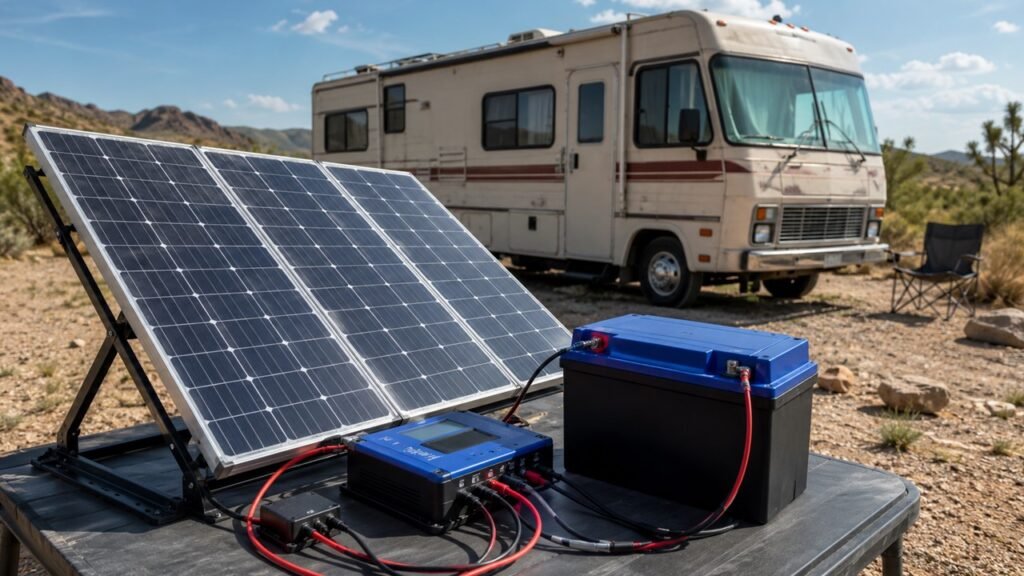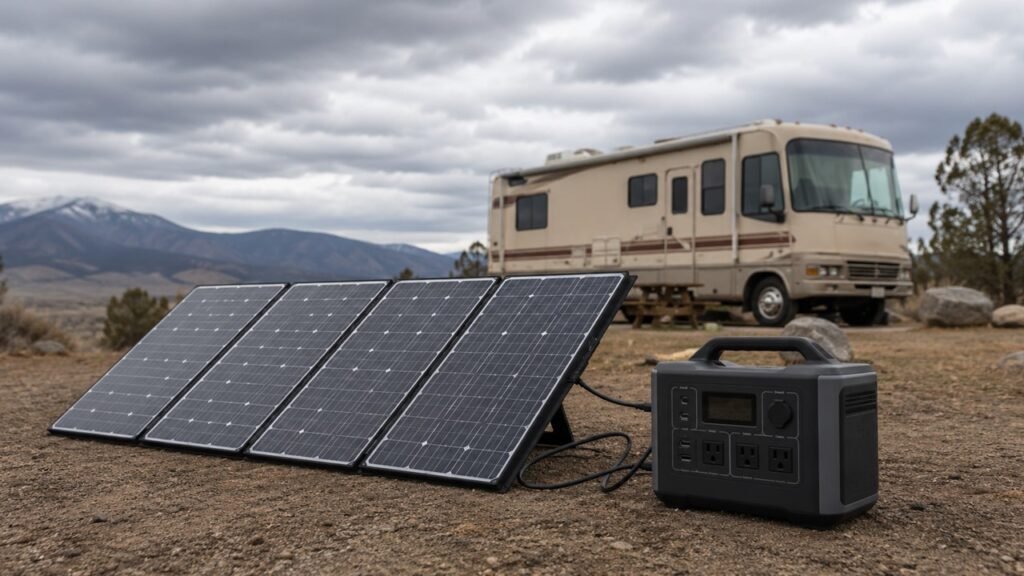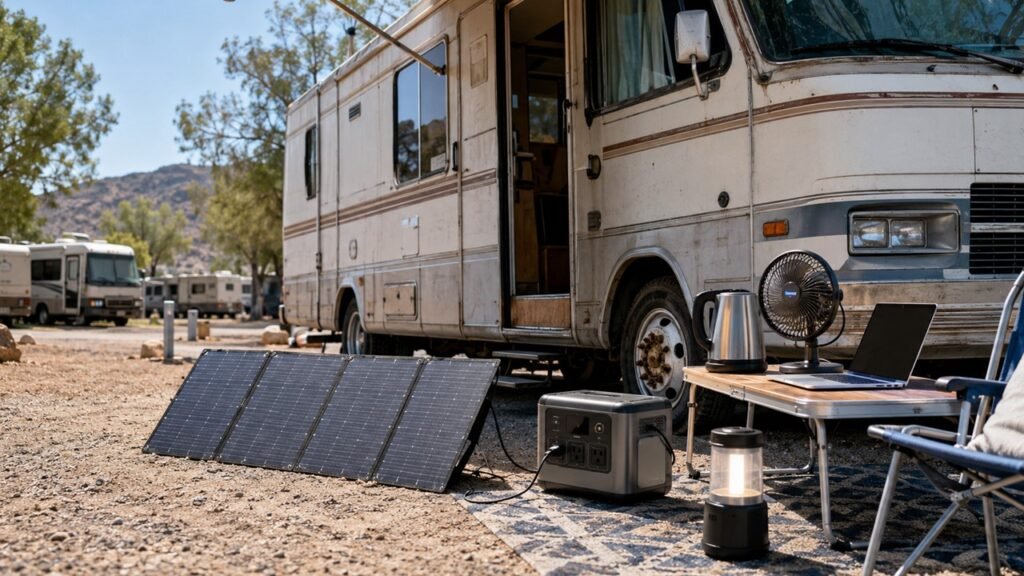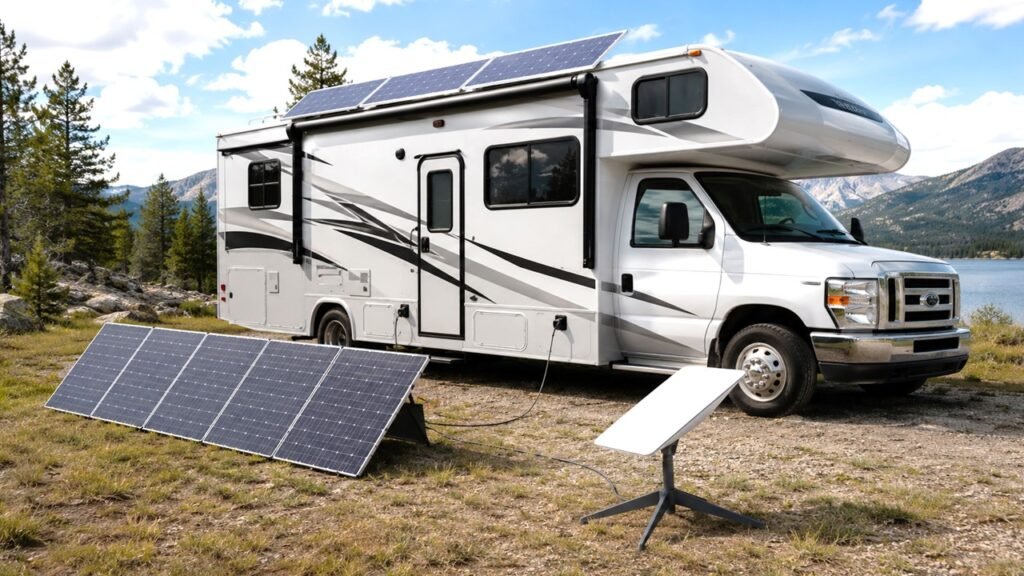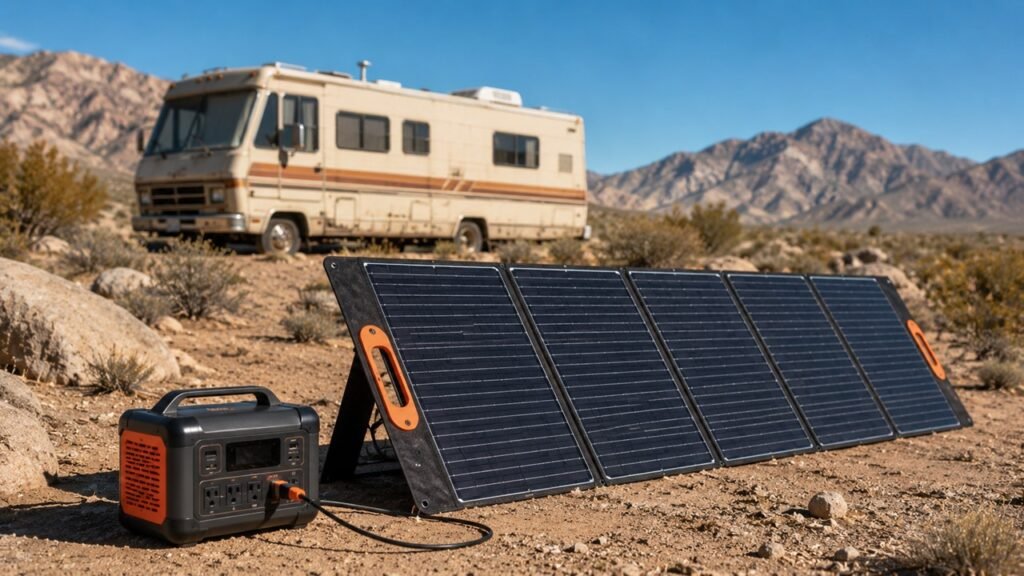
If you’re wondering how much solar power an RV really needs, most RVs require between 200W and 1,200W of solar panels, depending on energy usage and camping style.
A weekend camper may only need 200W to 300W, while full-time boondockers often need 800W to 1,200W or more to support refrigerators, laptops, Starlink, and other daily essentials. The right RV solar system depends on your daily power consumption, battery capacity, and available sunlight.
In this guide, you’ll learn how to calculate your RV’s solar needs, size your battery bank, and determine whether your setup can support appliances ranging from refrigerators and CPAP machines to microwaves and air conditioners.
Key Summary
- Most RVs need 200W to 300W of solar for light camping, 400W to 600W for typical off-grid travel, and 800W to 1,200W+ for full-time boondocking.
- RV solar needs depend on daily energy use, peak sun hours, battery capacity, and the appliances you run.
- Solar panel size is determined by daily watt-hour consumption, available sunlight, and a 25% to 35% efficiency buffer.
- Battery storage should typically cover at least two days of average power usage for reliable off-grid camping.
- RV air conditioners require substantially larger solar arrays, battery banks, and inverter systems than standard RV appliances.
How Much Solar Power Does an RV Need?
Most RVs need 200W to 300W of solar power for light camping, 400W to 600W for typical off-grid travel, and 800W to 1,200W or more for full-time boondocking. The exact amount depends on your daily watt-hour consumption, available sunlight, battery storage capacity, and the appliances you plan to run.
Solar panels generate electricity for your RV. Batteries store that electricity for later use. Appliances consume the stored energy throughout the day and night. A properly sized solar system ensures your batteries can recharge fast enough to keep up with your daily power needs.
| RV Usage Type | Recommended Solar Array | Recommended Battery Capacity | Typical Appliances |
| Light Weekend Camping | 200W to 300W | 1,000Wh to 1,500Wh | LED lights, phones, water pump |
| Standard RV Camping | 400W to 600W | 2,000Wh to 3,000Wh | 12V fridge, fans, laptops, lights |
| Remote Work RV Setup | 600W to 1,000W | 3,000Wh to 5,000Wh | Starlink, laptops, monitors, fridge |
| Full-Time Boondocking | 800W to 1,200W+ | 4,000Wh to 6,000Wh+ | Fridge, CPAP, TV, microwave, electronics |
| RV Air Conditioner Use | 1,500W to 3,000W+ | 8,000Wh to 15,000Wh+ | Air conditioner, large inverter loads |
For many RV owners, a 400W to 600W solar setup paired with a 2,000Wh to 3,000Wh battery bank provides enough power for a refrigerator, lighting, vent fans, device charging, and moderate laptop use while camping off-grid. This range offers a practical balance between cost, roof space, and energy independence.
How to Calculate RV Solar Power Needs
Calculating RV solar power needs is simpler than most people think. Once you know how much electricity your appliances use each day, you can estimate the solar panel wattage and battery capacity needed to stay off-grid comfortably.
Step 1: Calculate Your Daily Power Consumption
Your daily power consumption is the total amount of energy your RV appliances use in a typical day. This figure is measured in watt-hours (Wh) and forms the foundation of every solar calculation.
To calculate daily energy use:
Daily Watt-Hours = Appliance Watts × Hours Used Per Day
For example:
- 12V RV Fridge: 50W × 10 hours = 500Wh
- Roof Vent Fan: 30W × 6 hours = 180Wh
- Laptop: 65W × 3 hours = 195Wh
- LED Lights: 20W × 4 hours = 80Wh
- Water Pump: 80W × 0.5 hours = 40Wh
Total Daily Consumption = 995Wh
In this example, the RV uses approximately 1,000Wh of electricity per day.
Step 2: Determine Your Average Peak Sun Hours
Solar panels only produce their rated output during peak sun hours. Peak sun hours refer to the amount of usable sunlight available for solar generation each day.
Most RV travelers experience:
| Location Type | Average Peak Sun Hours |
| Cloudy Northern Areas | 3 to 4 Hours |
| Most U.S. Locations | 4 to 5 Hours |
| Desert and Southern Regions | 5 to 7 Hours |
If you frequently travel across different regions, using 4 peak sun hours is a realistic planning assumption.
Step 3: Calculate the Minimum Solar Panel Size
Once you know your daily energy consumption and peak sun hours, you can estimate the minimum solar array size.
Solar Panel Watts Needed = Daily Watt-Hours ÷ Peak Sun Hours
Using the previous example:
995Wh ÷ 4 Sun Hours = 249W
This means the RV needs approximately 250 watts of solar production per day under ideal conditions.
Step 4: Add a Buffer for Real-World Solar Losses
Solar systems rarely operate at 100% efficiency. Heat, shade, dirty panels, wiring losses, battery charging losses, and inverter inefficiencies all reduce actual output.
A good rule is to add a 25% to 35% safety buffer.
Adjusted Solar Size = Minimum Solar Requirement × 1.3
Using our example:
250W × 1.3 = 325W
Since solar panels come in standard sizes, rounding up to a 400W solar system would be the practical choice.
Step 5: Match Your Solar Array to Your Battery Bank
Solar panels generate energy during the day, but batteries store that energy for nighttime and cloudy weather.
A common rule used by experienced RVers is:
Recommended Battery Capacity = Daily Watt-Hours × 2
For an RV using 1,000Wh per day:
1,000Wh × 2 = 2,000Wh Battery Storage
This provides roughly two days of usable energy and helps maintain power during poor weather conditions.
Example RV Solar Calculation
Let’s put everything together using a typical travel trailer setup.
| Appliance | Daily Energy Use |
| 12V RV Fridge | 500Wh |
| Roof Vent Fan | 180Wh |
| Laptop | 195Wh |
| LED Lighting | 80Wh |
| Water Pump | 40Wh |
| Total Daily Consumption | 995Wh |
Calculation:
- Daily Energy Use = 995Wh
- Peak Sun Hours = 4
- Minimum Solar Required = 995Wh ÷ 4 = 249W
- Solar With 30% Buffer = 249W × 1.3 = 324W
- Recommended Solar System = 400W
- Recommended Battery Storage = 995Wh × 2 = 2,000Wh
For this RV, a 400W solar array paired with a 2,000Wh battery bank would provide a reliable off-grid power system for everyday camping and travel.
Typical RV Appliance Wattage
Understanding how much power common RV appliances consume makes it easier to estimate your daily energy needs and choose the right solar setup. The table below shows typical wattage ranges and estimated daily energy consumption for appliances commonly used while camping off-grid.
| Appliance | Typical Running Watts | Estimated Daily Energy Use |
| LED Lights | 3W to 10W each | 30Wh to 100Wh |
| Water Pump | 60W to 100W | 10Wh to 50Wh |
| Roof Vent Fan | 20W to 40W | 80Wh to 320Wh |
| 12V RV Refrigerator | 45W to 70W | 300Wh to 700Wh |
| Phone Charger | 10W to 20W | 20Wh to 60Wh |
| Laptop | 45W to 90W | 100Wh to 450Wh |
| Television | 50W to 150W | 100Wh to 600Wh |
| Starlink Internet | 50W to 100W | 200Wh to 800Wh |
| Microwave | 900W to 1,500W | 75Wh to 375Wh |
| Coffee Maker | 600W to 1,200W | 50Wh to 200Wh |
| CPAP Machine | 30W to 90W | 210Wh to 810Wh |
| RV Air Conditioner | 1,200W to 2,000W | 1,200Wh to 16,000Wh+ |
Is 400W of Solar Enough for an RV?
For many RV owners, 400W of solar is enough to support a comfortable off-grid camping experience. A properly designed 400W system can typically generate around 1,200Wh to 2,000Wh of electricity per day, depending on sunlight conditions and system efficiency.
A 400W solar setup is often sufficient for running a 12V refrigerator, LED lights, vent fans, phone chargers, laptops, and a water pump. This makes it one of the most popular solar sizes for travel trailers, camper vans, and smaller motorhomes.
However, whether 400W is enough ultimately depends on your daily energy consumption. RVers who work remotely, use Starlink for several hours each day, run a CPAP machine nightly, or frequently use high-draw appliances may find that 600W to 1,000W of solar provides a more comfortable energy buffer.
A 400W system is generally not enough for extended air conditioner use. While it can help recharge batteries after short AC sessions, running an RV air conditioner regularly requires a significantly larger solar array and battery bank.
How Much Battery Capacity Do You Need for RV Solar?
Battery capacity determines how much energy your RV can store and use when the sun is not shining. While solar panels generate electricity during the day, batteries provide power overnight, during cloudy weather, and whenever solar production is insufficient.
A practical rule used by many RVers is to have at least two days of battery storage based on your average daily energy consumption. This provides a safety margin and reduces the risk of running out of power during poor weather conditions.
| RV Usage Type | Daily Energy Consumption | Recommended Battery Capacity |
| Light Weekend Camping | 500Wh to 800Wh | 1,000Wh to 1,500Wh |
| Standard RV Camping | 1,000Wh to 1,500Wh | 2,000Wh to 3,000Wh |
| Remote Work Setup | 1,500Wh to 2,500Wh | 3,000Wh to 5,000Wh |
| Full-Time Boondocking | 2,500Wh to 4,000Wh | 5,000Wh to 8,000Wh |
| RV Air Conditioner Use | 5,000Wh+ | 8,000Wh to 15,000Wh+ |
Can Solar Panels Run an RV Air Conditioner?
Yes, solar panels can run an RV air conditioner, but only if the solar system includes a sufficiently large battery bank and inverter. Air conditioners are among the most power-hungry appliances found in an RV, often consuming between 1,200W and 2,000W while running.
In most solar-powered RV systems, solar panels do not directly power the air conditioner. Instead, solar panels charge the batteries, and the batteries supply power to the inverter, which then runs the air conditioner.
For short cooling periods, a large lithium battery bank paired with 1,500W or more of solar can be practical. However, running an RV air conditioner for several hours every day often requires a substantial investment in solar panels, batteries, and inverter capacity.
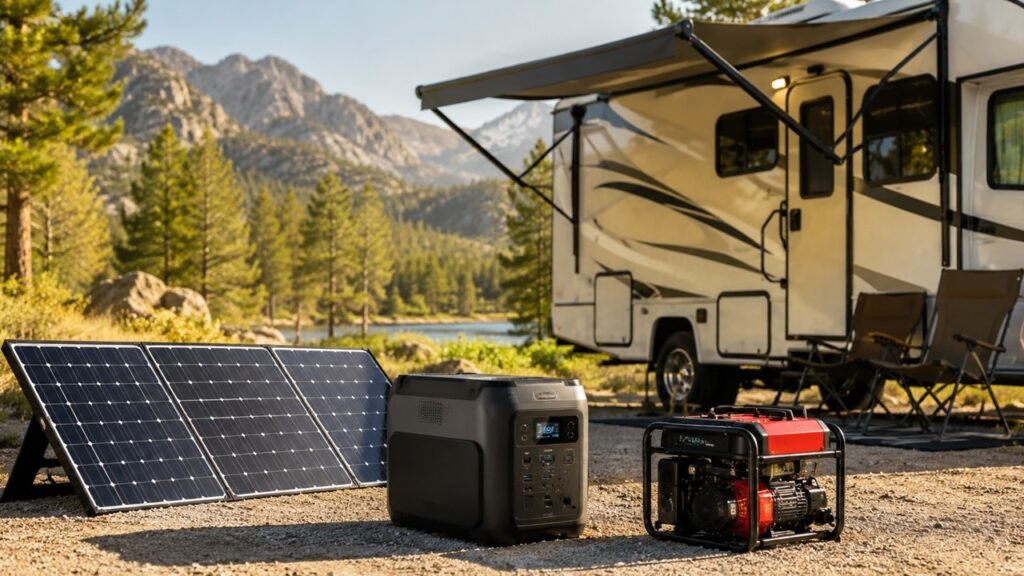
For this reason, many RVers use solar power for everyday appliances and reserve generators or shore power for extended air conditioner use, especially during hot summer conditions.
How Many Solar Panels Do You Need for an RV?
The number of solar panels needed depends on your target solar capacity and the wattage of the panels you choose. Higher-wattage panels require less roof space and fewer individual panels to achieve the same output.
| Desired Solar Capacity | Example Panel Configuration |
| 200W | Two 100W panels |
| 300W | Three 100W panels |
| 400W | Four 100W panels or Two 200W panels |
| 600W | Three 200W panels |
| 800W | Four 200W panels |
| 1,000W | Five 200W panels |
| 1,200W | Six 200W panels or Three 400W panels |
| 1,600W | Four 400W panels |
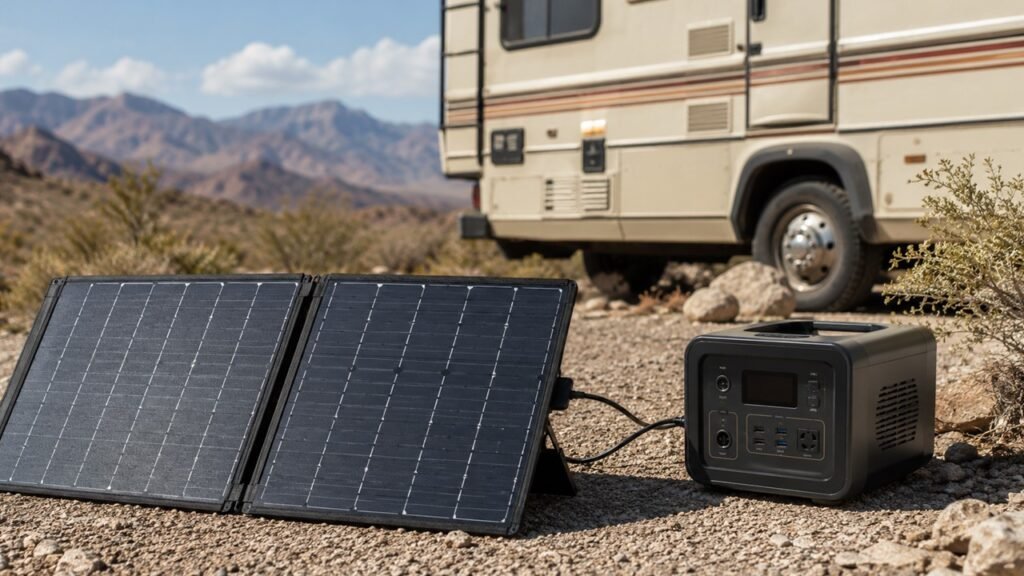
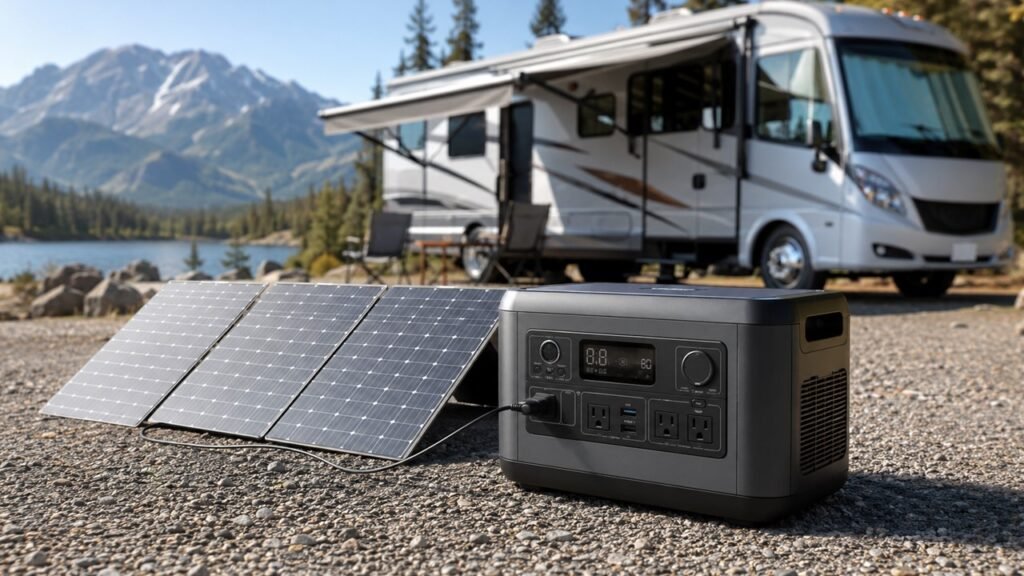
Roof space, air conditioners, skylights, vents, antennas, and other rooftop accessories can affect how many panels can realistically fit on an RV. Many RV owners supplement rooftop panels with portable solar panels to increase charging capacity when parked.
Rooftop vs Portable Solar Panels for RVs
Both rooftop and portable solar panels can power an RV effectively, but they serve different purposes. Rooftop solar panels offer convenience and automatic charging, while portable solar panels provide flexibility and can be positioned for maximum sunlight. The best option depends on your camping style, available roof space, and how often you camp in shaded areas.
To help you decide which setup better fits your RV lifestyle, here’s a side-by-side comparison of rooftop and portable solar panels.
| Feature | Rooftop Solar Panels | Portable Solar Panels |
| Installation | Permanent installation required | No permanent installation required |
| Daily Convenience | Charges automatically | Requires setup and storage |
| Charging While Driving | Yes | No |
| Performance in Shade | Limited by RV parking position | Can be moved into direct sunlight |
| Security | More secure | Greater theft risk if left unattended |
| Roof Space Required | Yes | No |
| Flexibility | Fixed location | Can be repositioned throughout the day |
| Initial Setup Cost | Usually higher | Usually lower |
| Expansion Options | Limited by roof space | Easy to add more panels |
| Best For | Full-time RVers and frequent travelers | Weekend campers and shaded campsites |
Many experienced RVers use a combination of rooftop and portable solar panels. Rooftop panels handle everyday charging, while portable panels provide additional power when parked under trees or during periods of high energy consumption. This hybrid approach offers the best balance of convenience, flexibility, and solar production.
Final Verdict
The answer to how much solar power an RV really needs depends on how much electricity you use each day. Most weekend campers can get by with 200W to 300W of solar, while the average RV traveler is usually better served by a 400W to 600W system paired with adequate battery storage.
If you spend extended periods off-grid, work remotely, use Starlink, or run multiple appliances daily, an 800W to 1,200W solar setup can provide greater energy independence and reduce reliance on generators or shore power.
The best approach is to calculate your daily watt-hour consumption first, size your battery bank second, and then choose enough solar panels to recharge those batteries during a typical day of sunlight. A properly sized system delivers reliable power without overspending on unnecessary equipment.
Related FAQs
Is 200W of solar enough for an RV?
Yes, 200W of solar can support light RV use, including LED lights, phone charging, a water pump, and small electronics. It is best suited for weekend camping rather than extended off-grid living.
Is 400W of solar enough for an RV?
For many RV owners, 400W is enough to run a 12V refrigerator, vent fans, lights, laptops, and charging devices. Heavy power users may need 600W or more.
How much solar do I need to run an RV refrigerator?
Most 12V RV refrigerators consume between 300Wh and 700Wh per day. A 200W to 400W solar setup is often sufficient when paired with a properly sized battery bank.
Can solar panels run an RV air conditioner?
Solar panels can help run an RV air conditioner, but only when supported by a large battery bank and inverter. Most RV air conditioners require significantly more power than standard RV appliances.
How many batteries do I need for RV solar?
Battery size depends on your daily energy consumption. A common recommendation is to have enough battery capacity to store at least two days of typical power usage.
Is rooftop solar or portable solar better for an RV?
Rooftop solar offers convenience and automatic charging, while portable solar provides flexibility in shaded campsites. Many RVers combine both for the best overall performance.

Daniel Brooks writes about RV living, gear, and travel planning with a focus on everyday usability. His guides break down complex topics into simple advice for real RV owners. He reviews products with long-term use in mind, not marketing hype.